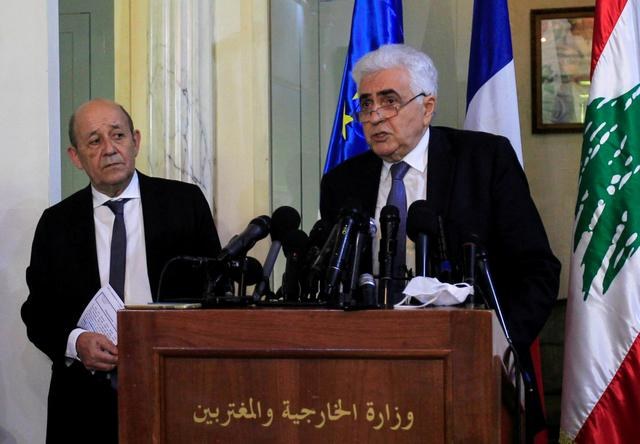
BEIRUT: The first major split opened up in Lebanese Prime Minister Hassan Diab’s barely six-month-old government on Monday when his foreign minister resigned.
Nassif Hitti said there was “an absence of a real will to achieve the comprehensive and structural reform demanded by the national and international community,” and Lebanon was “sliding toward becoming a failed state.”
Hitti was swiftly replaced by Charbel Wehbe, diplomatic adviser to President Michel Aoun and a career diplomat. Wehbe, 67, is a former secretary general of the ministry, and is close to Aoun and his influential son-in-law Gebran Bassil, a former foreign minister
Lebanon is enduring an economic crash, with the value of its currency plunging. The government has appealed to the International Monetary Fund for billions of dollars in aid, but there has been little progress on the reforms demanded in return for a bailout.
Diab’s administration has also been attacked by its opponents for weak decision-making and depending on dominant forces in the cabinet, most notably Hezbollah and the Free Patriotic Movement. As he resigned, Hitti launched a veiled attack on them.
“I participated in this government on the basis that I have one employer called Lebanon, and I found many employers and conflicting interests in my country, who did not agree about the interest of the Lebanese people and its rescue,” he said.
Hitti was said to be upset by the government’s poor performance, and because it had not carried out any of the pledges it made to the Lebanese people or the international community to root out corruption.
He was also uncomfortable at the growing diplomatic role given to security chief Maj. Gen. Abbas Ibrahim in communicating with some countries at the expense of the foreign ministry. He viewed this encroachment as depleting his “professional and diplomatic credit,” he said.
Government opponents praised Hitti’s courage. “The political forces holding on to the actual power will make Lebanon a failed state,” said Samir Geagea, head of the Lebanese Forces Party. “Hitti’s testimony came after a performance that lasted more than six months, and Lebanon’s situation will not settle as long as Hezbollah, the FPM and their allies have authority in Lebanon.”
Marwan Hamade, a member of the Lebanese parliament, said Hitti had “risen up” against the government to join the people and the revolution again. Another MP, Henri Helo, said: “We hope that more follow suit, which paves the way for a new government that meets the Lebanese people’s ambitions.”


![]()

First split opens up in new Lebanon government
Short Url
https://arab.news/4d5nm
First split opens up in new Lebanon government
- Foreign minister quits over lack of reform, warns of ‘failed state’


Latest updates




Recommended


© 2026 SAUDI RESEARCH & PUBLISHING COMPANY, All Rights Reserved And subject to Terms of Use Agreement.