WEEKLY ENERGY RECAP: US crude glut caps prices

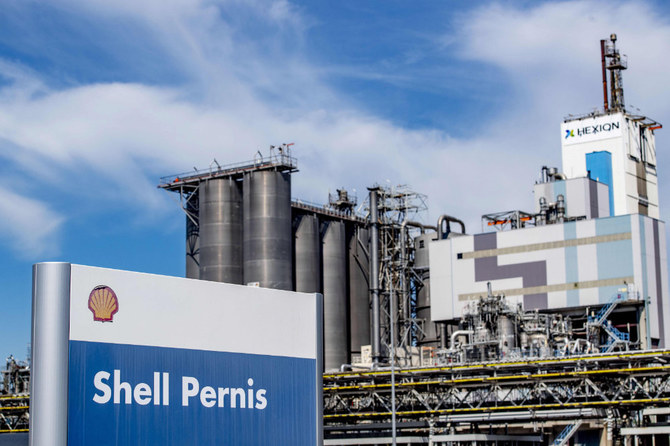
A picture taken on July 30, 2020 shows the exterior of the Shell Pernis site in Rotterdam. (AFP)
Short Url
Updated 01 August 2020
Follow

WEEKLY ENERGY RECAP: US crude glut caps prices

Brent crude nudged up to $43.40 per barrel after another steady week. Interestingly, Brent crude rose as futures weakened. That indicates abundant quantities of physical oil or an increased difficulty in placing barrels.

The US WTI oil benchmark took a different direction to Brent, falling to $40.27 per barrel. That may have been triggered by the historically large drop in US second-quarter gross domestic product.

WTI retreated despite US commercial crude stocks falling by 10.61 million barrels, which is the largest draw since the 11.5 million-barrel fall reported for the end of December 2019. 

This brings US inventories to a 14-week low amid rising crude oil exports that climbed to 3.21 million barrels per day (bpd). The drop in spare oil was also linked to rising consumption by refineries, which at 14.6 million bpd is the strongest since March.

Still, according to Energy Information Administration data, US crude inventories remain nearly 18 percent above the five-year average for this time of year.

The fact that US crude storage draws came amid persistently lower crude imports and higher crude exports, should have normally moved the price of US crude higher. 

Instead, it moved lower, despite the weakening of the US dollar. This may be telling the market that oil prices cannot move much higher until the huge storage glut is absorbed.

As oil prices remain steady for the third month in a row, the forward futures curve has weakened, creating a situation where increased production is favored even as refining demand recovered. This is clearly reflected in the WTI futures price curve. Rising coronavirus infections in some US states continue to weigh on market sentiment.

Rising oil demand in Asia could also be capped by a second wave of the virus. Notwithstanding such concerns, gasoline demand has improved to pre-pandemic levels in many countries.

The competition between these two forces of recovery and remission in the global spread of the virus will determine where the oil price settles in the months ahead.

••••••••••••••

• Faisal Faeq is an energy and oil marketing adviser. He was formerly with OPEC and Saudi Aramco. Twitter:@faisalfaeq


Saudi Arabia launches skills framework to support mining, industrial growth 

Updated 6 sec ago
Follow

Saudi Arabia launches skills framework to support mining, industrial growth 

JEDDAH: Saudi Arabia has launched a new skills framework for the mining and industrial sectors to standardize job roles and support workforce development. 

The initiative was unveiled by Minister of Industry and Mineral Resources Bandar Alkhorayef on the sidelines of the Global Labor Market Conference 2026, according to Al-Eqtisadiah. 

The framework is intended to help employers, job seekers and training providers better navigate labor demand in mining and industry, as Saudi Arabia accelerates investment in manufacturing, minerals processing and related value chains under Vision 2030. 

“This is, in fact, a tool which ensures clear definitions of occupations and their required skills. It will cover more than 500 job roles, detailing the necessary skills, responsibilities, and titles,” Alkhorayef said during a discussion panel at the event. 

The Ministry of Industry and Mineral Resources said the initiative — known as the Industry & Mining Occupations & Skills Framework — will serve as a national reference for occupations and skills in mining and industry. 

The framework is designed to achieve a set of strategic objectives that support human capital development in the industrial and mining sectors. It aims to strengthen workforce planning, training programs, and career pathways, while supporting informed decision-making. 

Covering more than 500 industrial occupations, over 300 professional specialties, 600 skills, and 900 professional certifications, the framework sets standardized job titles, descriptions, and skill requirements to support recruitment, performance, and competitiveness. 

For each occupation, a profile is developed, outlining the code, job titles, and descriptions, as well as other information such as key tasks, educational qualifications, and required skills.

These profiles give employees clarity on roles, career pathways, and accredited credentials, while helping job seekers match their qualifications with suitable roles and focus on targeted skill development. 

The framework, published by the ministry, runs to nearly 3,200 pages and was developed through collaboration with the General Authority for Statistics, alongside government bodies, private sector organizations and academic institutions. 

The launch comes as Saudi Arabia’s mining push gains momentum after new surveys of the Arabian Shield showed the Kingdom’s mineral resources are larger than previously estimated. 

Official estimates have jumped by about 90 percent to roughly SR9.37 trillion ($2.5 trillion), up from around SR5 trillion in 2016, strengthening the case for further mining investment and skills development.