South Korea sect leader arrested over coronavirus outbreak

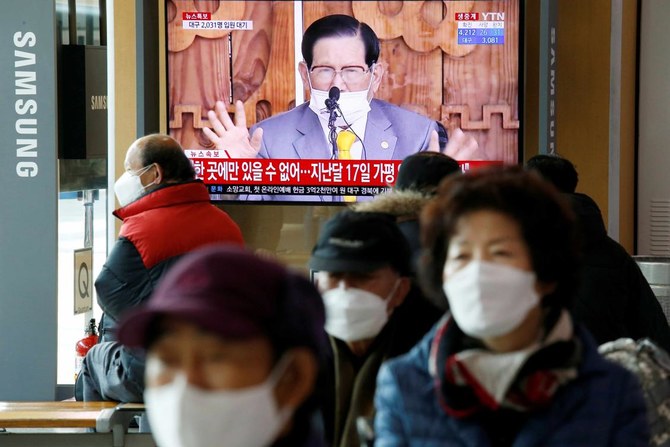
People watch a TV broadcasting a news report on a news conference held by Lee Man-hee, founder of the Shincheonji Church of Jesus the Temple of the Tabernacle of the Testimony, in Seoul, on March 2, 2020. (REUTERS/Heo Ran/File Photo)
Short Url
Updated 01 August 2020
Follow

South Korea sect leader arrested over coronavirus outbreak

  • Members of Lee Man-hee's Shincheonji Church of Jesus account for 36% of South Korea's COVID-19 cases

SEOUL: South Korean authorities arrested the founder of a secretive Christian sect at the center of the country’s largest outbreak of COVID-19 infections on Saturday for allegedly hiding crucial information from contact-tracers and other offenses.
Lee Man-hee is the powerful head of the Shincheonji Church of Jesus which is linked to more than 5,200 coronavirus infections, or 36% of South Korea’s total cases.
Prosecutors allege the 89-year-old conspired with other sect leaders to withhold information from authorities during the peak of the outbreak among his more than 200,000 followers.
Lee, who has described the novel coronavirus as the “devil’s deed” to stop the sect’s growth, allegedly hid details on members and their meeting places as authorities tried to trace infection routes in February, Yonhap news agency reported.
Lee is also suspected of embezzling about 5.6 billion won ($4.7 million) in church funds, including about 5 billion won which he allegedly used to build a retreat, Yonhap said.
The sect said in a statement that Lee was concerned about government demands for members’ personal information but never tried to hide anything.
Lee was arrested immediately after a court in Suwon District, south of Seoul, approved the warrant.
A prosecution official could not be reached outside of office hours.


Venezuela aims to boost oil output but sanctions stand in the way, VP says

Updated 4 sec ago
Follow

Venezuela aims to boost oil output but sanctions stand in the way, VP says

  • Sanchez called the recent capture of Nicolas Maduro a “dark day” for the country

DUBAI: Venezuela’s Vice President for Economy Calixto Ortega Sanchez said on Wednesday that his country needed vast foreign investment and sanctions relief to tap its huge oil reserves and restart its ailing economy.

“We know that the reference for Venezuela is that (it is) the country with the biggest oil reserves, and we want to stop being known for this, and we want to be known as one of the countries with the highest production levels,” Sanchez said.

Responding to questions by American journalist Tucker Carlson, Sanchez called the recent capture of Nicolas Maduro a “dark day” for the country but said Venezuela was working to reestablish a relationship with the US, which he described as a “natural partner” for the country.

“The Venezuelan people and authorities have shown that they are ready to peacefully move forward and to build opportunities,” he said during a session at the World Government Summit.

Sanchez, who headed Venezuela’s central bank, said the most pertinent issue facing his country is continued US sanctions.

Despite failing to result in regime change, the sanctions had effectively stifled the economy from growing, he added.

He said the Venezuelan government was now working to reform its laws to allow foreign investment and hoped the US would ease sanctions to aid their work.

“The first decisions that interim President Rodriguez took was to go to the National Assembly and ask for reform to the hydrocarbon law … this law will allow international investors to go to Venezuela with favorable conditions, with legal assurance of their investments,” he added.

“The economy is ready for investment. The economy is ready for the private sector; it is ready to build up a better future for the Venezuelan people.”

Sanchez played down inferences by Carlson that his government had been taken over, insisting that the regime still held authority in the country. He said the country had set up two funds to receive money from oil production that would fund better welfare and social conditions for Venezuelans.

“Allow us to have access to our own assets … we don’t have access to our own money,” he added.

“If you allow us to function like a regular country, Venezuela will show extraordinary improvement and growth.”