

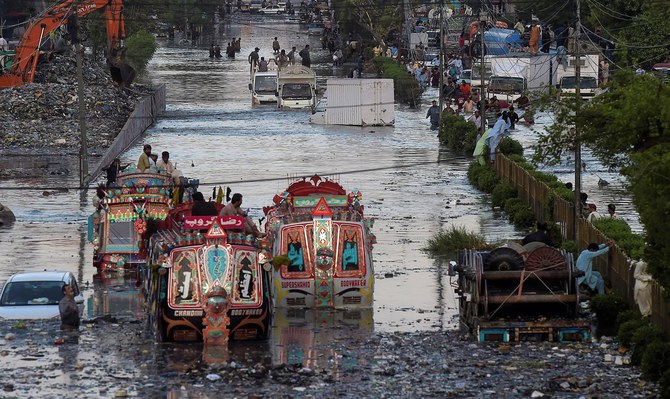

KARACHI: Federal Minister for Information and Broadcasting Shibli Faraz criticized the provincial administration of Sindh on Tuesday, saying that the heavy monsoon rain that flooded Pakistan's commercial capital, Karachi, was enough to expose the performance of the Pakistan Peoples Party (PPP) that was responsible for managing the country's southeastern province.
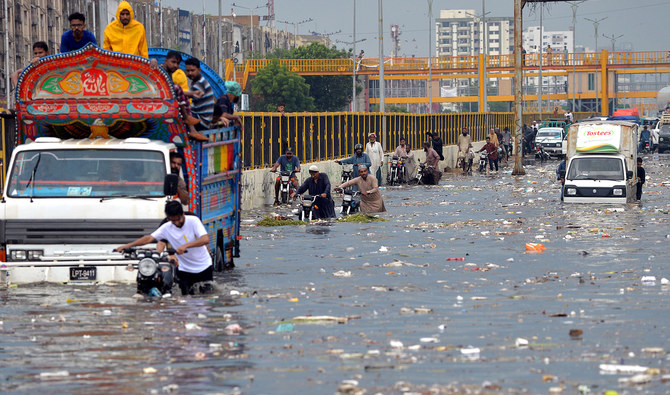
People wade through a flooded street after heavy monsoon rains in Karachi on July 26, 2020. (AFP)
Addressing a news conference in Islamabad, the minister wondered where all the money allocated for the development of the country's largest city had disappeared.
He also promised the residents of Karachi that the federal government would not leave them at the mercy of the provincial authorities.
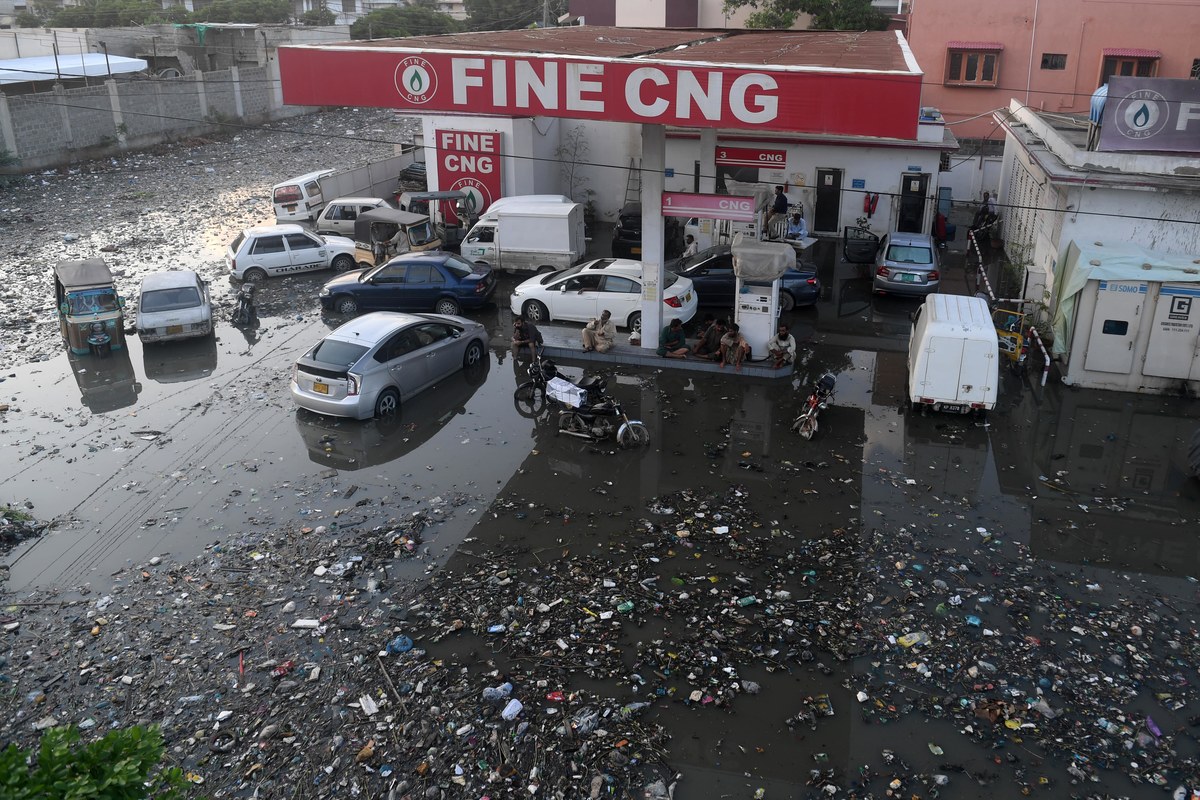
Commuters wait at a CNG station to cross a flooded street after heavy monsoon rains in the Pakistan's port city of Karachi on July 27, 2020. (AFP)
Faraz slammed the Sindh administration shortly after PPP Chairperson Bilawal Bhutto-Zardari held important political meetings in Lahore with leaders of two other opposition factions, Jamiat-e-Ulama-e-Islam (JUI-F) and Pakistan Muslim League-Nawaz (PML-N), to build a movement against the ruling Pakistan Tehreek-e-Insaf (PTI) party, saying that all opposition leaders were on the same page and would to challenge the PTI administration since it had become a threat for the country.
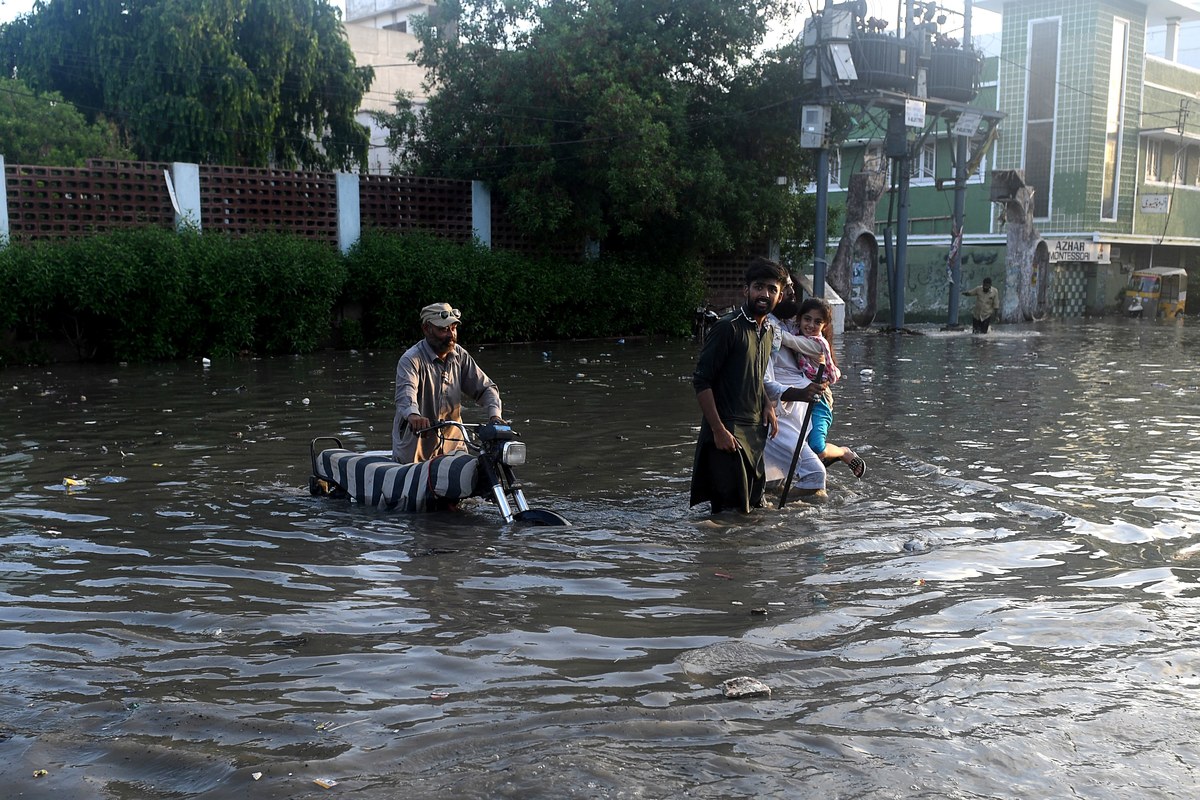
People cross a flooded street after heavy monsoon rains in the Pakistan's port city of Karachi on July 27, 2020. (AFP)
His party was quickly criticized for not managing things well in its own province where Karachi has been submerged by one of the worst spells of rain that started on Sunday.
Many of the angry residents of the city have turned to social media, posting videos of their neighborhoods where rainwater can be seen getting contaminated by sewage and trash.
Earlier in the day, Federal Minister for Maritime Affairs Ali Haider Zaidi, who ran a cleanliness drive in Karachi last year, blamed the PPP for mismanaging the situation in Karachi and said in a Twitter post that he was going to discuss it with Prime Minister Imran Khan.
I promise to take it up with the PM who has always shown great concern about KHI. PM has followed the constitution in letter & spirit & allowed provinces to work independently.
But what happens when a Provincial Govt works against the interest of its citizens?#PPPGovtDestroyedKhi— Ali Haider Zaidi (@AliHZaidiPTI) July 27, 2020
Karachi's Mayor Wasim Akhtar said he was powerless in a city where there were too many decision makers.
“The Karachi Municipal Corporation (KMC) is responsible for cleaning 38 drains of storm water. But since we don’t have funds, we cannot do it,” Akhtar told Arab News.
He recalled being summoned by a water commission three years ago where he said he had a shortfall of Rs 60 million and was unable to clean the city's drains. “After listening to us, Justice Amir Hani Muslim ordered the Sindh government to release funds. They only gave us Rs 500 million that we used to clean the drains in June 2018," he said.
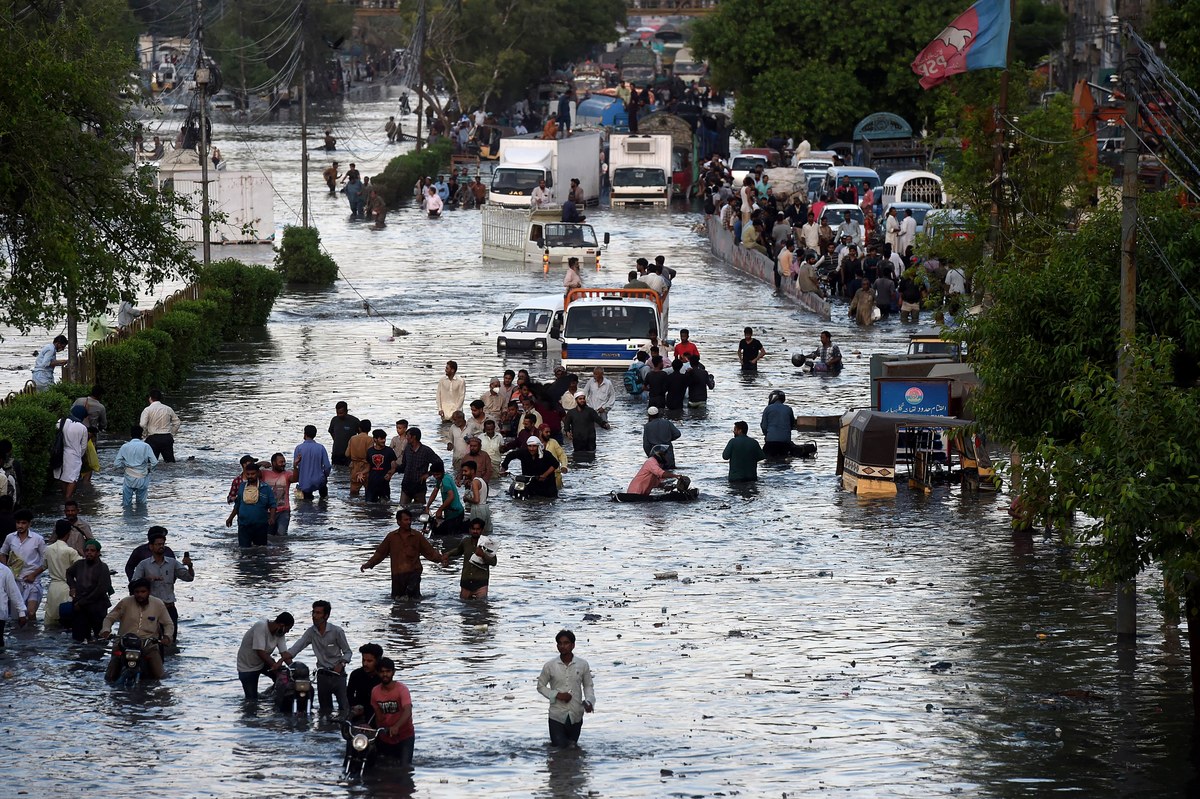
Commuters cross a flooded street after heavy monsoon rains in the Pakistan's port city of Karachi on July 27, 2020. (AFP)
After this year's monsoon warning, Akhtar said, he held a news conference, asking the chief minister to approved $11 million for cleaning drains from the World Bank fund.
“The work could not be completed and we saw the result,” he continued.
Asked about what the provincial authorities were doing to address the situation, Sindh Minister Saeed Ghani said that drains were cleaned and the choking spots were cleared, but since a 200 feet wide drain had flattened about 30 feet and the retaining walls were removed by people, it overflowed during the recent spell of rains and the water had entered people’s houses.
“The houses which have come under water were built on the sides or over the drain,” he told Arab New.
“We haven’t created this problem and when we try to remove encroachments, our rivals begin to play politics on the issue,” he said.


