

Pandemic hit to Hajj saddens Pakistan’s senior would-be pilgrims

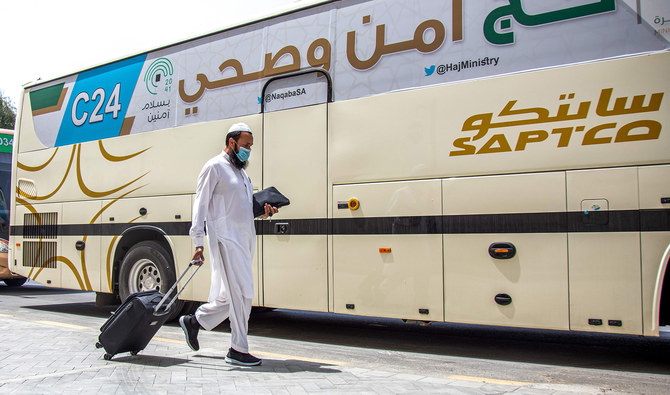
A handout picture provided by the Saudi Ministry of Hajj and Umrah on July 25, 2020, shows a traveler among the first group of arrivals for the annual Hajj pilgrimage, mask-clad due to the COVID-19 coronavirus pandemic, walking with his luggage to take a bus from the Red Sea coastal city of Jeddah's King Abdulaziz International Airport. (Ministry of Hajj And Umrah via AFP)
Short Url
Updated 28 July 2020
Follow

Pandemic hit to Hajj saddens Pakistan’s senior would-be pilgrims

  • Saudi Arabia announced it would bar arrivals from abroad to attend the Hajj this year due to the coronavirus
  • Some 2.5 million Muslims typically visit the holiest sites of Islam in Makkah and Madinah for the week-long pilgrimage

ISLAMABAD/LAHORE: Raja Muhammad Sultan was all set to fulfill his lifelong dream of going to Makkah for Hajj when Saudi Arabia announced it would bar arrivals from abroad this year due to the coronavirus, allowing only a limited number of Saudi citizens and residents to make the pilgrimage with social distancing measures enforced.
Some 2.5 million Muslims each year visit the holiest sites of Islam in Makkah and Madinah for the week-long pilgrimage, due to start on July 28. A once-in-a-lifetime duty for able-bodied Muslims who can afford the cost, it is usually extremely crowded.
Like many Muslims around the world, 79-year-old Sultan, a farmer, laments the restriction to domestic pilgrims this year to curb the spread of COVID-19.
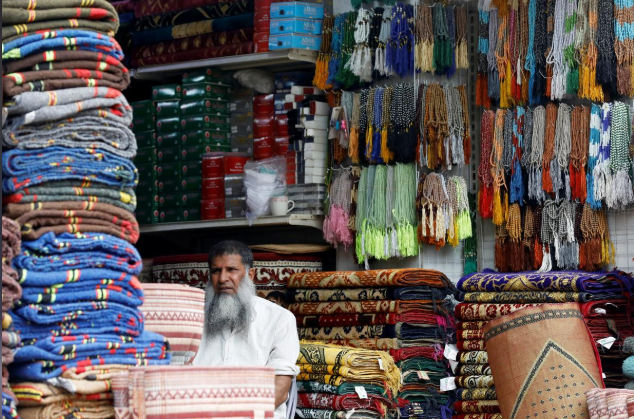


A shopkeeper sits amid items which are sold during the annual Haj pilgirmage season, as he waits for customers along a wholesale market, as the spread of the coronavirus disease (COVID -19) continues, in Karachi, Pakistan July 7, 2020. (REUTERS)


“I bought Ihram clothes, prayer beads and some other essential items to perform the Hajj, but this coronavirus shattered my lifetime dream,” he told Arab News from his home in Chakwal in Punjab province.
The moment is even sadder for Sultan because he and his wife waited 10 years to be selected for the pilgrimage and she passed away before they could make the journey together.
“My wife passed away last year with her unfulfilled wish,” he said. “I may not survive either.”
Sultan lives with his three sons and eight grandchildren. His fourth son works in Riyadh and the pilgrimage was also a chance to reunite after years of separation.
“My son promised to take me around all the holy places in Makkah and Madinah, but who knows the planning of our creator. He is the best planner,” the farmer said.
Sultan says he will now use the funds deposited for the pilgrimage on community welfare: “I am seeking Allah’s forgiveness and hopefully I’ll have a chance in my lifetime to go for Hajj.”
Rizwanullah Khan, too, will miss Hajj this year, a pilgrimage he had planned with his wife, daughter and son-in-law.
“I lost my senses the day I heard this news,” the 85-year-old man from Lahore said. “I don’t know if I will be able to purify myself and survive until next year, I don’t know.”
“All our preparations were complete. We had arranged Ihram, recited duas and took Hajj training,” said Khan’s son-in-law, Muhammad Akbar.
“Perhaps our prayers were not sincere enough to be answered. It is a great spiritual loss in our lives, great sadness,” he said, adding: “The cancelation is very depressing, but I think it was the right decision, it will save millions of lives.”


Death toll in Pakistan shopping plaza fire rises to 67, officials say

Updated 22 January 2026
Follow

Death toll in Pakistan shopping plaza fire rises to 67, officials say

  • Rescue teams still searching for damaged Gul Plaza in Karachi where blaze erupted on Saturday, says police surgeon
  • Karachi has a long history of deadly fires, often linked to poor safety standards, weak regulatory enforcement

KARACHI: The death toll from a devastating fire at a shopping plaza in Pakistan’s southern port city of Karachi jumped to 67 on Thursday after police and a hospital official confirmed that the remains of dozens more people had been found.

Police surgeon Dr. Summaiya Syed said rescue teams were still searching the severely damaged Gul Plaza in the Karachi, where the blaze erupted on Saturday.

Most remains were discovered in fragments, making identification extremely difficult, but the deaths of 67 people have been confirmed, she said. Asad Raza, a senior police official in Karachi, also confirmed the death toll. Authorities previously had confirmed 34 deaths.

Family members of the missing have stayed near the destroyed plaza and hospital, even after providing their DNA for testing. Some have tried to enter the building forcibly, criticizing the rescue efforts as too slow.

“They are not conducting the search properly,” said Khair-un-Nisa, pointing toward the rescuers. She stood outside the building in tears, explaining that a relative who had left to go shopping has been missing since the blaze.

Another woman, Saadia Saeed, said her brother has been trapped inside the building since Saturday night, and she does not know what has happened to him.

“I am ready to go inside the plaza to look for him, but police are not allowing me,” she said.

There was no immediate comment from authorities about accusations they have been too slow.

Many relatives of the missing claim more lives could have been saved if the government had acted more swiftly. Authorities have deployed police around the plaza to prevent relatives from entering the unstable structure, while rescuers continue their careful search.

Investigators say the blaze erupted at a time when most shop owners were either closing for the day or had already left. Since then, the Sindh provincial government has said around 70 people were missing after the flames spread rapidly, fueled by goods such as cosmetics, clothing, and plastic items.

The cause of the fire remains under investigation, though police have indicated that a short circuit may have triggered the blaze.

Karachi has a long history of deadly fires, often linked to poor safety standards, weak regulatory enforcement, and illegal construction.

In November 2023, a shopping mall fire killed 10 people and injured 22. One of Pakistan’s deadliest industrial disasters occurred in 2012, when a garment factory fire killed at least 260 people.