Duterte eyes reinstating death penalty by lethal injection for drug crimes

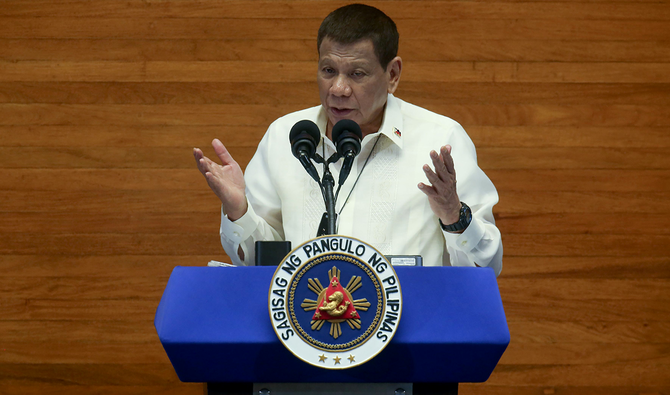
Philippines President Rodrigo Duterte delivering his annual State of the Nation Address in congress in Manila on Monday. (AFP)
Short Url
Updated 28 July 2020
Follow

Duterte eyes reinstating death penalty by lethal injection for drug crimes

  • Philippines’ leader says move will ‘deter criminality’ and save country’s youth

MANILA: Philippines President Rodrigo Duterte on Monday pushed for the revival of the death penalty through lethal injection for drug crimes.

The comments were part of his fifth annual  State of the Nation Address. Duterte urged Congress to pass the bill “to deter criminality in the country.”

“I reiterate the swift passage of a law reviving the death penalty by lethal injection for crimes specified under the Comprehensive Dangerous (Drugs) Act of 2002,” the 75-year-old former mayor of Davao City said, adding that the law would also “save the nation’s youth from the dangers posed by illegal and dangerous drugs.”

However, even as he pushed for the punishment to be brought back, Duterte said that his administration would not dodge its responsibility in fighting for human rights.

“My administration always believed that freedom from illegal drugs, terrorism, corruption, and criminality is itself a human right,” he said.

Since the start of his administration in 2016, Duterte has waged a bloody campaign against drugs that has been widely criticized by local groups and the international community.

In June this year the Philippines once again came under scrutiny when the UN Human Rights Council convened in Geneva.

During the session, UN High Commissioner for Human Rights Michele Bachelet gave the stark findings of her office’s report, which described widespread abuses as a result of Duterte’s war on drugs.

Also at the session, the Philippines Commission on Human Rights denounced the government’s “strong-arm” approach to enforce its brutal “drug war” which has reportedly killed thousands of people.

It led to groups such as Human Rights Watch and Amnesty International highlighting their own findings of serious rights violations in the country.

Philippine authorities say that around 5,600 people have died in Duterte’s drug war, but the country’s human rights commission claims the number could exceed 27,000.

In his address Duterte also gave telecom companies in the country, particularly SMART and GLOBE Telecom, until December to improve their services or “have their properties expropriated.”

“Find a way because if you are not ready to improve, I might just as well close all of you and we revert back to the line telephone and I will expropriate your (properties),” he warned. 

“Kindly improve the services before December. I want to call Jesus Christ in Bethlehem. Better have that line cleared, ” he said.


Top US defense official hails ‘model ally’ in South Korea talks

Updated 5 sec ago
Follow

Top US defense official hails ‘model ally’ in South Korea talks

SِEOUL: The Pentagon’s number three official hailed South Korea as a “model ally” as he met with local counterparts in Seoul on Monday, days after Washington’s new defense strategy called for reduced support for partners overseas.
Under Secretary of Defense for Policy Elbridge Colby arrived in South Korea on Monday and is seen as a key proponent of President Donald Trump’s “America First” foreign policy.
That policy — detailed in Washington’s 2026 National Defense Strategy (NDS) released last week — calls for the United States to prioritize deterring China and for long-standing US allies to take “primary responsibility” for their own defense.
Arriving in Seoul on his first overseas trip as the Pentagon’s number three official, Colby in a post on X called South Korea a “model ally.”
And he praised President Lee Jae Myung’s pledge to spend 3.5 percent of the country’s GDP on the military.
That decision, he told a forum, “reflects a clear-eyed and sage understanding of how to address the security environment that we all face and how to put our storied and historic alliance on sound footing for the long haul,” according to South Korea’s Yonhap News Agency.
“Such adaptation, such clear-eyed realism about the situation that we face and the need for greater balance in the sharing of burdens, will ensure that deterrence remains credible, sustainable and resilient in this changing world,” he added, according to the agency.
Colby also met Monday with South Korea’s defense and foreign ministers, who touted Seoul’s development of nuclear-powered attack submarines as proof the country was taking more responsibility for its defense.
Details remain murky on where the nuclear submarines will be built, however.
South Korea’s leader said last month it would be “extremely difficult” for them to be built outside the country.
But Trump has insisted they will be built in the United States.
Longstanding treaty allies, ties between the United States and South Korea were forged in the bloodshed of the Korean War.
Washington still stations 28,500 troops in South Korea as a deterrent against the nuclear-armed North.