Putin, Erdogan urge Armenia-Azerbaijan peace talks

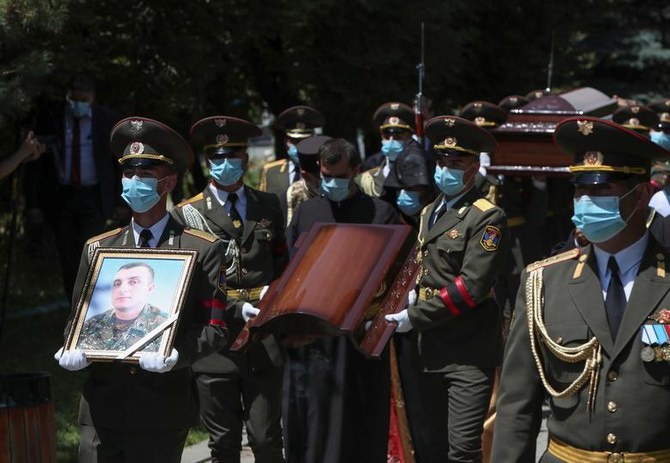
Mourners attend the funeral of Major Garush Hambardzumyan, who was killed in recent border clashes between the armed forces of Armenia and Azerbaijan, in Yerevan, Armenia, July 16. (Reuters)
Short Url
Updated 27 July 2020
Follow

Putin, Erdogan urge Armenia-Azerbaijan peace talks

  • Putin and Erdogan said the dispute must be settled “on the basis of international law in the interests of the peoples of Armenia and Azerbaijan”
  • The uptick in violence has been unusual as it broke out hundreds of kilometers from Karabakh, Azerbaijan’s southwestern region seized by Armenian separatists in a 1990s war

YEREVAN, Armenia: Russian President Vladimir Putin and Turkey’s Recep Tayyip Erdogan in a phone call Monday called for peace talks to end clashes between Armenia and Azerbaijan, the Kremlin said.
The phone call at Turkey’s initiative took place after Armenia’s military said one of its soldiers was killed by sniper fire from across the border with Azerbaijan in the latest bout of deadly violence.
Border clashes erupted in mid-July between the ex-Soviet republics, which have for decades been locked in a conflict over Azerbaijan’s breakaway region of Nagorny Karabakh.
Nineteen people — including the Armenian soldier — have been killed on both sides in the recent border clashes so far.
Putin and Erdogan discussed the conflict and the Russian strongman “underlined the importance of not allowing any actions that promote an escalation in tensions,” the Kremlin said in a statement.

Opinion

This section contains relevant reference points, placed in (Opinion field)

Regional powerbroker Moscow as well as Western powers have called for an immediate de-escalation amid fears that Russia and Turkey, which supports Azerbaijan, could be drawn into a confrontation.
Both Putin and Erdogan said they backed “resolving the conflict situation exclusively in a peaceful way, through talks.”
Russia has offered to mediate peace talks between the South Caucasus countries.
Putin and Erdogan said the dispute must be settled “on the basis of international law in the interests of the peoples of Armenia and Azerbaijan,” the Kremlin said.
Armenia’s defense ministry on Monday said that one of its troops was “killed by sniper fire from the direction of the enemy” overnight — after a week of relative calm on the border.
Azerbaijan for its part accused Armenia of using “large calibre machine guns and sniper rifles” and violating a cease-fire multiple times along the border over the past 24 hours.
The uptick in violence has been unusual as it broke out hundreds of kilometers (miles) from Karabakh, Azerbaijan’s southwestern region seized by ethnic Armenian separatists in a 1990s war that claimed 30,000 lives.
The recent violence has included artillery shelling and mortar fire, with both sides blaming one another and Azerbaijan threatening to strike Armenia’s nuclear power station if its strategic facilities were attacked.



WHO says one person dead from Nipah virus in Bangladesh

Updated 5 sec ago
Follow

WHO says one person dead from Nipah virus in Bangladesh

  • Nipah is an infection that spreads mainly through products contaminated by infected bats, such as fruit

DHAKA: The World Health Organization said on Friday that a woman ​had died in northern Bangladesh in January after contracting the deadly Nipah virus infection.
The case in Bangladesh, where Nipah cases are reported almost every year, follows two Nipah virus cases identified in neighboring India, which has already prompted stepped-up airport screenings across Asia.
The patient in Bangladesh, ‌aged between 40-50 ‌years, developed symptoms consistent with ‌Nipah ⁠virus ​on ‌January 21, including fever and headache followed by hypersalivation, disorientation and convulsion, the WHO added.
She died a week later and was confirmed to be infected with the virus a day later.
The person had no travel history but had a history of consuming ⁠raw date palm sap. All 35 people who had contact ‌with the patient are being monitored ‍and have tested ‍negative for the virus, and no further cases ‍have been detected to date, the WHO said.
Nipah is an infection that spreads mainly through products contaminated by infected bats, such as fruit. It can be fatal ​in up to 75 percent of cases, but it does not spread easily between people.
Countries including ⁠Malaysia, Thailand, Indonesia, and Pakistan implemented temperature screenings at airports after India said cases of the virus had been found in West Bengal.
The WHO said on Friday that the risk of international disease spread is considered low and that it does not recommend any travel or trade restrictions based on current information.
In 2025, four laboratory-confirmed fatal cases were reported in Bangladesh.
There are currently no licensed ‌medicines or vaccines specific for the infection.