Saudi Arabia backs Egyptian position in Libya, foreign minister says after talks with El-Sisi

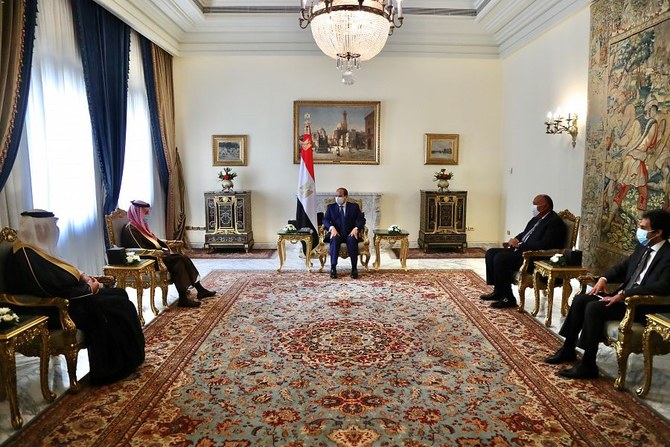
Saudi Arabia's foreign minister Prince Faisal bin Farhan was received in Cairo by Egyptian president Abdel Fattah El-Sisi on Monday for bilateral discussions. (SPA)
Short Url
Updated 28 July 2020
Follow

Saudi Arabia backs Egyptian position in Libya, foreign minister says after talks with El-Sisi

  • Turkish media: Ankara may send F-16 fighter jets, attack helicopters to support Al-Sarraj regime
  • El-Sisi and Prince Faisal discussed relations between the Kingdom and Egypt and ways of enhancing them across all fields

CAIRO/ISTANBUL: Saudi Foreign Minister Prince Faisal bin Farhan on Monday asserted the Kingdom’s support for the Egyptian position in Libya.

Expressing his hope for a ceasefire in Libya, he stressed the need for a political solution and spoke against external interference in the conflict.

“We will continue the coordination between those who have not tried to address this challenge. We will be in constant contact and we will be one hand to achieve the security and peace of the region,” Prince Faisal said.

His remarks came as pro-government Turkish media reported that Ankara is expected to send F-16 fighter jets and attack helicopters to Libya to support Fayez Al-Sarraj’s regime.

According to analysts, the move is thought to be in retaliation against the Egyptian Parliament’s July 20 decision to permit the deployment of troops outside the country, and Cairo’s threats to attack Turkish-backed forces in Libya.

The Saudi minister's remarks at a joint press conference with Egyptian Foreign Minister Sameh Shoukry followed a meeting earlier with Egyptian President Abdel Fattah El-Sisi.

Prince Faisal conveyed the greetings of King Salman and Crown Prince Mohammed bin Salman to the president, and held a session with Shoukry to discuss the relations between the two countries and the developments in the region, especially in Libya.

Shoukry told the press conference that Egypt would not allow the crossing of red lines in Libya, stressing that the Libyan Presidential Council needed to be reconfigured to operate under the supervision of the elected parliament.

He reiterated Egypt’s call for a ceasefire and said Cairo was seeking to restore peace in Libya and stop the military escalation.

He also stressed the importance of restarting the country’s oil pumps, and voiced his regret at the lack of political will to reach a solution.

In Cairo, journalist and political expert Ali Al-Sayyid said Egyptian-Saudi relations were currently at their best in years, and represented balance and stability in the Arab world.

“The fate of the two countries is one, and this one fate depends on both countries having one vision and idea that seeks to support the Arab world during the problems it is currently facing,” Al-Sayyid said.

-----

READ MORE: Egypt’s El-Sisi wishes Saudi Arabia’s King Salman a speedy recovery

-----

“What threatens national security in Libya threatens Egypt and Saudi Arabia. The national security of both countries is one,” he added.

Turkish journalist Metehan Demir recently said in a televised interview that the country was preparing to send aircraft to strategic locations like Al-Watiya airbase, in case Al-Sarraj’s forces launch an operation in Sirte and Al-Jufra in early August.

Another pro-government analyst, Hasan Basri Yalcin, also claimed that Cairo was set to deploy aircraft to support its land forces in the region, and added that Turkey would inevitably use its F-16s to preserve aerial control.

Sinan Ulgen, a former diplomat and the chairman of Istanbul-based think-tank EDAM, said it would make sense for Turkey to do so.

“The main question is that once Turkey decides to forward deploy its F-16s, how it is going to protect these very expensive machines,” he said.

Seth J. Frantzman, executive director of the Middle East Center for Reporting and Analysis, said Turkey may also seek to deploy combat aircraft to Libya in response to Russia increasing its own number of warplanes in the region.

“Turkey has prodded the US to support it in this endeavor and it appears that US Africa Command statements condemning Russia for deploying aircraft is part of supporting Ankara's position,” he told Arab News.

According to Frantzman, this means Turkey may feel empowered by the US to deploy more forces.

“This is the model that Turkey used to escalate in Syria and Libya. However, Turkey has rarely based its F-16s overseas, so deploying them to Libya would be a major step. It would show that Turkey intends to stay for the long-term in Libya,” he said.

Frantzman thinks that having Turkish and Russian warplanes in proximity in Libya could lead to the possibility of a clash over Sirte, and shows how Turkey and Russia are supplanting the former US role in the Middle East.

“Unless Cairo and others decide to step up, they will be left out in a region that is rapidly being dominated by Ankara, Moscow and Tehran,” he said.


Saudi traditional meal anchors Al-Balad’s culinary scene

Ghalib Naji Al-Shadwy (center) with his son (right) and longtime customer Abu Samer Al-Sulami (left). (AN photo)
Updated 5 sec ago
Follow

Saudi traditional meal anchors Al-Balad’s culinary scene

  • Slow-cooked sheep’s head is drawing new generations and visitors to Jeddah’s historic district

JEDDAH: In the streets of Al-Balad, where centuries-old buildings frame one of Saudi Arabia’s most storied districts, culinary heritage continues to draw visitors as powerfully as architecture. 

Among the area’s enduring attractions is Al-Shadwy for Sheep Head Meat, a family-run restaurant that has served one of the Kingdom’s most traditional dishes since 1958, turning a once-necessity meal into a symbol of Saudi food culture and hospitality.

Tucked into Baba Makkah, Al-Balad’s historic core, Al-Shadwy began as a modest corner table before becoming a landmark destination for locals, food enthusiasts and tourists seeking an authentic taste of the past.

Eating sheep’s head has long been rooted in Arab culinary traditions, shaped by the principle of using the entire animal and avoiding waste. (AN photo)

Now run by the third generation of the Al-Shadwy family, the restaurant remains devoted to a single specialty; sheep’s head, slow-roasted over charcoal using a recipe unchanged for decades.

Eating sheep’s head has long been rooted in Arab culinary traditions, shaped by the principle of using the entire animal and avoiding waste. In Saudi Arabia, the dish evolved into communal meal associated with generosity, warmth and social gathering.

Sixty-five-year-old owner Ghalib Naji Al-Shadwy, who inherited the restaurant from his grandfather and father, remains a familiar presence at the restaurant, overseeing the service and greeting customers. 

FASTFACTS

• Al-Shadwy for Sheep Head Meat is a family-run restaurant in Al-Balad that has served one of the Kingdom’s most traditional dishes since 1958.

• It began as a modest corner table before becoming a landmark destination for locals, food enthusiasts and tourists seeking an authentic taste of the past.

He told Arab News that the dish has been central to Saudi culinary culture for generations.

“The sheep’s head has been a staple in Saudi Arabia and other GCC countries culinary culture for centuries,” he said. “Traditionally, it was a meal served during cold winter mornings to provide energy and warmth. In many regions of Saudi Arabia, the sheep head (is) always on the top of the main plate for guests, and families festive holidays gather in restaurants or at home to enjoy the sheep’s head, making it a social and festive occasion.”

In Saudi Arabia, the dish evolved into communal meal associated with generosity, warmth and social gathering. (AN photo)

Speaking about its significance in hospitality culture, he added: “Serving it to guests is considered an act of generosity and care.” Rich and filling, it is most commonly eaten as breakfast or an early morning meal.

Preparing sheep’s head is a slow, careful process. According to Al-Shadwy, the heads are cooked at low temperatures to soften the tendons and connective tissue, resulting in tender meat and deep flavor.

The preparation includes curing and slow cooking, a method that has remained largely unchanged at the restaurant for more than six decades. 

Being a family-owned restaurant here for so many years makes us a part of Jeddah’s history.

Ghalib Naji Al-Shadwy, Al-Shadwy for Sheep Head Meat owner

“I’ve cooked many sheep heads a while back and I still enjoy it,” he said. “Most of the customers actually prefer the head and the brain.”

Despite its small size and somewhat tucked-away location, the restaurant’s popularity is unmistakable. Long queues form outside each morning, often guiding first-time visitors to its door. A sign reading “Al-Shadwy Mandi” in Arabic marks the entrance, while the steady crowd confirms its reputation.

Over the years, the restaurant has attracted officials, celebrities and social media figures, with photographs of notable guests lining the walls. Al-Shadwy said the steady attention reflections Al-Balad’s growing appeal as a cultural and culinary destination.

He said that interest in sheep’s head is no longer limited to older generations. Younger Saudis, he said, are increasingly curious about traditional dishes, while tourists often see it as an adventurous experience. 

“For many visitors, trying sheep’s head is considered ‘extreme food’ or a challenging dish,” he said. “But it gives them a sense of adventure and a unique story to tell.”

Inside the lively restaurant one morning, longtime customer Abu Samer Al-Sulami, who has been dining there for 40 years, described it as a rare example of authentic Saudi cuisine.

“I am a regular customer here and always come early in the morning because when you eat the sheep’s head it really gives you energy for work,” he said. 

Demand is highest in the early hours, particularly on Fridays. Al-Shadwy said the restaurant often sells out by mid-morning, making early visits essential.

“The number of sheep heads our restaurant sells daily varies but it reaches around 200 heads,” he added.

As he works alongside his two sons, Al-Shadwy says preserving the family legacy is as important as serving the fish. 

“Being a family-owned restaurant here for so many years makes us a part of Jeddah’s history,” he said.