No plans for Saudi-Israel meeting: Foreign minister Prince Faisal bin Farhan

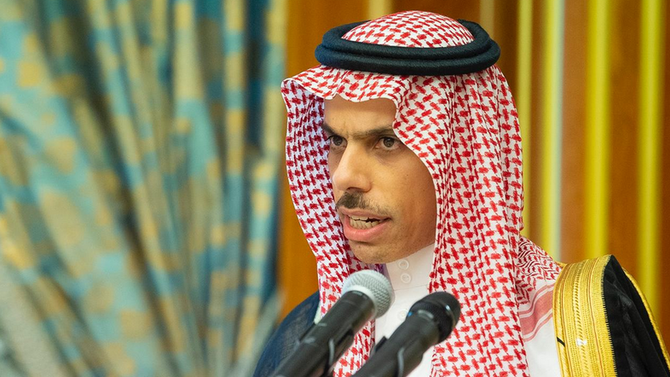
Saudi Arabia's foreign minister Prince Faisal bin Farhan said there were no plans for a meeting between Crown Prince Mohammed bin Salman and Israel's prime minister Benjamin Netanyahu. (SPA/File Photo)
Short Url
Updated 13 February 2020
Follow

No plans for Saudi-Israel meeting: Foreign minister Prince Faisal bin Farhan

  • Prince Faisal bin Farhan reiterated Saudi position on Trump's peace plan
  • FM also said Saudi Arabia's policy toward Palestine remained "firm"

LONDON: There are no plans for Saudi Arabia's Crown Prince Mohammed bin Salman to meet Israel's Prime Minister Benjamin Netanyahu, the Kingdom's foreign minister said Thursday.

Speaking to Al-Arabiya English, Prince Faisal bin Farhan also said Saudi Arabia's policy toward Palestine remained "firm."

Talking about media speculation in Israel that Netanyahu sought a meeting with the Saudi crown prince following President Donald Trump's Middle East peace plan announcement, Prince Faisal said: “There is no meeting planned between Saudi Arabia and Israel. Saudi Arabia’s policy has been very clear since the beginning of this conflict. There are no relations between Saudi Arabia and Israel and the Kingdom stands firmly behind Palestine."

He also talked about Sudan, after Netanyahu spoke to the head of the Sudan Transitional Sovereign Council in Uganda on Feb. 3, saying: “Sudan is a sovereign nation. They can assess their own sovereign interests.”

The foreign minister reiterated the Saudi position on the peace plan, which called for talks between the two side to ensure that the "legitimate rights of the Palestinian people" were observed.

Prince Faisal told Al-Arabiya English: “As we have said in the past, Saudi Arabia along with the other members of the Arab league has always shown a willingness to normalize relations with Israel if there is a just and fair settlement that is agreed by both Palestine and Israel. Short of that, Saudi policy will remain steadfast.

“The policy of Saudi Arabia towards Palestine is firm. Saudi Arabia welcomes any attempt to resolve the Middle East crisis. This has nothing to do with Saudi Arabia’s commitment towards the issue.”

The foreign minister was asked if the Kingdom had shared interests with Israel on policy toward Iran, to which he responded: “It is not difficult to find countries that have issues with Iran in the Arab world, the European Union, or the United States. Any overlap in interests would not be unique to Saudi Arabia.”


Saudi Post issues commemorative stamp to mark Al-Faw’s UNESCO recognition

Updated 8 sec ago
Follow

Saudi Post issues commemorative stamp to mark Al-Faw’s UNESCO recognition

RIYADH: Saudi Post has issued a SR3 ($0.79) commemorative stamp to celebrate the registration of Al-Faw Archaeological Area on the list of UNESCO World Heritage Sites, making it the eighth Saudi site on this prestigious list.

Located south of Riyadh at the junction of a vast plain and the Tuwaiq mountain range, Al-Faw is strategically positioned along ancient trade routes connecting the southern Arabian Peninsula to its center and east.

The area in Wadi Ad-Dawasir, at the intersection of the Empty Quarter desert and the Tuwaiq mountain range, is home to almost 12,000 archaeological remains and has a history of human habitation stretching back more than 6,000 years.

The site features a landscape shaped over millennia by human interaction with the environment and which was abandoned in the 5th century AD owing to depleted water sources.

The commemorative stamps issued honor significant national and international events, highlighting key chapters of Saudi history making them collectible for philatelists, researchers, and heritage enthusiasts, the Saudi Press Agency reported.

UNESCO, while recognizing the site last year, has said the site was a strategic point on the ancient trade routes of the Arabian Peninsula, but was abruptly abandoned around the fifth century.

Archaeological remains uncovered at the site range from prehistoric times to the late pre-Islamic era, testifying to successive occupations by three different populations.

Features include paleolithic and neolithic tools, tapered structures, cairns and circular constructions, the sacred mountain of Khashm Qaryah, rock carvings, funeral cairns, an ancient water management system, and remains of the city of Qaryat Al-Faw.

Other Saudi sites on the UNESCO Heritage List are Al-Hijr (2008), At-Turaif in Diriyah (2010), Historic Jeddah (2014), rock art in the Hail Region (2015), Al-Ahsa Oasis (2018), Hima Cultural Area (2021), and Uruq Bani Maarid protected area (2023).