

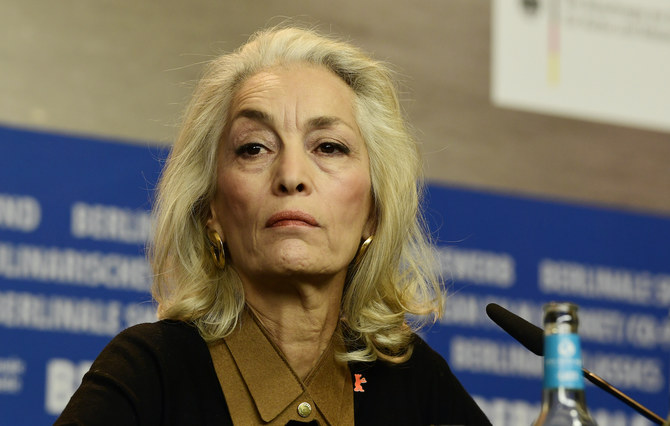
Tunisian producer Dora Bouchoucha joins Venice International Film Festival jury
Updated 27 July 2020
Arab News
DUBAI: Tunisian film producer Dora Bouchoucha was on Monday named as a jury member for the 77th Venice International Film Festival due to take place in September.
Festival organizers announced that Bouchoucha, Tunisia’s first female movie producer, would be a judge for the Luigi De Laurentiis award for best debut feature screening in Venice.
The 62-year-old filmmaker will join Italian director Claudio Giovannesi, who will serve as president, and French artistic director Remi Bonhomme, who has also been appointed as artistic director for the Marrakesh International Film Festival.
In 2017, the Huffington Post described Bouchoucha as “a born rebel, a trailblazer of wonderful self-assurance, elegance, and beauty” and in 2018 she attended the Cannes Film Festival premiere of “Dear Son,” a feature film co-produced by her company, Nomadis Images.
The winner of the Luigi De Laurentiis award will receive $100,000 to be shared between the film’s director and producer.
Venice is the world’s longest-running film festival and in January its organizers announced that Australian actress Cate Blanchett would preside over this year’s edition.
Due to the lockdowns imposed on the film industry around the world to help limit the spread of the coronavirus disease (COVID-19) pandemic, the festival was likely to be attended by fewer productions, said regional governor Luca Zaia, who is also a board member of the Biennale di Venezia arts organization.
Daniel Boulud on creating a French menu with Saudi soul
The acclaimed French chef discusses ‘building on a legacy’ with Riyadh’s Café Boulud
Updated 7 sec ago
Ghadi Joudah
RIYADH: Daniel Boulud was in a reflective, quietly excited mood when we met at his Riyadh outpost of Café Boulud during the restaurant’s first anniversary at the end of October.
“We’re building on a legacy that started in my village in France and continued with Café Boulud in New York 28 years ago,” he told Arab News. The touchpoints are classic: tradition, seasonality, and French technique. But our conversation quickly turned to how those ideas breathe in Riyadh.
“The promise was always to be very French, but also current and global,” Boulud said. In practice then, “there is the DNA of the original Café Boulud,” but local preferences mean the menu is lighter and brighter — more raw preparations, a Mediterranean lift, and more space for produce.
Seasonal truffles at Cafe Boulud. (Supplied)
For Boulud, recipes aren’t static; techniques and flavors adapt to their new place. So in Riyadh he’s created dishes using “local spices, local ingredients — inspirations from the warm weather.” Those local ingredients, he said, include “dates, dried fruits, certain local dairy — like the cream — and of course cardamom and coffee.”
Boulud is no stranger to the Saudi palate. In the early Eighties, he was employed as a cook by a Saudi family. That’s when he first fell for Arabian coffee. Now he folds that memory into a pot de crème made with coffee, cardamom, and caramel. It tastes like a postcard from then to now.
Topian Amberjack at Cafe Boulud. (Supplied)
But Boulud remains flexible about his ingredients’ origins. “I want the tomato to be local, but whether it’s from Syria, Lebanon, Egypt, or France, as long as it’s a good tomato, I’m happy,” he explained. Essentially, integrity outranks origin. Consistency is the key.
Boulud said that many of his restaurants’ regulars skip the menu altogether. They already know the path they want their meal to take. One that Boulud recommends: a crudo or ceviche to open — “something crisp, fresh, refreshing, light” — then shellfish, if the supply is good, or a fish course (Dover sole, tuna, salmon, striped bass, daurade, or cod). And finally meat, something cooked over a wood fire for depth, or long, slow braises “with the meat falling off the bone.”
Cafe Boulud Riyadh. (Supplied)
And Boulud said he still loves the ritual of a cheese course, preferably “an incredible selection,” often shared — before dessert. The latter could go one of two ways: chocolate (sometimes with nuts, spice, or that Saudi-accented coffee and cardamom), or fruit-led finales that track the seasons, with the occasional preserve or dried fruit such as dates and figs.
With the Kingdom’s dining scene booming, it seems likely that an increasing number of young Saudis will now see becoming a chef as a viable career option. For those that do, Boulud’s advice is to stay close to home for inspiration.
“The first skill is to know where you’re from,” he said. “Do you know your own cuisine?” He recommended mastering family flavors, seeking mentors with “discipline and ethics,” and then travelling to expand both culinary and cultural literacy.
Boulud also stressed the need for clarity in cooking. (“Fusion is very confusing,” he warned.) Seasoning and techniques can be adapted, ideas can be combined, but there’s one question he wants chefs to be able to answer: “What are the roots of your dish?”