

Three years after Marawi siege, Philippines to start rebuilding 31 mosques

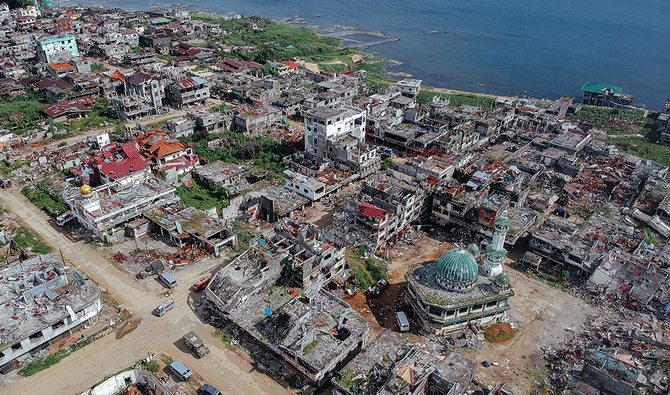
Philippine government is ready to rebuild 31 mosques in the city of Marawi. (Shutterstock)
Short Url
Updated 25 July 2020
Follow

Three years after Marawi siege, Philippines to start rebuilding 31 mosques

  • $2.1 million project a ‘symbol of hope for all Maranaos,’ southern city mayor says

MANILA: Three years after pro-Daesh terrorists laid siege to the Philippine city of Marawi, the government is ready to rebuild 31 mosques in the area.

The mosques were destroyed during intense combat operations by the military to dislodge members of the Maute group who staged the siege, officials told Arab News on Saturday.

“It’s a welcome development  ... the establishment of the destroyed mosques inside the most affected area (MAA) or ground zero, because these are very important to us,” Majul Gandamra, mayor of Marawi City, which is part of the Lanao Del Sur province in the southern Philippines, told Arab News.

He added that reconstruction of the mosques, at a cost of 105 million Philippine pesos ($2.1 million), was “really necessary” and should not be “left behind” as the government rebuilds the war-torn southern city.

It follows a recent visit to the city by Human Settlements and Urban Development Secretary Eduardo del Rosario to inspect rehabilitation work inside the MAA. Del Rosario said that the order to rebuild the mosques was based on a directive by President Rodrigo Duterte. 
 
“That is the order of . . . President Rodrigo Duterte and that will be done,” said Del Rosario, who met the Marawi City clans serving as administrators of the two biggest mosques in the city — the Dansalan Bato Ali Mosque and the Grand Mosque or the Islamic Center.

Del Rosario, who is also the head of the task force in charge of the rehabilitation of Marawi, said that the assigned team had an inventory of the sites that needed total reconstruction and those that required retrofitting and repairs. 

Six out of the 31 mosques, including the iconic Bato Mosque and the Grand Mosque, were a top priority, he said.

Based on assessments by government engineers, Bato Mosque where the Maute group held their hostages during the five-month siege is considered “structurally unsound.” The original structure needs to be demolished and a new mosque built. The Grand Mosque, however, can be restored by massive retrofitting and repairs.

Four other mosques are on the priority list.

“During our March meeting with the president, he mentioned that we give priority to the construction of the affected mosques. I am happy to announce that we got a private donation for this,” Del Rosario said.

Mayor Gandamra said that he was confident the government could deliver on its commitment, despite the difficulties in financing the project due to a “prohibition on the disbursement of public funds for the establishment of religious structures” under Philippine law.

“So we are engaging the private sector as in the case of the Bato Mosque and the Grand Mosque, which some private companies have already agreed to help support the construction of these big mosques inside ground zero. So we are very happy with this development,” he said.

Gandamra stressed that the rebuilding of the mosques was “a big thing for the people of Marawi” as the destruction of the religious sites had “greatly impacted them in the same way that the war also destroyed their homes.”

“The mosques are very important to us because these are our places of worship and of course it’s in these significant structures where Muslim people are taught the way of life. So it’s really important for us that these structures are already there before we return to our homes once we’re allowed to go back,” he said. It was unfortunate that radical elements had used these places during the siege to depict a wrong narrative about Islam, he said. 

The Marawi siege, launched by the pro-Daesh Maute group, began on May 23, 2017 and lasted until October that year. More than 1,000 militants, government troops and civilians were killed, while the once-bustling city was flattened, displacing more than 100,000 residents.

“We are hoping with the support of the government and our private partners, our mosques will rise again, and perhaps in a much better state than it was before the siege,” Gandamra said. The reconstruction of the mosques “symbolizes hope for all Maranaos,” he said.

“After all we have to move on, and we are going to work hand-in-hand with the government and other partners to rebuild Marawi.”

Meanwhile, Sultan Nasser Sampaco of the Sultanate League of the Philippines, thanked Duterte, Del Rosario and Gandamra for making the reconstruction of Bato Mosque a priority among the other mosques in the area. He said that the structure was a symbol of the Royal Sultanate of Dansalan with three sultans and two datu (or chief) who are also its custodian and administrator.
 
Built in the 1950s, the Bato Mosque is among the oldest and most renowned places of worship for Muslims, not only in Mindanao but the rest of the country as well.

Bangladesh’s Hindu minority in fear as attacks rise and a national election nears

Updated 2 sec ago
Follow

Bangladesh’s Hindu minority in fear as attacks rise and a national election nears

  • Among Hindus, fear has grown more pervasive as the Muslim-majority nation moves toward a national election
  • Attacks on Hindus in Bangladesh have also inflamed tensions with neighboring India
DHAKA: Dipu Chandra Das, a 27-year-old Hindu garment worker, was accused in December by several Muslim colleagues of making derogatory remarks about the Prophet Muhammad. The accusations drew a violent mob to his workplace. He was beaten to death, his body hung from a tree and set on fire.
Across Bangladesh, Hindus watched the recorded images on their phones with dread. Protests erupted in Dhaka and other cities, with demonstrators demanding justice and greater protections. The interim government, led by Muhammad Yunus, ordered an investigation, and police said that about a dozen people were arrested.
But human rights groups and Hindu leaders say the killing wasn’t an isolated act, but part of a wider surge in attacks on the minority community, fueled by rising polarization, the reemergence of Islamists and what they describe as a growing culture of impunity. Among Hindus, fear has grown more pervasive as the Muslim-majority nation moves toward a national election on Feb. 12.
“No one feels safe anymore,” said Ranjan Karmaker, a Dhaka-based Hindu human rights activist. “Everyone is terrified.”
Surge in attacks
Hindus make up a small minority in Bangladesh, about 13.1 million people, or roughly 8 percent of the country’s population of 170 million, while Muslims make up 91 percent.
The Bangladesh Hindu Buddhist Christian Unity Council, an umbrella group representing minority communities, says it documented more than 2,000 incidents of communal violence since the ouster of former Prime Minister Sheikh Hasina in a mass uprising in August 2024.
The group recorded at least 61 killings, 28 instances of violence against women — among them rape and gang rape — and 95 attacks on places of worship involving vandalism, looting and arson. It has also accused the Yunus-led administration of routinely dismissing or downplaying reports of such violence.
When contacted by The Associated Press for a response, an official from Yunus’ press team declined to comment. The administration headed by Yunus has consistently denied claims that it has failed to ensure adequate protection for minority communities and insisted that most incidents aren’t driven by religious hostility.
Previous elections in Bangladesh have also seen increases in violence, with religious minorities often bearing the brunt. But with Hasina’s Awami League party barred from contesting elections and with her living in exile in India, many Hindus fear the worst as they have long been viewed as aligned with Hasina.
Karmaker, the rights activist, said that Hindus are often perceived as voting en masse for one side, a perception that heightens their vulnerability. He said that the community was also gripped by fear because of a culture of impunity, and near-weekly incidents, warning that in some parts of the country the Hindu community was facing “an existential crisis.”
“The individuals involved in this violence are not being brought under the law, nor are they being held accountable through the justice system. It creates the impression that the violence will continue,” Karmaker said.
Islamists reclaim influence
The surge in attacks against Hindus has unfolded alongside the reemergence of Jamaat-e-Islami, Bangladesh’s largest Islamist party, and its student wing. After years on the political sidelines because of bans, arrests and sustained crackdowns under Hasina’s government, the party sees the election as an opportunity to reclaim influence.
Jamaat-e-Islami anchors a broader Islamist alliance of 11 parties, among them the student-led National Citizen Party, or NCP, whose leaders played a central role in the 2024 uprising.
As concerns grow over what its return could mean for religious minorities, Jamaat-e-Islami has moved to recast its public image, even though it advocates Shariah, or Islamic law. It has organized public rallies featuring Hindu participants and nominated a Hindu community leader as one of its candidates.
Meanwhile, NCP has pledged to support citizens facing religious discrimination and said that if elected, it would establish a dedicated unit within the Human Rights Commission to protect minority rights.
Political analyst Altaf Parvez said that such decisions were largely symbolic. He said that other political parties, including the Bangladesh Nationalist Party, had also failed minorities by nominating only a handful of candidates — a move, he said, that didn’t reflect a genuine political commitment to inclusive politics.
Parvez said a systematic pattern of attacks was taking place in rural areas to inject more fear among the minorities before the vote.
“It will impact the participation of the voters from the minority communities in the next elections too,” he said.
Tensions rise with India
Attacks on Hindus in Bangladesh have also inflamed tensions with neighboring India, prompting protests by Hindu nationalist groups and criticism from Indian Prime Minister Narendra Modi’s government.
India’s Foreign Ministry recently accused Bangladesh of downplaying a “disturbing pattern of recurring attacks” on Hindus, saying such violence was wrongly blamed on personal or political disputes. Bangladesh, in turn, described India’s criticism as “systematic attempts” to stoke anti-Bangladesh sentiments.
The dispute has spilled into diplomacy and sporting events. Both sides have suspended some visa services and accused each other of failing to protect diplomatic missions. Protests in India led cricket officials to bar a Bangladeshi player from the Indian Premier League tournament, followed by Bangladesh’s boycott of this month’s World Cup in India.
Sreeradha Datta, a Bangladesh expert at India’s Jindal School of International Affairs, said that India’s concerns were “legitimate.”
“Hindus in Bangladesh are a very vulnerable group that can’t defend themselves, and Yunus’ administration is in exit mode and deliberately looking the other way,” she said.
Families demand justice
For those caught in the violence, the losses have been deeply personal.
When word of Das’ killing reached his home village in Bangladesh’s Mymensingh district, disbelief settled in among relatives and neighbors. Many said they watched images of his killing on their phones.
“When people say they saw it on their phones, my chest feels like it is going to burst,” his father said.
Das was known as a quiet, well-behaved man. He was also the sole breadwinner for his family, relatives said, and his death has left his wife and mother facing an uncertain future.
His mother, Shefali Rani Das, said the family is seeking justice for the killing.
“They beat him, hung him from a tree, and burned him. I demand justice,” she said.