MANILA: A regional security expert on Wednesday said the liberation of Marawi City from the Daesh-backed Maute group has not ended the threat of violent extremism in the Philippines.
Sidney Jones, director of the Indonesia-based Institute for Policy Analysis of Conflict (IPAC), said this as she warned of grave consequences if the Philippine government fails to efficiently rebuild Marawi which suffered massive devastation from the five months of battle between government troops and the Maute group.
Jones also raised the possibility that children of militants killed in the Marawi siege could be the next generation of fighters. She said that there is “ongoing radicalization taking place on a very quiet, below-the-radar-screen level” among youth in Mindanao, particularly those directly affected by the Marawi crisis.
“One of the things particularly to think about are (the) children and younger siblings of people who were killed,” Jones said in a forum with foreign correspondents.
She pointed out that the government placed the number of slain terrorists at 800 to 900. The question, however, is “how do you know that all (these) people killed are really terrorists?” She that it was never clear how the determination was made to say that they are indeed militants.
The fact that the number of terrorist casualties kept going up, whereas the number of civilians stayed at 47 from the start of the siege in May all the way till the end, just “doesn’t make sense,” Jones stressed. That leaves the children and young siblings of these slain militants very vulnerable to recruitment and involvement in radical organizations, she added.
Jones thus said it is important to identify the families and children of the so-called 800 terrorists killed in Marawi, where are they, and what programs can be put in place for them.
According to the IPAC director, the problem with the children and siblings of the slain militants “could be exacerbated if there’s a failure to rebuild Marawi very quickly or efficiently.”
Jones notes that many displaced residents are not angry at the destruction of their homes, but are also unhappy at the conditions in evacuation centers — a situation that can be exploited by extremists.
“And as I say, watch the reconstruction of Marawi and watch what happens … in terms of resentment in evacuation centers if people don’t go home quickly,” she continued.
“Reconstruction of Marawi, how it’s conducted will be key,” Jones emphasized.
While saying that she doesn’t think there’s a likelihood that militants could take over another city, Jones said that revenge bombings in Manila, Zamboanga, or Cotabato can come next after the government declared victory against Daesh-backed militants in Marawi.
“We’re more likely to see bombing attacks in urban areas to say we’re (militants) still here,” Jones said.
She added there’s also a possibility of attacks on Philippine embassies elsewhere, and the rise of a new Maranao movement that will take a more Islamist stance, as well as eruption of clan wars against the Mautes. Basilan could also revert to kidnappings under Furuji Indama.
Another thing to pay attention to, she said, was the presence of Indonesians and Malaysians in Marawi
“It is important to note how far back the links between Mindanao-based Indonesian extremists actually go. There’s a long, complex history with lots of different groups … just because Marawi is liberated doesn’t mean an end to that,” Jones said.
“The ideology that supports violent extremism isn’t going away any time soon,” she further said.
Asked about the announcement made by Philippine National Police (PNP) chief Gen. Ronald Dela Rosa that Malaysian jihadist Muhammad Amin Baco has replaced Isnilon Hapilon as the new Daesh emir in Southeast Asia, Jones said: “It looks like he jumped to (that) conclusion.”
Jones stressed “there’s no way” that Baco is Daesh’s new emir in Southeast Asia.
She said there may have been information from captured Indonesian Muhammad Ilham Syahputra that Baco was there when Hapilon and the Maute brothers were killed, and he (Baco) may have temporarily assumed leadership of the stragglers in Marawi. “But you can’t extrapolate from that to saying that somebody is emir,” Jones emphasized.
“I’m not sure what the basis was on which the police chief made that statement,” Jones said, adding: “I don’t think we have any evidence to support that.”


![]()
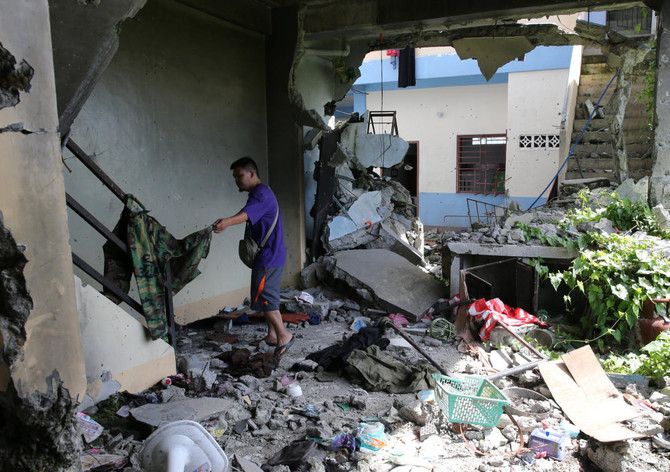
Liberation of Marawi City from Maute group has not ended threat of violent extremism in the Philippines.
Liberation of Marawi City from Maute group has not ended threat of violent extremism in the Philippines.
Latest updates





© 2026 SAUDI RESEARCH & PUBLISHING COMPANY, All Rights Reserved And subject to Terms of Use Agreement.