

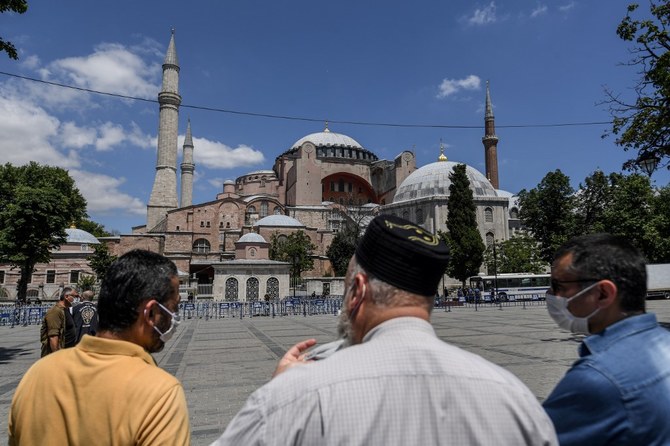

ROME: The Turkish government’s decision to convert Istanbul’s historic Hagia Sophia museum into a mosque was based on “power and politics,” a leading Italian Muslim cleric has claimed.
Imam of Milan Yahya Pallavicini said the 1,500-year-old UNESCO World Heritage Site should have been left as it was originally built, as a church.
The world-famous site became a museum in 1934 but a Turkish court annulled its status and President Recep Tayyip Erdogan announced it would be ready for Friday prayers from July 24.
“It should be neither museum nor mosque; Hagia Sophia was just to remain a church,” said Pallavicini, who is also president of Coreis (the Islamic religious community of Italy).
“For centuries political and cultural choices that I have not agreed with have been made. I know my position may not sound diplomatic enough, but it is supported by historical facts and Qur’anic references,” he told Italian news agency Adnkronos.
“In the history of Islam, when Muslim scholars visited a place of worship, such as a synagogue, a monastery, or a burial place of other confessions, they always respected those places and their identity.
“When he (Caliph Omar) entered Jerusalem, he was offered the opportunity to pray in a church. But he refused in a sign of respect for the Christian faithful. A similar approach should be maintained nowadays too.
“Places of worship should be left to the use they were originally built for. In Istanbul there are already so many beautiful mosques where Muslims can pray, so there was no need to have another one. In my opinion the decision on Hagia Sophia is just a result of logics of power and politics,” Pallavicini added.
The imam said he agreed with the sentiments of Pope Francis who had spoken of being “very saddened” by the conversion of Hagia Sophia into a mosque.
“The pope is right to defend the opportunity to protect the spaces of worship of different religions. In different ways, we can all agree on that. On the other hand, whoever truly supports inter-religious dialogue, as clearly Pope Francis does, needs also to respect the specific identities of the different faiths.”
Referring to demonstrations organized by the Northern League anti-immigrant party outside the Turkish Consulate in Milan, Pallavicini said: “Some Italian politicians should not take advantage of this particular episode for political reasons.
“Whoever speculates on triumphalism and sovereignty exploiting religious and cultural symbols, is never for inter-religious dialogue.”
Several representatives of the Italian Catholic church have also criticized Erdogan’s decision.
Monsignor Ettore Malnati, the episcopal vicar for the laypeople and culture of the Trieste diocese, described the move as “worrying.”
He told Arab News: “We all must reflect on this, as well on all the incarcerations of journalists and free people who have exposed themselves in Turkey for a democratic, secular, and respectful society for the right of religious freedom.
“Hagia Sophia was a Christian church for over 1,000 years. It was built for Christian worship by the Christian emperor Justinian. President Erdogan’s choice sounds like a message of ideological fundamentalism that certainly does not go in the direction of a tolerant society and of an international community respecting plural culture and spiritualities.
“Erdogan sends that message to the Christians and to the Islamic countries too,” Malnati added.
However, Monsignor Paolo Bizzeti, the apostolic vicar of Anatolia, said: “Polls say that about 70 percent of the Turkish population approved Erdogan’s decision, and this must be taken into account.”
Speaking to the Italian news agency, ANSA, he added: “I hope that now the possibility of praying will be granted to Christian refugees in Turkey by Erdogan, who proclaims himself as a man of faith.
“I hope that he will allow the opening of more Christian chapels in Turkish territory so that people who are in transit in this country may be given the chance to find a place where they can pray together as a community while in this country.”


