Saudi Arabia ‘puts pilgrim safety first,’ says Hajj official

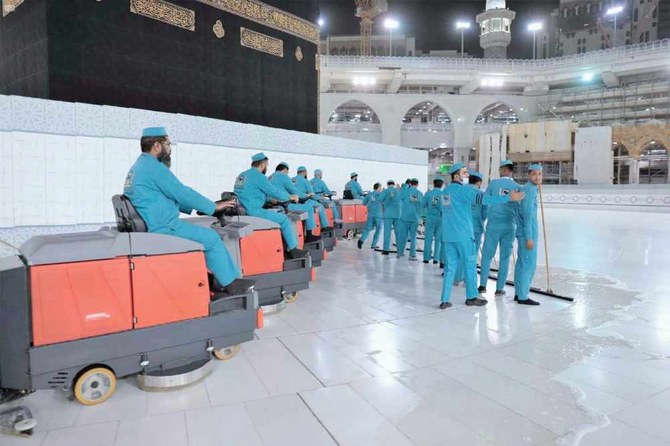
Workers are using 54,000 liters of eco-friendly sanitization solution and 95 pieces of equipment for daily cleaning operations at the Grand Mosque in Makkah. (SPA)
Short Url
Updated 24 July 2020
Follow

Saudi Arabia ‘puts pilgrim safety first,’ says Hajj official

  • More than 3,500 workers are taking part in a major cleaning operation at the Grand Mosque in Makkah
  • The General Presidency for the Affairs of the Two Holy Mosques is overseeing the disinfection program as part of the Kingdom’s efforts to limit the outbreak

MAKKAH: Saudi preparations for Hajj are focusing on extensive health measures to limit the threat of coronavirus, according to a Hajj official.

“Maintenance team preparations and follow-up are being carried out on a daily basis to prepare for the season and to ensure that services in Makkah and at holy sites are at the highest state of readiness despite the small number of pilgrims this year,” Alaa Al-Nofaie, adviser to the chairman of the board of the Makkah Region Development Authority, told Arab News.

Abdulhamid Al-Maliki, assistant undersecretary for service affairs at the General Presidency for the Affairs of the Two Holy Mosques, told Arab News that the urgent situation caused by the pandemic requires a united effort to help the government present a good image of the Kingdom in terms of security, health and services.

He said that vigorous efforts by the Presidency to combat COVID-19 will enable the Kingdom to meet any challenge.

Hajj personnel are ready to deal with the fast-spreading virus, especially among crowds, he added.

More than 3,500 workers are taking part in a major cleaning operation at the Grand Mosque in Makkah. The General Presidency for the Affairs of the Two Holy Mosques is overseeing the disinfection program as part of the Kingdom’s efforts to limit the outbreak.

Workers are using 54,000 liters of eco-friendly sanitization solution and 95 pieces of equipment for daily cleaning operations at the holy site.

The mayor of Makkah, Mohammed Abdullah Al-Quwaihis, told Arab News that COVID-19 case numbers are lower in the Kingdom compared with Western countries, which were late to enforce precautionary measures.

He said that inaction rapidly increased case numbers in the West and that the actions of Saudi authorities prevented the same crisis occurring in the Kingdom.

Fadhel Al-Buainain, an economist, said that despite the economic cost of suspending Umrah and reducing pilgrim numbers, the Kingdom has put the safety of Muslims first.

Meanwhile, the Guidance Affairs Agency headed by the General Presidency for the Affairs of the Two Holy Mosques has launched an interactive platform for pilgrims during the Hajj season.

Part of the “We Are Proud to Serve the Pilgrims and Visitors” campaign, the platform includes all programs, Qur’an recitations, lessons, lectures and speeches.It can be visited at gph.gov.sa/images/gph_files/hajj8/Guidance_for_the%20month_of_Dhu_al-Hijjah.pdf


Satellite imagery shows apparent attack on Iranian nuclear site, report says

Updated 11 sec ago
Follow

Satellite imagery shows apparent attack on Iranian nuclear site, report says

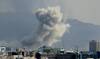
VIENNA/WASHINGTON:  Commercial satellite imagery has captured what appears to be the first known strikes on an Iranian nuclear site since the start of the US-Israeli air operation, an independent policy institute said on Monday.

The Institute for Science and International Security said imagery produced by Colorado-based Vantor showed two strikes on access points to the underground uranium enrichment plant at Natanz, which was hit by the US  last June.

David Albright, a former UN nuclear inspector and founder of the institute, said the strikes appeared to have occurred sometime between Sunday afternoon and Monday morning local time, based on the satellite imagery his group reviewed.

He was unable to identify whether the US or Israel hit the Natanz complex, one of the main facilities of Iran's nuclear program.

He credited Ben Tzion Macales, an Israeli geo-analyst, as being the first to find satellite imagery of the Natanz strikes.

The and Israel launched their air war against Iran early Saturday, triggering Iranian retaliatory strikes around the region.

Albright's findings appeared to corroborate an earlier statement by Reza Najafi, Iran's envoy to the International Atomic Energy Agency, that Natanz was hit on Sunday. Najafi was disputing a comment by IAEA chief Raphael Grossi, who said there was no sign that any nuclear site had been hit.

Albright said it was likely that Grossi had relied on imagery produced before the pictures obtained by his institute.

The IAEA did not immediately respond to a request for comment. The White House and Central Command also did not immediately respond.

(Reuters)

Iran's nuclear programme is among the reasons Israel and the US have given for the attacks, alleging Iran was getting too close to being able to eventually make a nuclear bomb. Iran has repeatedly denied seeking a nuclear arsenal.

Albright's report said Vantor's imagery showed that three buildings at Natanz had been destroyed. Two were personnel entrances to two underground halls housing thousands of centrifuges, machines that enrich uranium for use in power plants or weapons depending on the duration.

Even though the halls were rendered inoperable by the US attack in June, the strikes could indicate that the halls still contained "recoverable centrifuges" or other related equipment, the report said.

The third building destroyed covered the only vehicle access ramp to the underground halls, it said.

Grossi said in a statement to a meeting of the IAEA's 35-nation board of governors that the agency had no indication that "any of thenuclear installations ... have been damaged or hit."

Moments after Grossi's remarks, Najafi told reporters outside that Natanz had been attacked.

"Again they attacked Iran's peaceful, safeguarded nuclear facilities yesterday," Najafi said. Asked by Reuters which facilities were hit, he replied: "Natanz" and left.

IAEA has limited contact with Iran

While the IAEA's crisis-response centre has been unable to reach Iran's nuclear regulatory authorities, there has been some contact with Iranian officials, Grossi told a press conference.

"We are, of course, in conversation with Iran, but at the moment, it's very limited. Until last Thursday, it was very intense," he said, adding that while the IAEA has no staff in Iran at the moment, it is watching satellite images closely.

Tehran has not let the IAEA return to its bombed facilities since they were attacked in June.

Calls for dialogue to resume

Natanz housed facilities including two uranium-enrichment plants attacked in June - an above-ground one the IAEA says was destroyed and the underground facility containing the two centrifuge halls that were at least badly damaged at the time.

Asked about Najafi's remarks, Grossi stood firm at his later press conference, saying, "I will not get into a polemic on that. We stand by what I said before."

Grossi was in Geneva for the last two rounds of Oman-mediated talks between Iran and the United States, discussing nuclear specifics with both sides.

"An understanding eluded the parties this time. I am sure we are, quite understandably, feeling a strong sense of frustration," Grossi told the board.