Makkah Grand Mosque to remain closed during Eid Al-Adha to stop virus spread

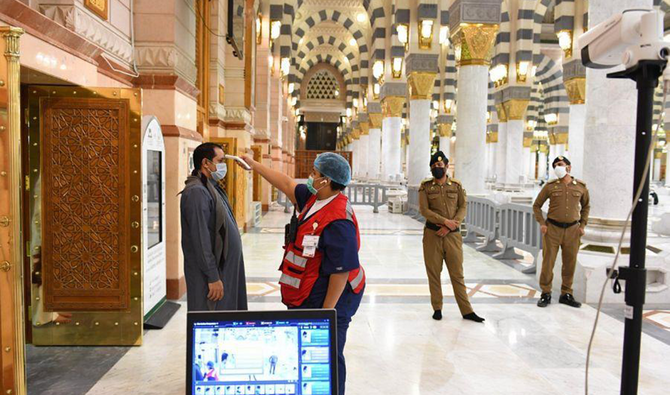
Due to the virus outbreak, the Grand Mosque will be closed to worshippers for Arafa day and Eid Al-Adha. (SPA)
Short Url
Updated 22 July 2020
Follow

Makkah Grand Mosque to remain closed during Eid Al-Adha to stop virus spread

  • Pilgrims’ safety top priority in Hajj planning: Security forces commander

JEDDAH/MAKKAH: The safety of pilgrims had been the top priority in preparing for this year’s Hajj, Saudi security officials said on Tuesday.

Announcing the completion of the first stage of planning for the annual religious gathering, the commander of the forces responsible for security at the Grand Mosque in Makkah stressed that protecting worshippers was paramount.

“We have mainly focused on the health aspect this year for its extreme importance in the current unique situation (the coronavirus disease pandemic). The remaining stages will be implemented in the coming days,” said Maj. Gen. Muhammad Al-Ahmadi.

He pointed out that new arrangements had been put in place to control pilgrims’ entry and exit to the Grand Mosque to ensure social distancing and effective precautionary measures against COVID-19.

Defined pathways for the performance of walking rituals around the Kaaba and between the hills of Safa and Marwah had been established, and entrance to the Grand Mosque area would only be allowed to those with official permission.

Due to the virus outbreak, the Grand Mosque will be closed to worshippers for Arafa day and Eid Al-Adha. “The decision to suspend prayers in the Grand Mosque including its outdoor arenas will continue. We invite people of Makkah to break their fast on the day of Arafat in their homes,” added Al-Ahmadi.

The command and control center in Makkah located in Mina and Muzdalifah will be fully operational. Entrances to Makkah city would be controlled by different security forces for 24 hours to prevent people without a permit gaining access.

The General Presidency for the Affairs of the Two Holy Mosques said that more than 80 years of experience in crowd and crisis management had been behind the Kingdom’s move to restrict the number of worshippers performing this year’s Hajj pilgrimage.

During a virtual meeting to review the Saudi operational plan for the Hajj season, president of the general presidency, Dr. Abdulrahman Al-Sudais, said that the Arafat sermon will be translated into 10 languages, including Chinese and Russian, in addition to an English interpretation on the Holy Qur’an channel and French on the Prophet’s Sunnah channel.

He added that the operational plan adopted for Hajj had focused on the enforcement of precautionary and preventive measures to safeguard the health of pilgrims.

Special arrangements have also been made for the delivery of the Kaaba’s Kiswa (cover) on Wednesday by Makkah Gov. Prince Khalid Al-Faisal, in line with measures to stop the spread of COVID-19, Al-Sudais said.

Meanwhile, on Tuesday, Saudi Minister of Hajj and Umrah Dr. Mohammed Saleh Benten visited the pilgrims’ reception headquarters at the Four Points hotel in Makkah, where he was briefed on preparations to receive and accommodate them from the fourth to the eighth day of the month of Dhu Al-Hijjah.

He then toured the pilgrims’ camp in Arafat and reviewed procedures for their movement to the Mount of Mercy (Jabal Al-Rahmah). Benten also checked services for pilgrims at Muzdalifah, including preparations for the provision of meals in three 40-foot vehicles.

In addition, the minister went to Mina and viewed one of the towers designated for  housing pilgrims, where he inspected facilities and room services.

At the end of the visit, he watched a presentation on the special procedures put in place to transfer pilgrims from their residences to the Jamarat Bridge outside of Makkah.


Saudi Arabia designates 2026 the Year of Artificial Intelligence

Updated 9 sec ago
Follow

Saudi Arabia designates 2026 the Year of Artificial Intelligence

  • SDAIA unveils official logo after it was approved by the Cabinet

RIYADH: Saudi Arabia has designated 2026 as the Year of Artificial Intelligence, underscoring the Kingdom’s growing leadership in global AI adoption, and reaffirming AI as a top priority by supporting the nation’s AI ambitions in line with Saudi Vision 2030.

With the Kingdom emerging as a global hub for data and AI, driven by the support of Crown Prince Mohammed bin Salman, the move was underscored by the Saudi Cabinet’s approval on Tuesday.

The Saudi Data and Artificial Intelligence Authority, meanwhile, launched the official logo for the Year of Artificial Intelligence, Saudi Press Agency reported Wednesday.

The logo integrates symbolism in its elements: a palm tree signifies the national emblem and the Kingdom’s cultural heritage, while the letters “AI” highlight the technological and innovative aspects central to promoting digital inclusion as part of Vision 2030.

The palm tree’s green color symbolizes the Saudi flag and the Kingdom’s national identity, while the accompanying blue color represents digital technology and progression toward advanced technological development.

The logo is accompanied by the official hashtag for the Year of Artificial Intelligence: #SaudiAIYear.

Muhammad Khurram Khan, a professor of cybersecurity at King Saud University, told Arab News: “Saudi Arabia’s decision to designate 2026 as the Year of Artificial Intelligence represents a strategic milestone in the Kingdom’s digital transformation under Vision 2030.

“Over the past several years, SDAIA has successfully moved the national AI agenda from planning to large-scale implementation. The progress is visible in the Kingdom’s rapid rise in global AI rankings, its significant investment in emerging technologies, and the development of advanced infrastructure such as national data platforms and large-scale data centers,” he said.

The Kingdom ranked 14th in the 2025 Global AI Index and holds a leading position in the Arab world for AI model development.

Investment in the sector has grown significantly, with government spending on emerging technologies rising by more than 56 percent in 2024 and AI companies securing $9.1 billion in funding.

“The newly unveiled logo effectively reflects this vision. The logo thoughtfully blends Saudi Arabia’s heritage with its technological ambitions, reflecting the Kingdom’s forward-looking vision for a technology-driven future,” said the professor.

“What distinguishes Saudi Arabia’s approach is its holistic strategy. Rather than focusing solely on technology deployment, the Kingdom has invested heavily in talent development, regulatory frameworks, and ecosystem building. Training thousands of specialists and engaging more than a million participants through national AI initiatives demonstrates a long-term commitment to building a sustainable knowledge economy. Equally important is the Kingdom’s emphasis on responsible AI governance, reflected in its participation in international AI partnerships focused on ethics,” he added.

Welcoming the Cabinet’s decision to designate 2026 as the Year of Artificial Intelligence, Abdullah bin Sharaf Al-Ghamdi, SDAIA president, said on Tuesday the decision reflects the crown prince’s vision to strengthen the Kingdom’s global standing in advanced technologies.

He described it as an important step toward creating national momentum around innovation and the role of artificial intelligence in shaping a smarter and more sustainable future.

Since its establishment in 2019, SDAIA has led the National Strategy for Data and Artificial Intelligence, which focuses on six pillars: ambition, competencies, policies, investment, innovation, and ecosystem.

These efforts have moved the Kingdom from strategic planning to implementation, including regulating AI sectors and developing advanced digital infrastructure.

Infrastructure has expanded with the launch of the Shaheen III supercomputer and the Hexagon data center, the world’s largest government data facility with a capacity of 480 megawatts.

The Kingdom has also established a National Data Lake integrating more than 430 government systems.

Human capital development remains a priority. More than 11,000 specialists have been trained, and the SAMAI program has reached over one million participants.

Internationally, Saudi Arabia has strengthened its presence in the AI sector. It became the first Arab nation to join the Global Partnership on AI and hosts the UNESCO-sponsored International Center for Artificial Intelligence Research and Ethics in Riyadh.

These initiatives reflect the Kingdom’s commitment to the responsible and ethical use of artificial intelligence to support economic diversification and serve humanity globally.