

With limited Hajj this year, businesses in peril in Pakistan’s Karachi

An ihram robe worn by Muslim pilgrims for Hajj on display at a shop in Karachi, Pakistan on July 20, 2020. (AN photo)
Short Url
Updated 24 July 2020
Follow

With limited Hajj this year, businesses in peril in Pakistan’s Karachi

  • 5,000 small businesses selling prayer mats and ihram in Karachi effected by limited Hajj and Umrah suspension
  • Pakistan’s Hajj industry is roughly worth Rs160 billion or one billion dollars

KARACHI: Every year, hundreds of Pakistanis visit Shaikh Rafi’s shop on Karachi’s busy MA Jinnah Road to buy prayer mats and ihram robes ahead of the annual Hajj pilgrimage to Makkah.
But not this year.
Since Saudi Arabia announced last month that the 2020 Hajj would welcome a “very limited” number of pilgrims in order to prevent the spread of the coronavirus, Rafi spends his days dusting off unsold goods and waiting anxiously for customers who never arrive.
“This is our routine since the last couple of months,” said Rafi, who sells prayer mats and ihram robes worn by Muslim pilgrims at his shop in Karachi’s Allahwala Market.
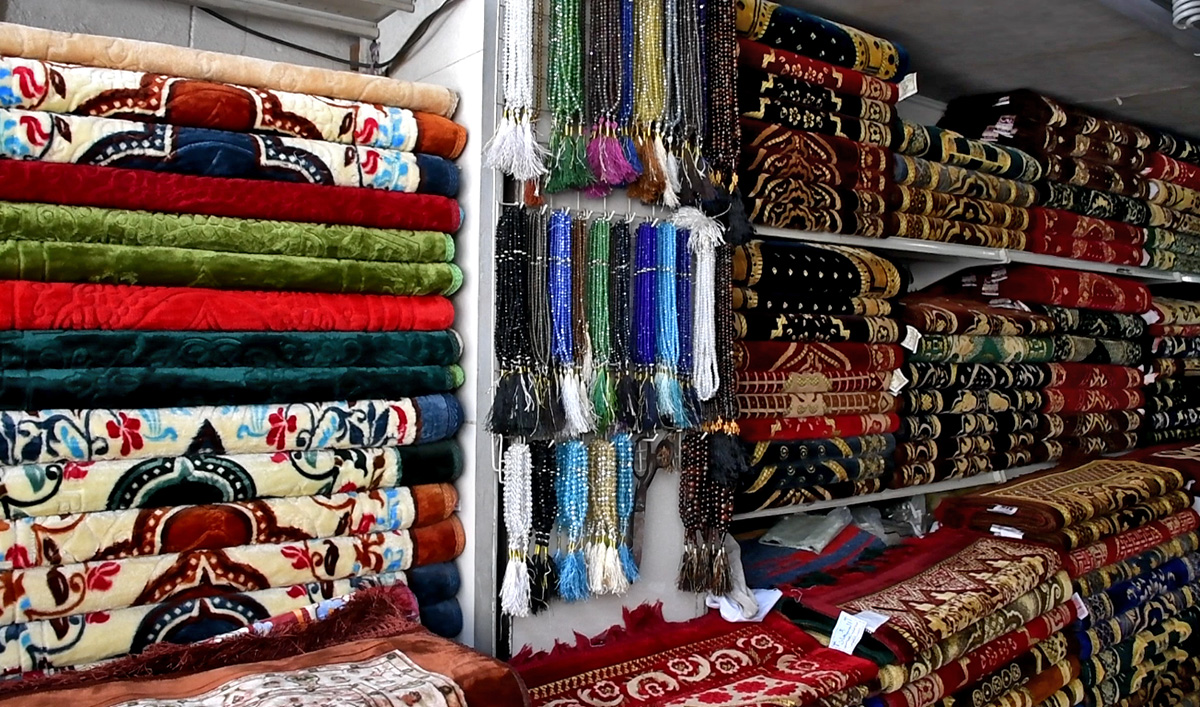


Muslim prayer mats and beads on display at a shop in Karachi, Pakistan on July 20, 2020. (AN photo)

The plans of around 2.5 million Muslims globally, almost 180,000 from Pakistan, were upended when Saudi Arabia restricted this year’s Hajj, ravaging Pakistan’s 160 billion rupee ($1 billion) Hajj industry.
Rafi’s is only one of at least 5,000 small businesses effected in the megacity of Karachi.
“Since the decision of the Kingdom to suspend Umrah flights and limit the Hajj, almost all related businesses are experiencing worst sales,” Rafi said. “We open shops expecting that someone might come but the day ends with no customers.”
“In normal circumstances people used to buy prayer rugs and caps, before or after performing Hajj or Umrah, as a gift for their relatives and friends but since the lockdown the industry is completely shutdown,” said Muhammad Rizwan, a wholesaler of rugs and caps.
Traders say businesses are not only suffering from lack of sales but also pending payments.
“There is no business for around the last five months and our payments have been stuck up with retailers and shop owners who buy on credit,” a wholesale supplier of ihram, Muhammad Hanif Katlia, told Arab News. “Many shop keepers have defaulted and have not paid rents while many have fled without paying dues.”

Some production units in the Hajj and Umrah industry have shut down completely, costing jobs, traders said, while many businesses have moved to manufacturing other items.
“The production has stopped for the last five months and we have laid off laborers,” said Jannat Gul, a manufacturer of ihram and other Hajj Items. “There is no buying and selling nor borrowers are paying back dues since the Umrah was suspended due to coronavirus.”
This year will be the first in modern times that pilgrims from abroad will not be allowed into Makkah
According to Pakistan’s Ministry of Religious Affairs and Interfaith Harmony, which oversees Hajj arrangements, 179,210 Pakistanis had already registered to attend this year: 71,684 through private tour operators and 107,526 through cheaper, government-supported packages.

Pakistan, seven Muslim nations condemn Israeli closure of Al-Aqsa Mosque gates during Ramadan

Updated 4 sec ago
Follow

Pakistan, seven Muslim nations condemn Israeli closure of Al-Aqsa Mosque gates during Ramadan

  • Joint statement says restrictions on access to Jerusalem holy sites violate international law
  • Disputes over access to site have repeatedly triggered protests and broader tensions

ISLAMABAD: Pakistan and seven other Muslim-majority countries on Wednesday condemned Israel’s continued closure of the gates of Al-Aqsa Mosque to Muslim worshippers during the holy month of Ramadan, calling the move a violation of international law and the historical status quo governing the holy site.

The foreign ministers of Pakistan, Egypt, Jordan, the United Arab Emirates, Indonesia, Türkiye, Saudi Arabia and Qatar issued a joint statement criticizing restrictions on access to the mosque and other places of worship in Jerusalem’s Old City.

Al-Aqsa Mosque, located within the Haram Al-Sharif compound in East Jerusalem’s Old City, is the third-holiest site in Islam and draws thousands of worshippers, particularly during Ramadan. Access to the site has long been a flashpoint in the Israeli-Palestinian conflict.

“The Foreign Ministers of the Islamic Republic of Pakistan, the Arab Republic of Egypt, the Hashemite Kingdom of Jordan, the United Arab Emirates, the Republic of Indonesia, the Republic of Türkiye, the Kingdom of Saudi Arabia and the State of Qatar condemn Israeli occupation authorities’ continued closure of the gates of Al-Aqsa Mosque / Al-Haram Al-Sharif to Muslim worshippers particularly during the holy month of Ramadan,” the joint statement said.

The ministers said restrictions on entry to Jerusalem’s Old City and its places of worship constituted a violation of international law and the established arrangements governing the site.

They expressed “absolute rejection and condemnation of this illegal and unjustified measure, as well as Israel’s continued provocative actions at Al-Aqsa Mosque / Al-Haram Al-Sharif and against worshippers.”

The statement also stressed that Israel “has no sovereignty over occupied Jerusalem or its Islamic and Christian holy sites.”

The ministers reiterated that the entire compound of the Al-Aqsa Mosque, covering 144 dunams, is a place of worship exclusively for Muslims and said the Jerusalem Endowments and Al-Aqsa Mosque Affairs Department, affiliated with Jordan’s Ministry of Awqaf and Islamic Affairs, holds authority to administer the site and regulate entry.

They called on Israel “to immediately cease the closure of the gates of Al-Aqsa Mosque, remove access restrictions to the Old City of Jerusalem, and to refrain from obstructing Muslim worshippers’ access to the mosque.”

The ministers also urged the international community to take what they described as a firm stance to compel Israel to halt violations against Islamic and Christian holy sites in Jerusalem.

The Al-Aqsa compound, known to Muslims as Haram Al-Sharif and to Jews as the Temple Mount, has been a focal point of tensions for decades, with access restrictions and police raids periodically sparking unrest.

Under longstanding arrangements dating back decades, the Islamic Waqf administered by Jordan oversees the site, while Israeli authorities control security and access to the Old City.

Restrictions around the compound often intensify during religious holidays such as Ramadan, when large numbers of Palestinian worshippers seek to attend prayers at the mosque. Disputes over access to the site have repeatedly triggered protests and broader tensions in Jerusalem and across the region.