

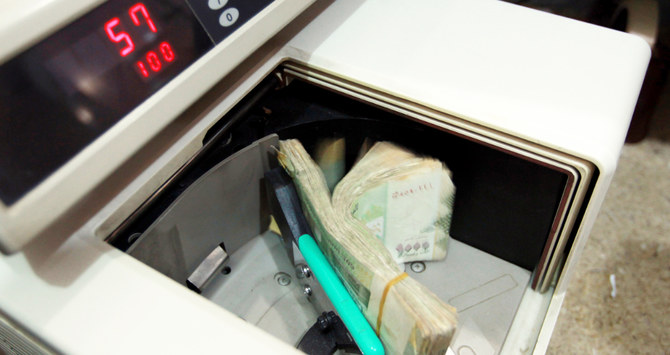

AL-MUKALLA: The depreciation of the Yemeni currency has caused more damage to Yemenis than the raging conflict in the country, economists and locals have said.
The Yemeni riyal traded 752 against the US dollar on Thursday’s black market for the first time in two years, falling from 700 in recent weeks. The riyal was 623 at the beginning of the year before slowly falling to 680 over the following six months. In January 2015, the riyal was 215 to one dollar.
The impact of the currency depreciation on the Yemeni economy and the public is dramatic, experts and economists said.
“The direct violence of the war has affected some people in Yemen, but the fall of the currency affects everyone,” Spencer Osberg, chief editor at the Sanaa Center for Strategic Studies, told Arab News.
“Yemen imports the vast majority of what its people consume. The domestic currency losing value has an immediate inflationary impact, meaning the necessities of life become more expensive for everyone,” he added.
Yemen was plunged into war when Houthi rebels seized control of Sanaa and gained territory across the country in late 2014, triggering heavy fighting that ravaged vital institutions. After almost five years, the Yemeni government has liberated most of the country. The focus of the fighting has moved to rugged and uninhabited areas in northern Yemen.
The war has disrupted oil and gas exports, the primary source of hard currency for the country. The disruption is the main cause in the decline of the Yemeni currency.
“In a country where roughly half of the population was living below or near the poverty line even before the conflict when the currency was stable, the Yemeni riyal’s fall in value in recent years has made the cost of staying alive far harder to afford for millions more people,” Osberg said.
When the riyal began to fall, local authorities in several Yemeni provinces raised fuel prices. The price of food increased by 10 percent, triggering limited protests in government-controlled areas. Many local food wholesalers only accept the Saudi riyal or US dollar.
Mohammed Omer, who owns a small grocery in Al-Mukalla, told Arab News that he is forced to buy the Saudi riyal at an inflated price from local exchange companies in order to buy goods from wholesalers.
“I sometimes frantically move from one exchange company to another when the Saudi riyal is scarce,” he said, adding that he, like all local traders, raised the prices of goods to offset losses caused by the fluctuation of the currency.
Saleh Yaslem, a local journalist, said his landlord asked for rent in Saudi riyals. Yaslem is paying SR600 monthly for a new flat, compared with 50,000 Yemeni riyals (SR256) for his old flat last year.
“This is a big problem for Yemenis whose salaries are in the Yemeni riyal,” he told Arab News.
Economists said the scarcity of Yemen’s main sources of foreign currencies has also caused the depreciation.
“Remittances, international humanitarian aid and bilateral support from Saudi Arabia are all decreasing dramatically while the Yemeni government has been printing new riyals to cover its operating budget, largely to pay public sector salaries,” Osberg said, adding that high demand for hard currency from fuel and goods traders has also contributed to the problem.
Mustafa Nasr, director of the Economic Media Center, said the Yemeni government’s failure to secure a new central bank deposit from Saudi Arabia, the civil war, currency speculators and a surplus of Yemeni riyals are the main reasons behind the depreciation.
“The rapid slump in the riyal is a disastrous issue that reflects the instability in the country,” he said.
To curb depreciation, the government should reassert control of the market, inject more hard currencies into the market, convince donors to bail out the economy, and resume oil and gas exports, experts said.
“Find ways to supply the market with foreign currency. This would require the cooperation of international stakeholders however, such as donor countries and humanitarian organizations recommitting to aid financing in Yemen,” Osberg said. He advised the government to create a more stable and secure environment for the central bank in Aden to operate by ending tension with the separatist Southern Transitional Council (STC).
“Neither Saudi Arabia nor any other international donor is likely to give the central bank access to billions of dollars when its head office is surrounded by fighters and the government has lost Aden to the STC. The government badly needs to give stakeholders confidence that it can be responsible for any financial support it is given,” he added.


