‘Rapidly’ growing population puts strain on Pakistan’s water, natural resources 

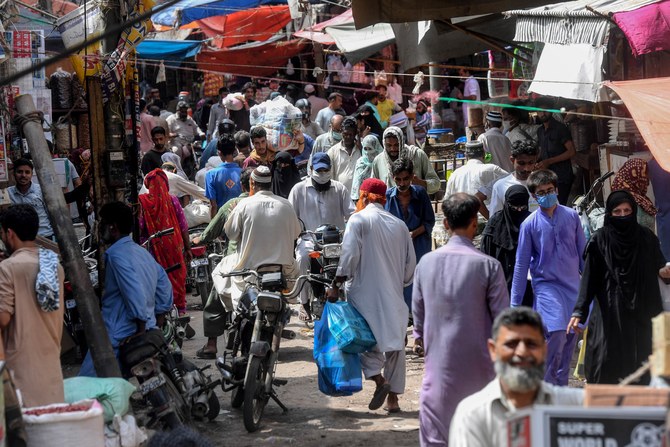
Residents shop at a wholesale market in Karachi, Pakistan on June 10, 2020. (AFP photo)
Short Url
Updated 21 July 2020
Follow

‘Rapidly’ growing population puts strain on Pakistan’s water, natural resources 

  • Pakistan’s population is growing rapidly with an annual fertility rate of 3.6 children per couple, a world population report says
  • Experts fear Pakistan could face acute shortage of water and food if population growth not controlled through government intervention 

ISLAMABAD: Pakistan’s total population is estimated at 220.9 million and is growing ‘rapidly’ with an annual fertility rate of 3.6 children per couple, a world population report has said, raising concern among experts this week of the effect of this on the country’s natural resources, food and water.
The 2020 World Population Data Sheet released by the US Population Reference Bureau on July 11 predicted Pakistan’s population would be 287.2 million by mid-2035 and 347.8 million by mid-2050. 
“It is a threat to Pakistan’s economic situation,” Dr. Nuzhat Khan, a public health practitioner, told Arab News on Monday, commenting on the report’s predictions, and adding that without government intervention, the country would face a shortage of housing, water and food.

“We will be starved. We won’t have enough food to feed everyone,” Khan said. 
She suggested that the government involve religious leaders to help raise awareness about family planning. “This is a very religious country and people go to the religious leaders for advice, and their help can bring a positive change,” Khan said. 
At the current rate, Pakistan’s annual population grows by an average of more than five million newborn babies per year. The government says it plans to bring this down to 1.1 percent, with the average addition of 2.3 million on an annual basis.

Dr. Shahid Hanif, director-general of the government’s Population Program Wing, said the government already had an effective population planning program in place. 
“We do know that we will be able to better utilize our resources with a manageable population, so we are focusing on dealing with this challenge,” he said.
Dr. Zeba Sathar, Pakistan’s country-director of the Population Council, said Pakistan was facing myriad problems due to the “population explosion.”
“We aren’t only eating out actual resources like forests and water, but an issue of food security is also emerging,” she said, urging the nation “to balance our resources” to meet the challenge.

“If the policy was clear like in many other Muslim and South Asian countries, if that was in place, the results would have been much different,” Sathar said. “A strong voluntary family planning program is virtually absent in Pakistan.”
More than a third of Pakistan’s population faces food insecurity, according to the World Food Programme. 

At least one killed, nine injured in IED blast in northwestern Pakistan

Updated 05 January 2026
Follow

At least one killed, nine injured in IED blast in northwestern Pakistan

  • Blast takes place near vehicle carrying employees of Lucky Cement factory in Lakki Marwat district, say police
  • No group has claimed responsibility for IED blast as Khyber Pakhtunkhwa police launch probe into the incident

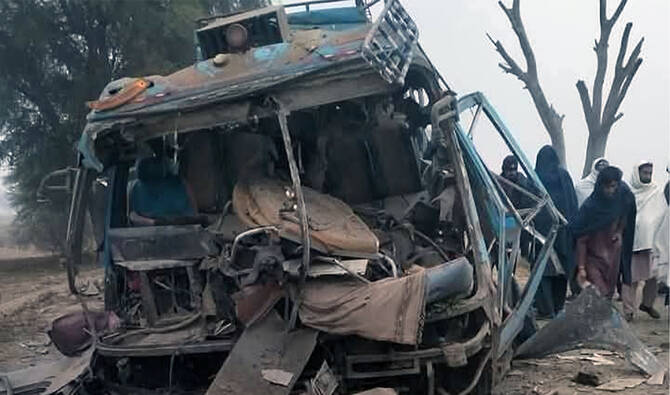
PESHAWAR: At least one person was killed and nine others were injured in Pakistan’s northwestern Lakki Marwat district on Monday after an improvised explosive device (IED) blast occurred near a vehicle transporting employees of a cement factory, a police official said.

Lakki Marwat police official Shahid Marwat told Arab News the blast took place on the district’s Begu Khel Road at around 6:30 a.m. The explosion occurred near a vehicle carrying employees of the Lucky Cement factory located in the district, he said.

“Initial investigations suggest the device had been planted by militants,” Marwat said. “A rapid police response force was immediately deployed to the scene to evacuate the dead and wounded, secure the area and collect evidence.”

The police officer said several victims were in critical condition and were referred for treatment to the nearby Bannu district, adding that all those affected by the blast were residents of Begu Khel village.

He said police had launched an investigation into the incident.

No group has so far claimed responsibility for the attack. However, the Pakistani Taliban, or the Tehreek-e-Taliban Pakistan (TTP), have claimed responsibility for similar attacks in the past against Pakistani law enforcers and civilians in the province.

The TTP has carried out some of the deadliest attacks against Pakistani law enforcers since 2008 in its bid to impose its own brand of strict Islamic law across the country.

The attack comes as Pakistan struggles to contain a sharp surge in militant violence in recent months. According to statistics released last month by the Pakistan Institute for Conflict and Security Studies (PICSS), combat-related deaths in 2025 rose by 73 percent to 3,387, compared with 1,950 deaths in 2024.

These deaths included 2,115 militants, 664 security forces personnel, 580 civilians, and 28 members of pro-government peace committees, the think tank said. Most of the attacks took place in Khyber Pakhtunkhwa’s Pashtun-majority districts and southwestern Balochistan province, the PICSS noted.

On Sunday, three traffic police officials were shot dead by unidentified gunmen in Lakki Marwat district. No group claimed responsibility for the incident.

Islamabad accuses the Afghan government of harboring militants who launch attacks against Pakistan, a charge Kabul repeatedly denies. The surge in militant attacks in Pakistan has strained ties between the two neighbors, with Islamabad urging Kabul to take steps to dismantle militant outfits allegedly operating from its soil.