

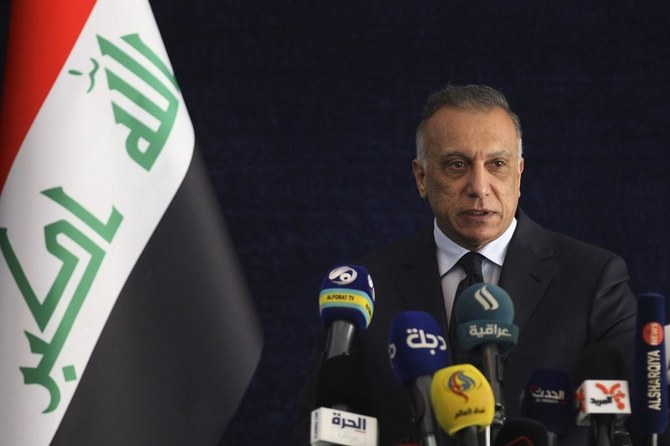
Iraqi PM’s visit to be rescheduled after King Salman’s recovery
‘Our wise leadership in coordination with our brothers in Iraq has decided to postpone the visit’
Updated 21 July 2020
Arab News
JEDDAH: The visit of Iraqi Prime Minister Mustafa Al-Kadhimi to Saudi Arabia has been postponed after the hospitalization of King Salman on Monday.
The king was admitted to the King Faisal Specialist Hospital in Riyadh for some tests due to cholecystitis (inflammation in the gallbladder), the royal court said in a statement.
“In recognition of the importance of the visit and a desire to make it succeed, our wise leadership in coordination with our brothers in Iraq has decided to postpone the visit,” Saudi Foreign Minister Prince Faisal bin Farhan wrote on Twitter.
The visit will be rescheduled after King Salman is discharged from hospital, he said.
In a tweet, Saudi Deputy Minister of Defense Prince Khalid bin Salman said Saudi Arabia and Iraq were both strategically important to each other.
“Iraq represents an important strategic dimension to the Kingdom and vice versa.”
تقدر المملكة اختيار رئيس الوزراء العراقي زيارتها كأول دولة بعد توليه منصبه، واحتفاءاً بهذه الزيارة البالغة الأهمية ورغبة في توفير كل سبل النجاح لها، آثرت قيادتنا الرشيدة، بالتنسيق مع أشقائنا في العراق، تأجيل الزيارة إلى ما بعد خروج مولاي خادم الحرمين الشريفين من المستشفى
He added: “It was therefore, natural for Riyadh to be the first stop in (Iraqi Prime Minister) Mustafa Al-Kadhimi’s foreign visits,” he added.
Highlighting the importance of Saudi-Iraqi ties, Culture Minister Prince Badr bin Abdullah bin Farhan said the two countries share common history, culture and civilization.
Despite the postponement of the Iraqi prime minister’s visit to Saudi Arabia, he added, the visiting Iraqi delegation is holding meetings with their Saudi counterparts to enhance ties. Saudi Arabia and Iraq signed investment agreements on energy and sports, the Kingdom’s state TV reported on Monday.
Despite the postponement of the visit, the Iraqi delegation is holding meetings with their Saudi counterparts to enhance ties.
Prince Badr bin Abdullah bin Farhan, Culture minister
The agreements were signed as part of the meetings of the Saudi-Iraqi Coordination Council. They also inked deals on investment and education. The two sides also signed a memorandum in the health sector to fight the coronavirus pandemic.
Meanwhile, the Iraqi prime minister tweeted: “I wish King Salman a speedy recovery and look forward to seeing him at the earliest possible time, as we’ll reschedule my visit soon.”
He added: “Iraq’s relations with KSA are strong and based on mutual strategic interests and brotherly ties. I’m optimistic about the potential and future of our ties.”
Iraq’s oil, finance, electricity and planning ministers arrived in Saudi Arabia on Sunday to begin meetings ahead of the premier’s visit.
يمثل العراق بعدًا استراتيجيًا هاماً للمملكة والعكس؛لذلك كان طبيعيًا أن تحل الرياض محطةً أولى في جدول زيارات السيد مصطفى الكاظمي،وقد آثرت قيادة البلدين تأجيلها إلى ما بعد خروج مولاي خادم الحرمين حفظه الله من المستشفى لمنحها المكانة اللائقة التي تستحقها كزيارة دولة من الطراز الرفيع
— Khalid bin Salman خالد بن سلمان (@kbsalsaud) July 20, 2020
Saudi women-led publisher Khunfus is a love letter to print
Debut title ‘Book of Rajab’ is ode to older generations of Saudi Arabia, illustrated by Palestinian Spanish artist
Founded by sisters and longtime friend, publisher is powered by collaboration, community
Bringing text, visuals, heritage, Saudi publisher is part of generation treating books as cultural artifacts
Updated 8 sec ago
Sumaiyya Naseem
JEDDAH: In a digital era when the future of print is often declared obsolete, three young Saudi women are returning to books as works of art and storytelling. They insist that stories still deserve paper, ink and the unhurried attention of the curious mind.
Khunfus, a women-led publishing house founded by sisters Maria and Lama Alem alongside their longtime friend Haya Bakhashab, was launched in 2025 in the belief that books can be both cultural artifacts and storytelling vessels. And so, the story began with a shared love of literary experiences and, of course, beetles.
“Khunfus, or beetles, is from a folk story we grew up hearing from our grandmother. It embodies something warm, and we wanted to infuse that feeling into the publishing house,” Maria, who joined our group via video call from Riyadh, told Arab News.
Khunfus founders with collaborators Nouf Al-Harthi (Arabic writer), Nader Sharaf (illustrator), and Sein Studio (book designers) at the ‘Book of Rajab’ launch at the Islamic Arts Biennale. (Supplied)
“It’s about being inspired by local culture,” Lama, who is based in Jeddah, added. “It’s not an exotic animal; it’s an everyday insect you can find in Saudi Arabia. It’s about finding the beauty in the mundane or the unexpected.”
The name is also a nod to the global tradition of wildlife as publishing house mascots.
“We all love books, we appreciate good design, and we love a good story,” Lama said about the shared passion that sparked the initiative.
Saudi Arabia, as any other country in the world, has the capacity of its people to express themselves through storytelling. The legacy that it can contribute is enormous and inspiring.
Nader Sharaf, Palestinian Spanish illustrator of ‘Book of Rajab’
Khunfus emerged as a response to the familiar refrain that print is dying and the ink is running out. “We grew up hearing that people don’t read anymore, that print books have no future,” Maria said.
But what the young women actually noticed was not an absence of readers in the Kingdom, but a disconnect between disciplines. She explained: “We would find Arabic books that were so beautifully written but the design or the visual elements were not as strong. And then we’d find the opposite with incredible visuals without the same attention to text.”
‘Book of Rajab’ features illustrations by Nader Sharaf, a Palestinian Spanish artist based in Madrid. (Supplied)
Khunfus is bringing text and visuals together to create “a third thing … a holistic experience.”
Each founding member contributes a distinct sensibility to the team: Maria tends toward editing and structure; Lama anchors the literary core immersed in creative writing; and Haya oversees visuals, drawing on her background in graphic design and illustration.
They are firm believers in publishing. “We want diverse, different, contradicting and warring voices to overlap. The more, the better,” Maria added.
An illustration by Palestinian Spanish artist Nader Sharaf, featured in 'Book of Rajab.' (Supplied)
In a region where cultural projects are often framed through scale and spectacle, this publishing house is a close-knit endeavor that the founders believe “launched at the right time.” Saudi Arabia’s literary landscape is making room for fresh possibilities to join classic, established works on the shelves.
“Collaboration is central to our ethos,” she noted. “We lean into warmth and friendliness.” This extends to the community they are building around Khunfus, from consultants and creatives who respond to their open calls to private readings with friends while the books are still in progress.
“We see (community) as a big asset … something that you can’t cultivate without it happening organically and naturally,” she added. “We love working with different people, and we want to build a community of collaborators as well as readers.”
Khunfus’ debut title ‘Book of rajab’ is a collection of short stories illustrated by palestinian Spanish artist nader Sharaf. (Supplied)
A 2024 grant from King Abdulaziz Center for World Culture’s Ithra Content Initiative, in collaboration with the Cultural Development Fund, enabled Khunfus to complete production on their debut title “Book of Rajab” and their upcoming title “A Wild Companion.”
The Islamic Arts Biennale, where they debuted “Book of Rajab” last year, as well as the Diriyah Biennale Foundation’s Paperback Art Book Fair and Misk Art Book Fair in Riyadh, are among local cultural hubs that offered the team a welcoming stage to share their work, connect with readers, and build relationships with local and regional publishers.
“It’s more niche, young, upcoming, and less overwhelming than a large international book fair,” Maria said. “We were able to learn from people who are in our kind of place.”
Khunfus team at Focal Point Sharjar in 2025, an annual art book fair part of the Sharjah Art Foundation. (Supplied)
Support also came from established peers in the publishing industry such as Dar Arwa and Dar Waraqa who were “very generous with their advice,” Lama said. Within Saudi Arabia’s evolving publishing ecosystem, support from those who have experience can make a big difference for a new or indie publisher.
Khunfus’ philosophy of merging text and visuals finds its fullest expression in “Book of Rajab,” a collection of illustrated Arabic short stories, with an upcoming English edition, that resists easy categorization.
“It’s mythology, it’s archiving because we were illustrating things in Jeddah that no longer exist. It’s inspired by folklore, and talks about grief, so there’s an emotional arc to the book,” Maria said.
(Khunfus) is not an exotic animal; it’s an everyday insect you can find in Saudi Arabia. It’s about finding the beauty in the mundane or the unexpected.
Lama Alem, Khunfus cofounder
The stories were originally written by Lama, but the Arabic text was authored for the book by writer Nouf Al-Harthi who brought her own voice and poetic flair to the work.
“Since it’s our first title as Khunfus, we wanted to center Arabic,” Lama explained. “We looked for someone who could give Arabic justice because it is such a beautiful, rich language.”
The stories unfold across a single day, the first of the month of Rajab, “when the city turns a bit magical.” The seventh month of the Hijri calendar was once used as a placeholder birthdate for earlier generations in case of missing documentation.
Collaborators Maria Alem and Abdulaziz Al-Johani discuss plants featured in the upcoming title 'A Wild Companion' at the PaperBack Art Book Fair in Riyadh. (Supplied)
“The book is an ode to that generation and the relationship between that generation and ours,” Lama said, noting that the stories are colored with surrealism and magic and “tiny elements that celebrate everyday life in Jeddah.” It also explores themes like legacy, intergenerational inheritances, and the changing city.
The timeline of the stories moves from morning to the following dawn, guided visually by shifts in light. To bring this world into being, they added dreamlike illustrations by Nader Sharaf, a Palestinian Spanish artist based in Madrid.
Never having been to the coastal city before, he was initially doubtful about getting on board. But with the right team, anything is possible, and the process that followed was rooted in trust and collaboration.
“They took my hand and went with me along this path,” Sharaf said, describing how the team introduced him to “Jeddah’s idiosyncrasies and particular cultural elements” through an archive of photos and their own experiences.
“We took it story by story,” Maria added. Sometimes text was removed to allow illustration to speak; at other times, the visuals receded to allow the reader’s imagination to flourish.
“Not all publishing houses give you the opportunity to dive into a universe that is so different from yours,” the artist added. “Here it has been a really good bridge between two worlds.”
One story, about a man buying a watermelon, became emblematic for the project and its creators. “The man’s knocking on the watermelon and listening in to check if it is good or not was a surprising bridge between Nader’s background and ours,” Maria said.
What followed was experimentation, with Sharaf suggesting visualizing seeds as musical notes. The Khunfus team shared videos of Saudi folkloric group dances to create a visual that was culturally informed for a work set in Jeddah.
In recognition of his illustrious efforts, Sharaf was named a finalist in Madrid’s prestigious Professional Association of Illustrators’ awards.
Being shortlisted alongside established Spanish illustrators for the story has been a “remarkable” moment in his career as an artist. It also speaks to the power of stories to make new connections and cross borders.
“To me it was a confirmation that it doesn’t matter where you are from or what you are writing about,” he said. “Your stories will reach everybody if they are written from your heart, about your culture.”
Khunfus’ next major project, “A Wild Companion,” is in the pipeline and slated for release in the near future. It expands the vision from Jeddah to the wider Saudi landscape in a series of books about the flora and fauna of the Kingdom.
The first book explores 101 species found on the Sarawat and Hijaz mountains. Maria wrote the work collaboratively with Abdulaziz Al-Johani, and with support from local botanists and consultants, including Mohammad Alawfi and Usama Al-Ghazali.
“It’s not scientific writing; it’s poetry, storytelling, recipes, and music,” she said, noting that it also includes works from 20 regional creatives. The series is bilingual and will continue with titles on marine life, urban flora and fauna, deserts, and oases.
Throughout its work, Khunfus resists the pressure to speak for everyone. Stories rooted in culture and heritage do not intend to stand for everyone’s experience of Jeddah or the Kingdom.
“For me, it’s about not just documenting (and preserving) culture but creating something new from it,” Lama said. “It is something that’s alive and changing.”
For Sharaf, the commitment to fiction and storytelling carries national significance. He said: “Fiction represents and defines what a nation craves for, what a nation dreams of.
“Saudi Arabia, as any other country in the world, has the capacity of its people to express themselves through storytelling.
“The legacy that it can contribute is enormous and inspiring.”