

Four men arrested for destroying newly unearthed Buddha statue in northwestern Pakistan

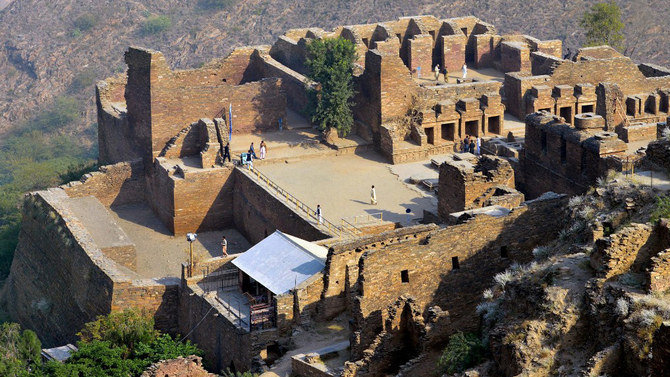
In this photograph taken on Nov. 16, 2012 tourists visit the monastery of Takht Bahi in northwestern Khyber Pakhtunkhawa province. Takht Bahi is an archaeological site listed as a UNESCO World Heritage Site. (AFP)
Short Url
Updated 19 July 2020
Follow

Four men arrested for destroying newly unearthed Buddha statue in northwestern Pakistan

  • Takht Bahi residents say the statue is believed to be between 1,700 and 1,800 years old
  • The area known for a Buddhist monastery from the first century CE is listed as a UNESCO World Heritage Site

PESHAWAR: Police in northwestern Khyber Pakhtunkhwa province on Saturday arrested four men accused of destroying an ancient statue of Buddha that was unearthed hours earlier near a UNESCO World Heritage Site, officials said.

The human-size statue was discovered when a contractor and three laborers were digging the foundations of a house in Takht Bahi, Mardan district, on Saturday morning. Takht Bahi is an archaeological site of a Buddhist monastery from the first century CE. The men were arrested after a video showing one of them breaking the sculpture with a sledgehammer went viral on social media.

"Police have detained the contractor and three laborers," Bakht Muhammad from the provincial archeology department told Arab News, "Soon after discovering the statue during the digging, the house owner and other people decided on the spot to smash the statue into pieces to earn God's blessing."

He said members of the archeology department went to the site when they noticed the video and immediately filed a police report.

"Protection and preservation of Buddhist sites is of topmost priority of the provincial government because thousands of Buddhist pilgrims from China, Thailand and South Korea visit their sacred sites every year," he added.

According to the local administration's estimates, the province has more than 1,000 ancient heritage sites of historical and religious importance.

Takht Bahi resident Muhammad Zaman said hundreds of people visit the Buddhist site every week.

"This act of breaking the Buddhist statue indicates how a section of our society is insensitive towards the importance of cultural heritage. It also depicts religious intolerance. The statue that was smashed is believed to be between 1,700 and 1,800 years old." 

Dr. Abdul Azeem, archeology director at the Department of Archeology and Museums in Islamabad, referred to the incident as an act of vandalism stemming from ignorance.

"This act of vandalism is barbaric. But at the same time, we need to educate our people and create awareness among them about the importance of artifacts," he said.

In January last year, the government of Khyber Pakhtunkhwa announced it had devised a multi-pronged strategy to revive and refurbish the tourism sector in the province and preserve the region's Buddhist sites of the ancient Gandhara civilization.


Pakistan says multilateralism in peril, urges global powers to prioritize diplomacy over confrontation

Updated 8 sec ago
Follow

Pakistan says multilateralism in peril, urges global powers to prioritize diplomacy over confrontation

  • The country tells the UN international security system is eroding, asks rival blocs to return to dialogue
  • It emphasizes lowering of international tensions, rebuilding of channels of communication among states

ISLAMABAD: Pakistan warned the world community on Monday that multilateralism was “in peril” amid rising global tensions, urging major powers to revive diplomacy and dialogue to prevent a further breakdown in international security.

Speaking at a UN Security Council briefing, Pakistan’s ambassador to the UN, Asim Iftikhar Ahmad, said the world was drifting toward confrontation at a time when cooperative mechanisms were weakening.

His comments came during a session addressed by Finland’s foreign minister Elina Valtonen, chairing the Organization for Security and Co-operation in Europe (OSCE), the world’s largest regional security body.

Formed out of the 1975 Helsinki Final Act, the OSCE was designed during the Cold War to reduce tensions, uphold principles of sovereignty and human rights and promote mechanisms for peaceful dispute resolution.

“Today, the foundational ethos of international relations, multilateralism, cooperation and indivisible security, as envisaged in the preamble of Helsinki Final Act, is perhaps facing its biggest challenge in decades,” Ahmed said. “The OSCE, too, is navigating a difficult geopolitical landscape, with conflict raging in the heart of Europe for nearly four years, depletion of trust and unprecedented strains on peaceful co-existence.”

He said a return to the “Helsinki spirit” of dialogue, confidence-building and cooperative security was urgently needed, not only in Europe but globally.

“This is not a matter of choice but a strategic imperative to lower tensions, rebuild essential channels of communication, and demonstrate that comprehensive security is best preserved through cooperative instruments, and not by the pursuit of hegemony and domination through military means,” he said. “Objective, inclusive, impartial, and principle-based approaches are indispensable for success.”

Ahmed’s statement came in a year when Pakistan itself fought a brief but intense war after India launched missile strikes at its city in May following a militant attack in Indian-administered Kashmir. New Delhi blamed Pakistan for the assault, an allegation Islamabad denied while calling for a transparent international investigation.

The Pakistani diplomat said the international system was increasingly defined by bloc politics, mistrust and militarization, warning that such trends undermine both regional stability and the authority of multilateral institutions, including the UN itself.

He urged member states to invest more in preventive diplomacy and the peaceful settlement of disputes as reaffirmed by the Council in Resolution 2788.

Ahmad said Pakistan hoped the OSCE would continue reinforcing models of cooperative security and that the Security Council would back partnerships that strengthen international law and the credibility of multilateral frameworks.

The path forward, he added, required “choosing cooperation over confrontation, dialogue over division, and inclusive security over bloc-based divides.”