

Police say 'terrorist attack' foiled after major arrests in Karachi

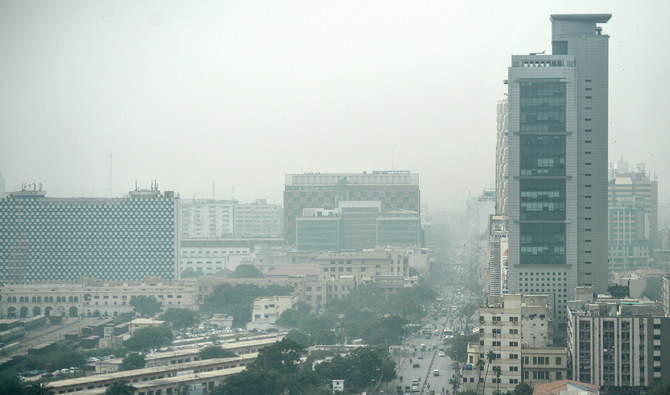
This photograph taken on Nov. 14, 2019 shows a general view of Pakistan's port city of Karachi. (AFP/File)
Short Url
Updated 19 July 2020
Follow

Police say 'terrorist attack' foiled after major arrests in Karachi

  • Police say six arrested men are associated with the Baloch Liberation Army (BLA), which claimed responsibility for last month's attack on Pakistan Stock Exchange
  • The suspects have reportedly confessed to having carried out assaults against security forces in different parts of Balochistan

KARACHI: Police on Saturday said they had arrested six militants associated with Baloch separatist groups and have foiled a “major terrorism bid” in Karachi.
“On Friday, the police and intelligence agencies in a joint operation arrested six dangerous terrorists associated with the separatist organization BRAS, who were planning a major terrorist attack in Karachi,” Senior Superintendent of Police Fida Hussain told reporters in Karachi.
He said the men have been identified as Sher Khan, Kareem Bux alias Gul, Dilshad, Moran Khan, Durr Khan and Ameer Bux, and confessed to having carried out attacks on the army, paramilitary Frontier Corps and levies in different parts of Balochistan.
He added that heavy weapons, including launchers, grenades and an improvised explosive device (IED) were seized from the suspects.
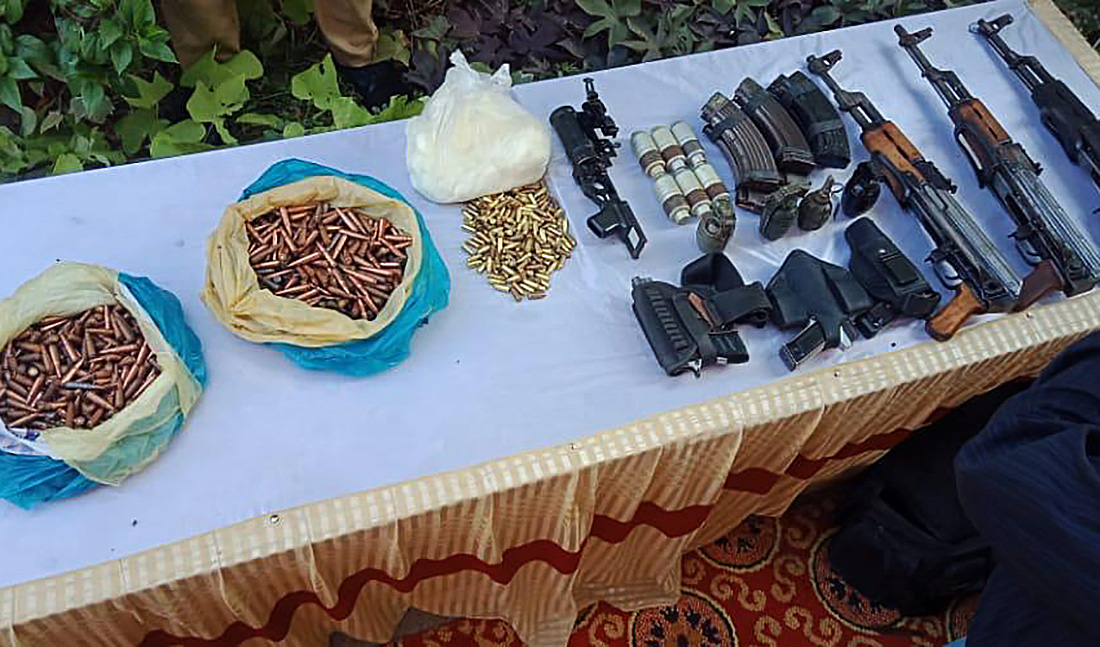


In this photo released by police on Saturday, officers in Karachi present heavy weapons seized from six militants arrested in Karachi on Friday, July 17, 2020. (Photo courtesy: Karachi Police)

Law enforcement agencies, Hussain said, have been actively pursuing the separatist network after last month’s attack on the Pakistan Stock Exchange in Karachi, for which the Baloch Liberation Army (BLA), a component of BRAS, claimed responsibility.
According to Hussain, evidence has been found that “hostile intelligence agencies” were using the separatist groups to “sabotage” the China-Pakistan Economic Corridor infrastructure project.
BRAS is a collation of four Baloch separatist groups: BLA, Balochistan Liberation Front (BLF), Baloch Republican Army (BRA) and Baloch Republican Guards (BRG). 
It was established in November 2018 to launch coordinated attacks against the Pakistani military, Chinese interests in Balochistan and CPEC sites. The group had claimed responsibility for an attack on a Chinese consulate and the murder of 14 security officials on a coastal highway last year.


In Peshawar, 76-year-old artist struggles to keep near-extinct Mughal wax art alive

Updated 4 sec ago
Follow

In Peshawar, 76-year-old artist struggles to keep near-extinct Mughal wax art alive

  • Craft involves intricate process using heated wax, oil, pigments, limestone to create textured, miniature artworks
  • Riaz Ahmad, who has trained his son in wax art, says he hopes to train more people to preserve traditional craft 

PESHAWAR: Riaz Ahmad, 76, stirs wax in a small plastic can with a long chopstick, takes it out on the palm of his left hand and adds natural color before drawing designs on a piece of cloth.

Surrounded by several such pieces of black cloth with unique art, Ahmad strives every passing day to keep the 500-year-old, Mughal-era wax art alive at his home near the Lahori Gate in the northwestern Pakistani city of Peshawar.

Ahmad comes from a well-known family of wax artists who were based in Shillong and Darjeeling in present-day India and had migrated to Peshawar during the 1947 partition of the sub-continent.

His work remains rooted in tradition, faithfully repeating patterns passed down through generations and winning Ahmad several awards both at home and abroad in recognition of his dedication.

“I have been making the same Mughal era designs that my forefathers used to make,” he told Arab News last week.


“I went to India in 2004, where I received the UNESCO Seal of Excellence [for Handicrafts] award... On 23 March, 2012, the Government of Pakistan awarded me the Tamgha-i-Imtiaz.”

The near-extinct traditional craft, which is believed to have originated in Central Asia and refined under the Mughal patronage, particularly in Peshawar, involves an intricate process using heated wax, linseed oil, powdered pigments, and limestone to create detailed, textured and often colorful miniature artworks by hand.

Ahmad learnt wax art from his father, Miran Bakhsh, nearly six decades ago.

“My parents used to do this work in Shillong and Darjeeling [in present-day India]. They had a shop there, and after the Partition, they migrated to Peshawar, Pakistan,” he said. “When they came here, they started doing the same work.”

A basic piece of his work costs around Rs3,000 ($10.7). A larger piece made on order can fetch between Rs5,000 and Rs15,000 ($17-$53), but such orders are rare.

“Wax and colors have become expensive. When I sell a piece for Rs3,000, around Rs1,000 goes into expenses, and Rs2,000 is my daily wage,” Ahmad said.

But the 76-year-old worries more about the future of the art form, which he insists cannot be learned quickly and requires “love and dedication.”

“Some people say they want to come, some from Karachi and some from Lahore, but it becomes difficult for me to go there or for them to come here,” he said.

Most wax artists in Peshawar have abandoned the art due to a lack of institutional support, according to Ahmad, who relies primarily on exhibitions to earn a living.

“The reason [for the decline of this art form] is that the government does not pay attention. They are caught in their own conflicts, and the culture is suffering,” Ahmad said.

“Other artists have left this art. Some are selling rice and some are driving rickshaws,” he added. “I have been doing this work inside my house. If there is any event, we go there and sell our art.”

Saad Bin Awais, a spokesperson for the Khyber Pakhtunkhwa Culture and Tourism Authority (KPCTA), said the government has engaged artisans in several projects. He said some of these projects have come to an end while others are ongoing.

“Riaz Ahmad is the only wax artist in Khyber Pakhtunkhwa and the authority is serious about facilitating him,” he said, adding that the KPCTA facilitates Ahmad’s participation in exhibitions across the country to showcase his art.

“We have also been collecting data of artists in Khyber Pakhtunkhwa for an upcoming project to facilitate them in any way possible.”

Ahmad has trained his son, Fayyaz, in wax art who now practices it in Islamabad. The septuagenarian says he wishes to train more people to preserve the dying art form.

“I cannot leave this work,” he said. “I will continue this art even though my hands shake.”