

ACWA Power CEO sees downturn in energy prices from renewables

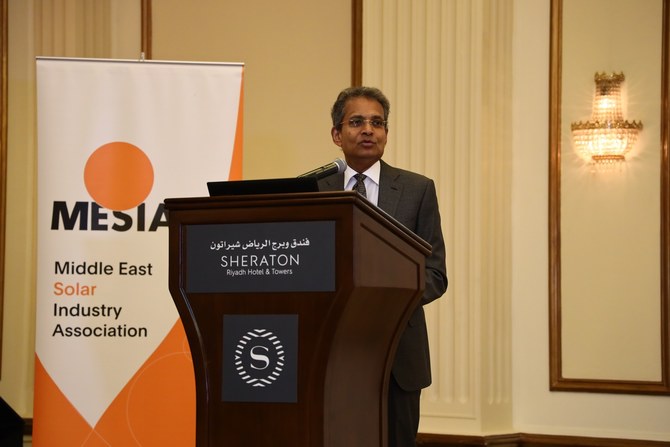
Paddy Padmanathan, president and CEO of ACWA Power, said that he sees a further decrease in prices of energy produced from renewable resources in the Kingdom. (Supplied)
Short Url
Updated 16 July 2020
Follow

ACWA Power CEO sees downturn in energy prices from renewables

  • ‘Competition drives innovation and entrepreneurship, which drives down cost, which in turn attracts more demand, which then brings more participants, which then drives costs further down’
  • ‘Let’s not forget, oil will still be needed in many tens of millions of barrels for a long time to come, because oil is used for much more than just transportation and industrial use’

RIYADH: Prices of energy generated from renewables are expected to witness a continuous decrease in the region in the coming years, according to officials in a renewable firm and investment banks.

Paddy Padmanathan, president and CEO of ACWA Power, a leading renewables firm in the region, said in the virtual BMG Economic Forum on Wednesday that he sees a further decrease in prices of energy produced from renewable resources in the Kingdom.

“Competition brings the best out of the private sector, and what happened in solar and wind energy is one of many examples in this respect. Competition drives innovation and entrepreneurship, which drives down cost, which in turn attracts more demand, which then brings more participants, which then drives costs further down,” Padmanathan said.

He added that the massive decrease in the cost of generating power out of renewables can be attributed to the decrease in capital expenditures due to the advance of technology, the reduction of maintenance and operation cost due to the deployment of robots and improving efficiencies of panels and materials used, and finally the reduction of financing costs in light of negative interest rates in many countries worldwide.

“We’re able to deliver solar and wind energy at less than 2 cents per kilowatt in countries like Saudi Arabia and the UAE, and even in countries with more critical challenges like Egypt and Ethiopia to below 0.5 cents per kilowatt,” Padmanathan said.

Richad Soundardjee, CEO of Societe Generale Middle East, said although there is an increasing shift toward and demand for renewable energy globally, reaching the goal of a total transformation toward renewables is still far away.

“Energy transformation is much more complex than just to say let’s drop oil and move to renewables, or let’s change all the petrol cars to electric cars, because … this is the end of the game, but how we get there is really what matters,” he added.

Padmanathan said Saudi Arabia, which has the lowest cost of producing oil, is well positioned to continue supplying the demand for oil that will continue to be needed.

He added that the Kingdom is now on the frontline of the Oil to Chemical (OTC) project that will help in the journey of energy transformation.

“Let’s not forget, oil will still be needed in many tens of millions of barrels for a long time to come, because oil is used for much more than just transportation and industrial use,” he said.

“There are, I think, a list of more than 142 products, starting from lipsticks all the way to medicines … The reality is that there will still be demand for a significant amount of oil going forward.”


Closing Bell: Saudi stocks slip as Tadawul falls 1% amid broad market weakness

Updated 30 December 2025
Follow

Closing Bell: Saudi stocks slip as Tadawul falls 1% amid broad market weakness

RIYADH: Saudi stocks fell sharply on Tuesday, with the Tadawul All Share Index closing down 108.14 points, or 1.03 percent, at 10,381.51.

The broader decline was reflected across major indices. The MSCI Tadawul 30 Index slipped 0.78 percent to 1,378.00, while Nomu, the parallel market index, fell 1 percent to 23,040.79.

Market breadth was strongly negative on the main board, with 237 stocks falling compared to just 24 gainers. Trading activity remained robust, with 164.7 million shares changing hands and a total traded value of SR3.19 billion ($850.6 million).

Among the gainers, SEDCO Capital REIT Fund led, rising 2.73 percent to SR6.77, followed by Chubb Arabia Cooperative Insurance Co., which gained 2.69 percent to SR20.20.

National Medical Care Co. added 1.72 percent to close at SR141.60, while Alyamamah Steel Industries Co. and Thimar Advertising, Public Relations and Marketing Co. advanced 1.57 percent and 1.13 percent, respectively.

Losses were led by Al Masar Al Shamil Education Co., which tumbled 8.36 percent to SR24.65. Raoom Trading Co.fell 6.75 percent to SR64.20, while Alkhaleej Training and Education Co. dropped 6.60 percent to SR18.12 and Naqi Water Co. declined 5.51 percent to SR54.00. Gulf General Cooperative Insurance Co. closed 5.44 percent lower at SR3.65.

On the announcement front, Chubb Arabia Cooperative Insurance Co. signed a multiyear insurance agreement with Saudi Electricity Co. to provide various coverages, expected to positively impact its financial results over the 2025–2026 period. The deal will run for three years and two months and is within the company’s normal course of business.

Meanwhile, Bupa Arabia for Cooperative Insurance Co. announced a one-year health insurance contract with Saudi National Bank, valued at SR330.2 million, covering the bank’s employees and their families from January 2026. Despite the sizable contract, Bupa Arabia shares fell 0.8 percent to close at SR137, weighed down by the broader market weakness.

In contrast, United Cooperative Assurance Co. revealed an extension of its engineering insurance agreement with Saudi Binladin Group for the Grand Mosque expansion in Makkah. The contract value exceeds 20 percent of the company’s gross written premiums based on its latest audited financials and is expected to support results through 2026. However, the stock came under selling pressure, ending the session down 4.51 percent at SR3.39.