

UN report: Qatar’s migrant workers face ‘structural racism’

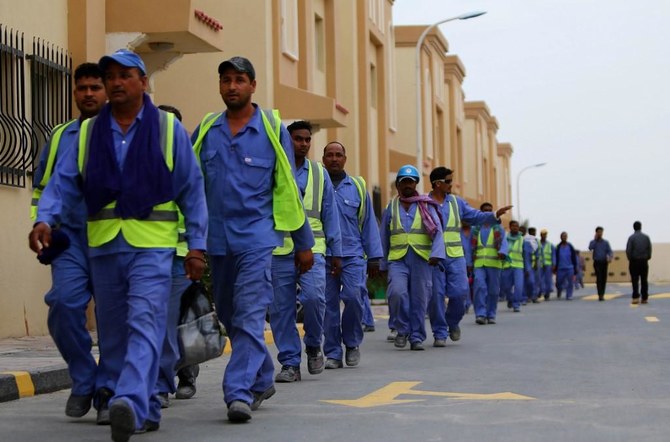
The UN has highlighted “serious concerns of structural racial discrimination against non-nationals” in Qatar in a damning report. (File/AFP)
Short Url
Updated 16 July 2020
Follow

UN report: Qatar’s migrant workers face ‘structural racism’

  • The report says there is a “de facto caste system based on national origin” in Qatar
  • Low-income workers continue to suffer severe discrimination and exploitation

LONDON: The United Nations has highlighted “serious concerns of structural racial discrimination against non-nationals” in Qatar in a damning report that will be presented to the UN human rights council.
The report says there is a “de facto caste system based on national origin” in Qatar, “according to which European, North American, Australian and Arab nationalities systematically enjoy greater human rights protections than south Asian and sub-Saharan African nationalities,” The Guardian reported.

Approximately 2 million migrant workers are employed in Qatar, the vast majority of them low-income laborers from South Asia and East and West Africa.
Although 18,500 are currently building World Cup 2022 stadiums, tens of thousands more are employed on projects linked to the event, including in the construction, hospitality and security sectors, the British newspaper reported.
The UN special rapporteur on racism, Tendayi Achiume, who wrote the report, said Qatar “needs to do more in the light of the persistent complex challenges that undermine its compliance with its international obligations.”
Low-income workers continue to suffer severe discrimination and exploitation, the report said.
Violations of human rights include unsafe working conditions, racial profiling by police, and denial of access to some public spaces.
Many low-income workers are too afraid to seek justice for labor violations due to the “imbalances rooted in the kafala (sponsorship) system,” and workers who flee abusive employers are deemed to be “absconding,” the report said.
Workers are unable to change jobs without their employer’s permission under the sponsorship system.
Plans to abolish it, announced by Qatari authorities in October 2019, have failed to materialize.
Qatar’s government canceled a visit by the UN special rapporteur on slavery that was scheduled for January, soon after the preliminary findings of the report were published.
FIFA, the international football governing body that awarded the World Cup to Qatar in 2010, failed to acknowledge the racial discrimination described by Achiume in a statement to The Guardian.
FIFA said it is working with its partners toward “an inclusive tournament experience for all and a firm stance against discrimination of any kind.”


Netanyahu says Israel and Hamas will enter ceasefire’s second phase soon

Updated 08 December 2025
Follow

Netanyahu says Israel and Hamas will enter ceasefire’s second phase soon

  • Says the second phase addresses the disarming of Hamas and withdrawal of Israeli troops from Gaza
  • Second stage also includes the deployment of an international force to secure Gaza and forming a temporary Palestinian government

TEL AVIV, Israel: Israeli Prime Minister Benjamin Netanyahu said Sunday that Israel and Hamas are “very shortly expected to move into the second phase of the ceasefire,” after Hamas returns the remains of the last hostage held in Gaza.
Netanyahu spoke during a news conference with visiting German Chancellor Friedrich Merz and stressed that the second phase, which addresses the disarming of Hamas and the withdrawal of Israeli troops from Gaza, could begin as soon as the end of the month.
Hamas has yet to hand over the remains of Ran Gvili, a 24-year-old police officer who was killed in the Hamas-led Oct. 7, 2023, attack that sparked the war. His body was taken to Gaza.
The ceasefire’s second stage also includes the deployment of an international force to secure Gaza and forming a temporary Palestinian government to run day-to-day affairs under the supervision of an international board led by US President Donald Trump.
A senior Hamas official on Sunday told The Associated Press the group is ready to discuss “freezing or storing or laying down” its weapons as part of the ceasefire in a possible approach to one of the most difficult issues ahead.

Netanyahu says second phase will be challenging
Netanyahu said few people believed the ceasefire’s first stage could be achieved, and the second phase is just as challenging.
“As I mentioned to the chancellor, there’s a third phase, and that is to deradicalize Gaza, something that also people believed was impossible. But it was done in Germany, it was done in Japan, it was done in the Gulf States. It can be done in Gaza, too, but of course Hamas has to be dismantled,” he said.
The return of Gvili’s remains — and Israel’s return of 15 bodies of Palestinians in exchange — would complete the first phase of Trump’s 20-point ceasefire plan.
Hamas says it has not been able to reach all remains because they are buried under rubble left by Israel’s two-year offensive in Gaza. Israel has accused the militants of stalling and threatened to resume military operations or withhold humanitarian aid if all remains are not returned.
A group of families of hostages said in a statement that “we cannot advance to the next phase before Ran Gvili returns home.”
Meanwhile, Israeli military Chief of Staff Lt. Gen. Eyal Zamir on Sunday called the so-called Yellow Line that divides the Israeli-controlled majority of Gaza from the rest of the territory a “new border.”
“We have operational control over extensive parts of the Gaza Strip and we will remain on those defense lines,” Zamir said. “The Yellow Line is a new border line, serving as a forward defensive line for our communities and a line of operational activity.”
Germany says support for Israel is unchanged
Merz said Germany, one of Israel’s closest allies, is assisting with the implementation of the second phase by sending officers and diplomats to a US-led civilian and military coordination center in southern Israel, and by sending humanitarian aid to Gaza.
The chancellor also said Germany still believes that a two-state-solution is the best possible option but that “the German federal government remains of the opinion that recognition of a Palestinian state can only come at the end of such a process, not at the beginning.”
The US-drafted plan for Gaza leaves the door open to Palestinian independence. Netanyahu has long asserted that creating a Palestinian state would reward Hamas and eventually lead to an even larger Hamas-run state on Israel’s borders.
Netanyahu also said that while he would like to visit Germany, he hasn’t planned a diplomatic trip because he is concerned about an arrest warrant issued by the International Criminal Court, the UN’s top war crimes court, last year in connection with the war in Gaza.
Merz said there are currently no plans for a visit but he may invite Netanyahu in the future. He added that he is not aware of future sanctions against Israel from the European Union nor any plans to renew German bans on military exports to Israel.
Germany had a temporary ban on exporting military equipment to Israel, which was lifted after the ceasefire began on Oct. 10.
Israel kills militant in Gaza
The Israeli military said it killed a militant who approached its troops across the Yellow Line.
Gaza’s Health Ministry says Israeli forces have killed more than 370 Palestinians since the start of the ceasefire, and that the bodies of six people killed in attacks had been brought to local hospitals over the past 24 hours.
In the original Hamas-led attack in 2023, the militants killed around 1,200 people and took more than 250 others hostage. Almost all the hostages or their remains have been returned in ceasefires or other deals.
Israel’s offensive in Gaza has killed at least 70,360 Palestinians, according to Gaza’s Health Ministry, which operates under the Hamas-run government. The ministry does not differentiate between civilians and combatants, but says that nearly half the dead have been women and children. The ministry is part of Gaza’s Hamas government and its numbers are considered reliable by the UN and other international bodies.