PARIS: Nurses in white coats replaced uniformed soldiers as stars of France’s Bastille Day ceremonies Tuesday as the usual grandiose military parade was recalibrated to honor medics who died fighting COVID-19, supermarket cashiers, postal workers and other heroes of the pandemic.
With tears in their eyes or smiles on their faces, medical workers stood silently as lengthy applause rang out over the Place de la Concorde in central Paris from President Emmanuel Macron, the head of the World Health Organization and 2,000 other guests. A military choir sang the Marseillaise national anthem, and troops unfurled an enormous French tricolor flag across the plaza.
For some, the national homage is not nearly enough to make up for the equipment and staff shortages that plagued public hospitals as the virus raced across France, claiming more than 30,000 lives. Activists sent a banner above the ceremony tied to balloons reading: “Behind the tributes, Macron is suffocating hospitals.”
This year’s commemoration also paid homage to former President Charles de Gaulle, 80 years after the historic appeal he made to opponents of France’s Nazi occupiers that gave birth to the French Resistance.
But the battle against the virus was the main focus of the official event in central Paris, as Macron sought to highlight France’s successes in combating its worst crisis since World War II. Mirage and Rafale fighter jets painted the sky with blue-white-and-red smoke, and were joined by helicopters that had transported COVID-19 patients in distress.
Macron called the ceremony “the symbol of the commitment of an entire nation” and “the symbol of our resilience.”
The guests included nurses, doctors, supermarket and nursing home workers, mask makers, lab technicians, undertakers and others who kept France going during its strict nationwide lockdown. Families of medical workers who died with the virus also had a place in the stands.
“Exceptionally, this year, our armies ... will cede the primary place to the women and men in hospital coats who fought” the virus and who remain “ramparts in the crisis,” Macron said.
It was a Bastille Day unlike any other, as medics in jeans or sandals strolled onto the plaza for the climax of the ceremony, and the lengthy military parade was truncated into a smaller affair closed to the public to prevent new virus infections.
Masks were ubiquitous. Troops sported them as they got in formation, took them off for the ceremony, then put them on again when it was over. Macron made a point of donning his before speaking to WHO chief Tedros Ghebreyesus.
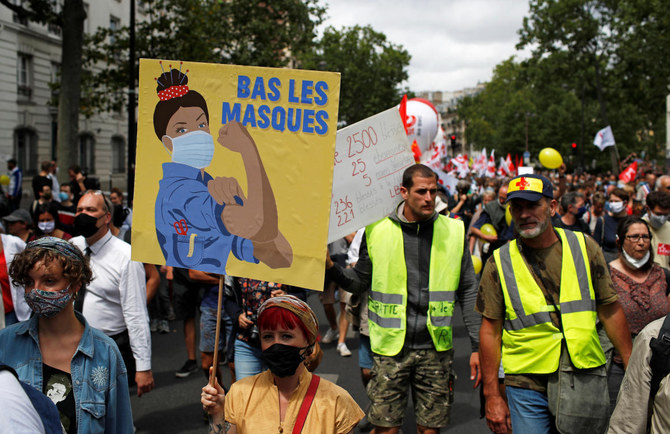
Across town from the Place de la Concorde, protesters plan to highlight France’s failures during the pandemic. Among those expected to demonstrate are medical workers who decried mask shortages and cost cuts that left one of the world’s best health care systems ill-prepared for the galloping spread of the virus.
The destination of their protest march wasn’t chosen by chance: They’re set to head to Bastille plaza, the former home of a royal prison that rebels stormed on July 14, 1789, symbolically marking the beginning of the French Revolution.
Tensions already erupted Monday night on the eve of the holiday, as troublemakers set off firecrackers and set a bus, a gym and dozens of vehicles on fire in the Paris region, according to the fire service.
Tuesday’s annual fireworks display over the Eiffel Tower will be largely restricted to television viewers only, since City Hall is closing off the heart of Paris, including embankments of the Seine and other neighborhoods where crowds usually gather on Bastille Day.
France has one of the world’s highest virus death tolls, and scientists are warning of a potential resurgence as people abandon social distancing practices, hold dance parties and head off on summer vacations.


![]()

France says ‘merci’ to virus heroes on poignant Bastille Day
Short Url
https://arab.news/6e8qb
France says ‘merci’ to virus heroes on poignant Bastille Day


Latest updates


© 2026 SAUDI RESEARCH & PUBLISHING COMPANY, All Rights Reserved And subject to Terms of Use Agreement.