

Emirates Mars Mission poised to fulfil Arab hopes and aspirations

1 / 5
2 / 5
3 / 5
4 / 5
5 / 5
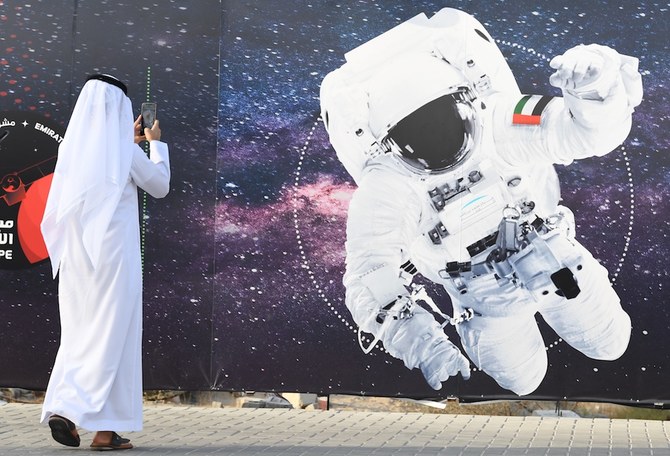
n this file photo taken on September 25, 2019 a man takes a picture of an illustration depicting an astronaut with the Emirati national flag outside Mohammed Bin Rashid Space Centre (MBRSC) in Dubai. (AFP/File Photo)
Short Url
Updated 09 February 2021
Follow

Emirates Mars Mission poised to fulfil Arab hopes and aspirations

  • First interplanetary expedition by an Arab country begins with the launch of the UAE Mars Mission
  • Historic moment to follow decades of preparations and hard work to achieve a vision set out by Sheikh Zayed

NOTE TO READERS:

This article has been updated to reflect a delay in the launch of the Hope Probe, which was originally scheduled at 00:51:27 a.m. UAE time on Wednesday.

DUBAI: Our fascination with space knows no bounds. A desire to unlock the secrets and mysteries of the universe has for decades encouraged nations to push the ever-advancing boundaries of scientific and technical knowledge as they strive to explore the unknown.

There have been a number of historic landmarks along the way, including the successful launch of the Sputnik 1 satellite in 1957, Yuri Gargarin’s orbit of the Earth in 1961, and the first Moon landing in 1969.

To this illustrious list we can now add the first interplanetary expedition by an Arab country, with the UAE launching on Monday the Emirates Mars Mission.

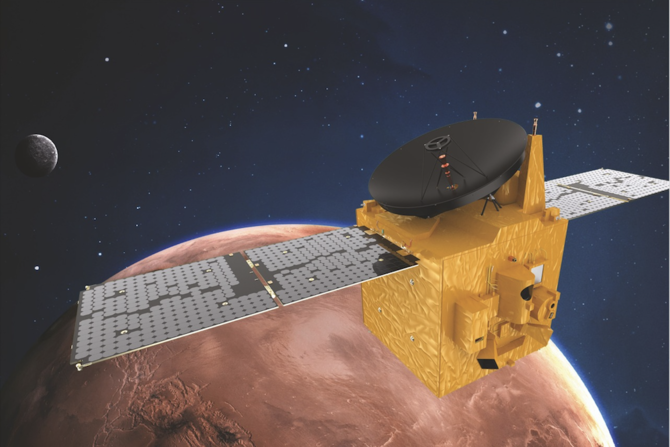
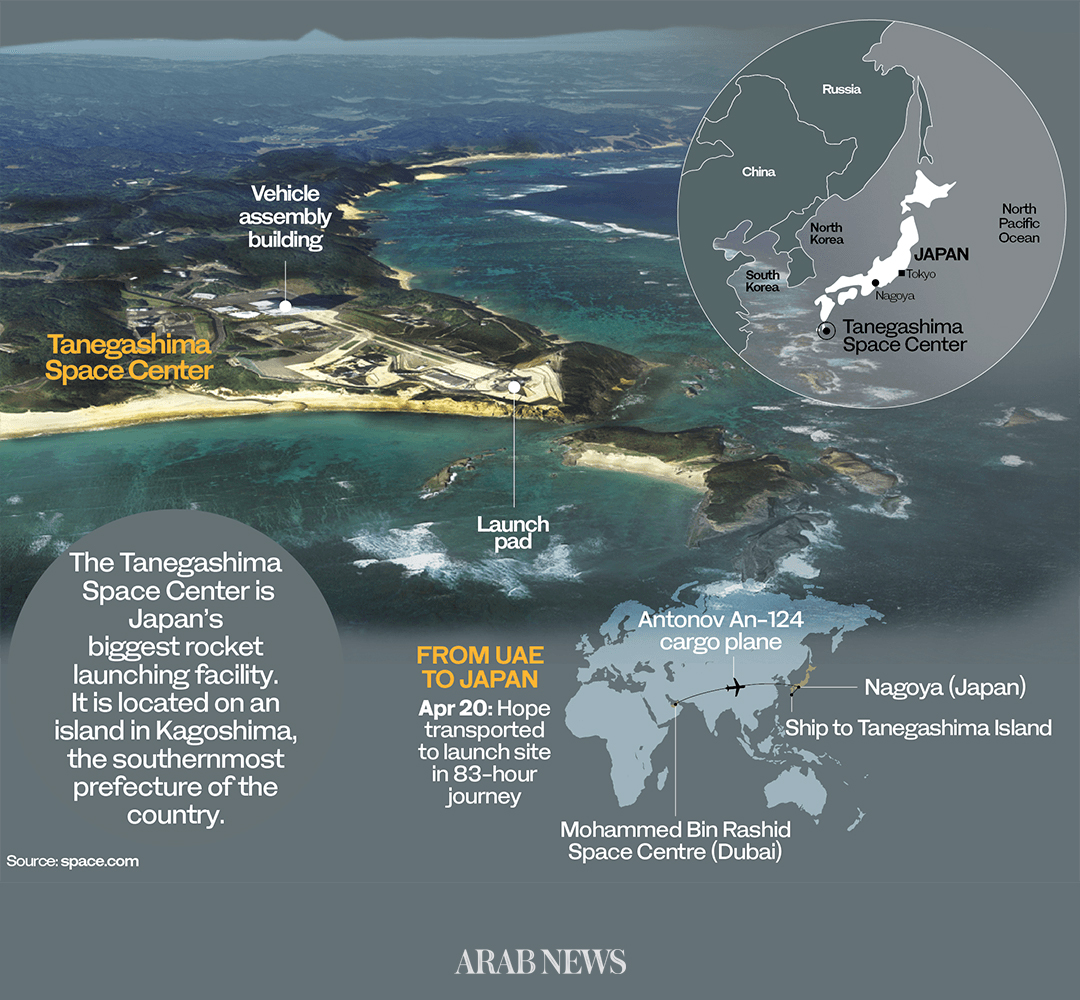
The unmanned probe, called Hope, lifted off from Tanegashima Space Center in Japan early on Monday and commenced its 495-million kilometer journey to the Red Planet."
“The cost of the Hope Mars Mission [has] reached $200 million, which is considered among the lowest in the world when compared with similar programs,” Mohammad Al-Gergawi, minister for cabinet affairs and the future of the UAE said in a message posted on Twitter by the Prime Minister’s Office.

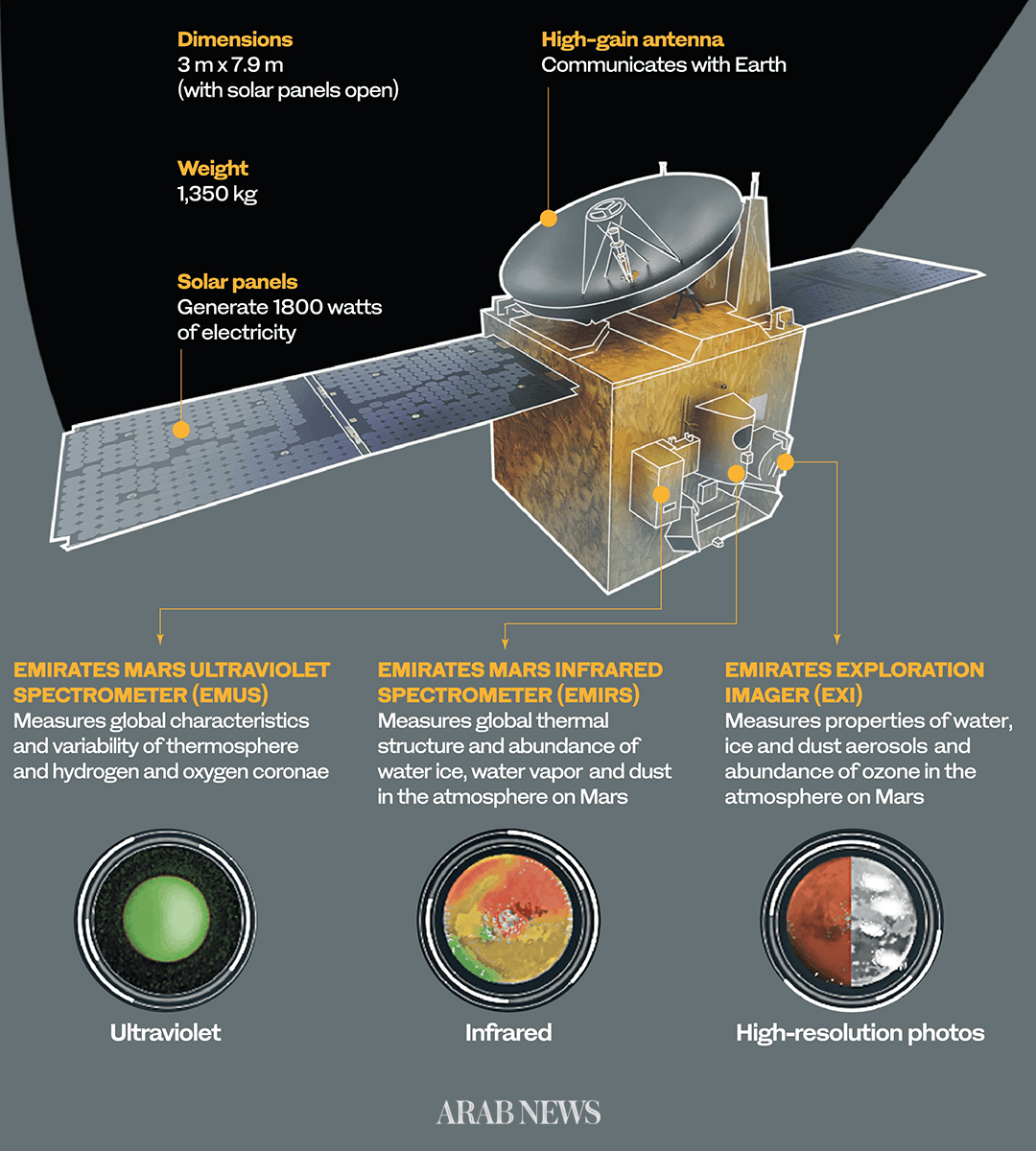
The Hope Probe, which was launched by a Mitsubishi Heavy Industries H2A rocket, weighs 289 tonnes and is 53 meters tall.

It is expected to enter orbit around Mars in Feb. 2021, in time for the 50th anniversary of the founding of the UAE.

“This mission embodies the [UAE’s] aspirations, sends a positive message to the world and demonstrates the importance of carrying on unabated despite barriers and challenges,” said Sarah Al-Amiri, minister of state for advanced sciences and the Emirates Mars Mission’s deputy project manager.
This historic moment for the region follows decades of preparations and work to achieve a grand vision set out in the 1970s by the UAE’s founder, the late Sheikh Zayed bin Sultan Al-Nayhan. His interest in space was triggered by a meeting in 1976 with NASA astronauts who had flown in a number of Apollo missions to the moon.

US President Richard Nixon also presented Sheikh Zayed with a gift of a moon rock collected from the Taurus-Littrow Valley during the 1972 Apollo 17 mission. That relic, from what remains the last moon landing to date, is on display in Al-Ain Museum.

Soon after, Sheikh Zayed sent a clear message to his people, and the world, that Emirati curiosity about, and ambitions for, space exploration would know no boundaries. So began the country’s journey into space.

In 2006, the UAE began collaborating closely with universities and space agencies around the world to establish knowledge-transfer programs, with the goal of one day sending a spacecraft to Mars.

However, it was not until the UAE Space Agency was formed in 2014 that the world really began to sit up and take notice of the country’s ambitious space-exploration plans.

In 2017, 34-year-old military pilot Hazza Al-Mansouri was one of two people selected from 4,000 applicants to join the agency’s inaugural astronaut corps.

After rigorous mental and physical tests, he trained in Russia as a part of an agreement between the Mohammed bin Rashid Space Center and the Russian space agency, Roscosmos.

The UAE’s first astronaut joined the crew of a Soyuz MS-15 spacecraft that took off on Sept. 25, 2019, bound for the International Space Station.

Al-Mansouri’s eight-day mission ended on Oct. 2, when he landed safely in Kazakhstan, after which he proudly stated that he had returned with “Sheikh Zayed’s space mission achieved.”

Thirty-four years earlier, in June 1985, Royal Saudi Air Force pilot Prince Sultan bin Salman became the first Muslim and Arab in space when flew on the STS-51-G mission of the US Space Shuttle Discovery. He was also the first member of a royal family in space and, at the age of 28, the youngest person to fly on the space shuttle.

When a Saudi went to space
Prince Sultan bin Salman speaks exclusively to Arab News about his 1985 NASA mission and how he became the first Arab, Muslim and royal in space

Enter


keywords

Two years later, Syrian military aviator Mohammed Faris joined the Soviet Interkosmos training program and flew as a research cosmonaut on the Soyouz TM-3 mission to the Mir space station. He spent seven days, 23 hours and 5 minutes in space.

Now, 51 years after the first moon landing, a team of Emiratis is leading a mission to the Red Planet and will supervise every aspect of the Hope Probe, a task that has been complicated by the global COVID-19 pandemic.

As a result, the mission team has been divided into three groups, given the challenges of transportation, travel, logistics and the need to follow proper health precautions.

The members of the first group arrived in Japan on April 6, where they completed a mandatory quarantine and health tests. The second team followed on April 21. The third team will remain in the UAE, providing back-up and support for the mission.

To ease concerns about the safety of a Mars mission during the pandemic, Sheikh Mohammed bin Rashid Al-Maktoum, prime minister of the UAE and ruler of Dubai, reviewed the final preparations for the mission on July 1.

He confirmed the launch date and described the mission as “an accomplishment for every Arab and a source of pride for every Emirati.”

On his part, Sheikh Hamdan bin Mohammed Al-Maktoum, crown prince of Dubai, said: “Hope Probe highlights our national treasure of hundreds of young Emirati engineers and experts ... . (It) represents a message of hope and optimism to mankind.”

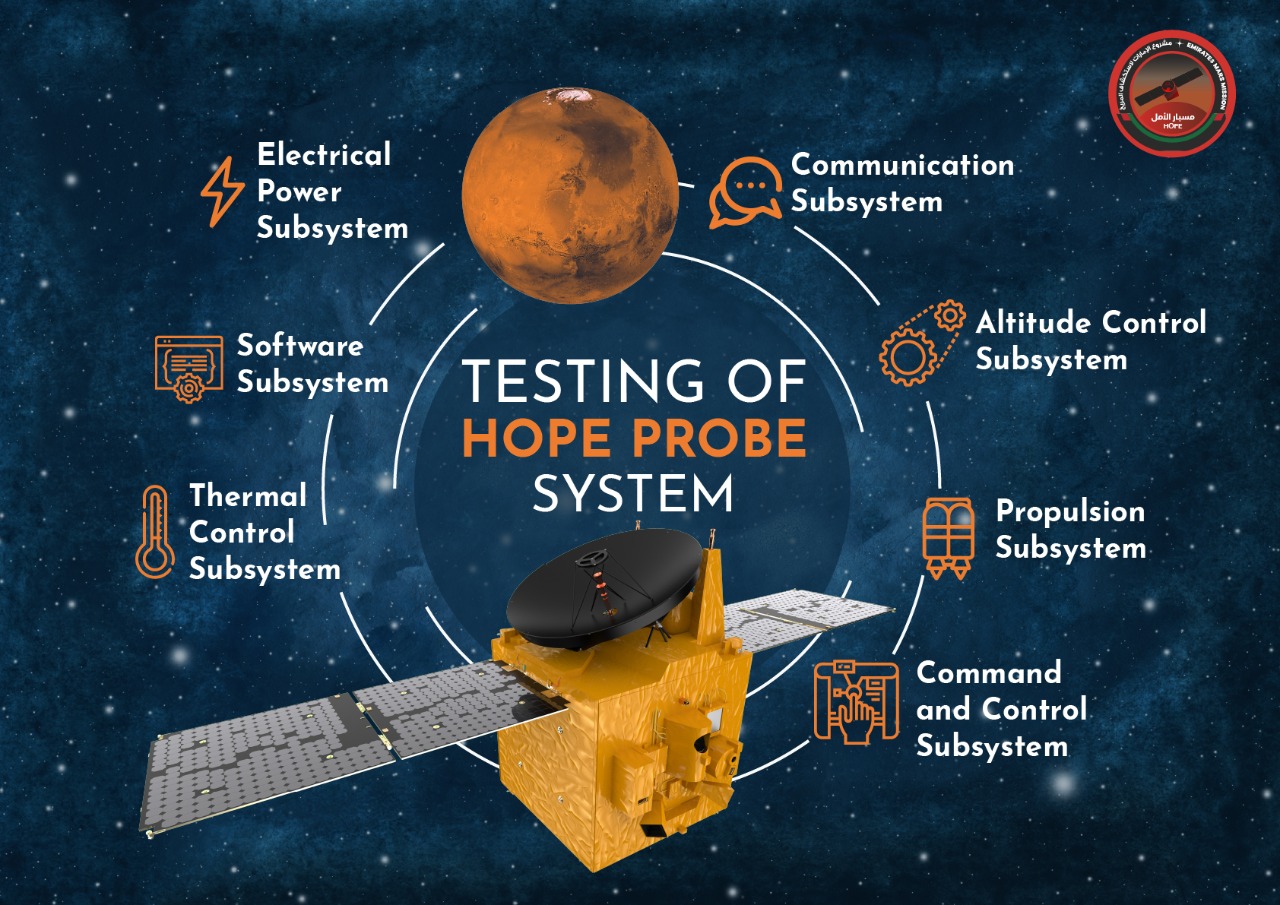
Suhail Al-Dhafri, Emirates Mars Mission deputy project manager and spacecraft lead, said that the probe has undergone a series of tests since its arrival at Tanegashima Space Center in April.

Conducted over 50 working days, they included functional tests of spacecraft subsystems such as electrical power, communications, altitude control, command and control, propulsion, thermal control and software systems.

Opinion

This section contains relevant reference points, placed in (Opinion field)

“The final checks are important steps to ensure that all systems are functioning and meeting the requirements before the fueling,” he said. “Getting these parameters are vital prior to getting the probe ready for the liftoff as per our launch window.”

After it enters orbit around Mars, the Hope Probe will study the planet’s daily and seasonal cycles, along with the erosion of the Martian atmosphere, a process that leaves the planet waterless and ill-suited to life.

The UAE will share the data it collects with more than 200 academic and scientific institutions around the world free of charge.
The UAE has plans to establish the first human settlement on Mars by 2117. This month, Sheikh Mohammed announced the launch of the Arab Space Pioneers program, which aims to advance Arab expertise in space science and technologies.

As part of a three-year program, young Arab researchers, scientists, inventors and creative talents will learn the skills required for a career in the expanding space sector.

The UAE promises to keep the world on its toes with its aim of establishing the first inhabitable human settlement on Mars by 2117 — one that can only be achieved through the expertise and determination of future generations.

--------------------

@jumana_khamis


Israeli military raids in Syria raise tensions as they carve out a buffer zone

Updated 15 December 2025
Follow

Israeli military raids in Syria raise tensions as they carve out a buffer zone

  • Syria’s interim president, Ahmad Al-Sharaa, who led the rebels who took over the country, said he has no desire for a conflict with Israel
  • Damascus has struggled to push Israel diplomatically to stop its attacks and pull its troops out of a formerly United Nations-patrolled buffer zone

BEIRUT: Qassim Hamadeh woke to the sounds of gunfire and explosions in his village of Beit Jin in southwestern Syria last month. Within hours, he had lost two sons, a daughter-in-law and his 4-year-old and 10-year-old grandsons. The five were among 13 villagers killed that day by Israeli forces.
Israeli troops had raided the village — not for the first time — seeking to capture, as they said, members of a militant group planning attacks into Israel. Israel said militants opened fire at the troops, wounding six, and that troops returned fire and brought in air support.
Hamadeh, like others in Beit Jin, dismissed Israel’s claims of militants operating in the village. The residents said armed villagers confronted Israeli soldiers they saw as invaders, only to be met with Israeli tank and artillery fire, followed by a drone strike. The government in Damascus called it a “massacre.”
The raid and similar recent Israeli actions inside Syria have increased tensions, frustrated locals and also scuttled chances — despite US pressure — of any imminent thaw in relations between the two neighbors.
An expanding Israeli presence
An Israeli-Syria rapprochement seemed possible last December, after Sunni Islamist-led rebels overthrew autocratic Syrian President Bashar Assad, a close ally of Iran, Israel’s archenemy.
Syria’s interim president, Ahmad Al-Sharaa, who led the rebels who took over the country, said he has no desire for a conflict with Israel. But Israel was suspicious, mistrusting Al-Sharaa because of his militant past and his group’s history of aligning with Al-Qaeda.
Israeli forces quickly moved to impose a new reality on the ground. They mobilized into the UN-mandated buffer zone in southern Syria next to the Golan Heights, which Israel captured from Syria during the 1967 Mideast war and later annexed — a move not recognized by most of the international community.
Israeli forces erected checkpoints and military installations, including on a hilltop that overlooks wide swaths of Syria. They set up landing pads on strategic Mt. Hermon nearby. Israeli reconnaissance drones frequently fly over surrounding Syrian towns, with residents often sighting Israeli tanks and Humvee vehicles patrolling those areas.
Israel has said its presence is temporary to clear out pro-Assad remnants and militants — to protect Israel from attacks. But it has given no indication its forces would leave anytime soon. Talks between the two countries to reach a security agreement have so far yielded no result.
Ghosts of Lebanon and Gaza
The events in neighboring Lebanon, which shares a border with both Israel and Syria, and the two-year war in Gaza between Israel and the militant Palestinian group Hamas have also raised concerns among Syrians that Israel plans a permanent land grab in southern Syria.
Israeli forces still have a presence in southern Lebanon, over a year since a US-brokered ceasefire halted the latest Israel-Hezbollah war. That war began a day after Hamas attacked southern Israel on Oct. 7, 2023, with Hezbollah firing rockets into Israel in solidarity with its ally Hamas.
Israel’s operations in Lebanon, which included bombardment across the tiny country and a ground incursion last year, have severely weakened Hezbollah.
Today, Israel still controls five hilltop points in southern Lebanon, launches near-daily airstrikes against alleged Hezbollah targets and flies reconnaissance drones over the country, sometimes also carrying out overnight ground incursions.
In Gaza, where US President Donald Trump’s 20-point ceasefire deal has brought about a truce between Israel and Hamas, similar buffer zones under Israeli control are planned even after Israel eventually withdraws from the more than half of the territory it still controls.
At a meeting of regional leaders and international figures earlier this month in Doha, Qatar, Al-Sharaa accused Israel of using imagined threats to justify aggressive actions.
“All countries support an Israeli withdrawal” from Syria to the lines prior to Assad’s ouster, he said, adding that it was the only way for both Syria and Israel to “emerge in a state of safety.”
Syria’s myriad problems
The new leadership in Damascus has had a multitude of challenges since ousting Assad.
Al-Sharaa’s government has been unable to implement a deal with local Kurdish-led authorities in northeast Syria, and large areas of southern Sweida province are now under a de facto administration led by the Druze religious minority, following sectarian clashes there in mid-July with local Bedouin clans.
Syrian government forces intervened, effectively siding with the Bedouins. Hundreds of civilians, mostly Druze, were killed, many by government fighters. Over half of the roughly 1 million Druze worldwide live in Syria. Most other Druze live in Lebanon and Israel, including in the Golan Heights.
Israel, which has cast itself as a defender of the Druze, though many of them in Syria are critical of its intentions, has also made overtures to Kurds in Syria.
“The Israelis here are pursuing a very dangerous strategy,” said Michael Young, Senior Editor at the Beirut-based Malcolm H. Kerr Carnegie Middle East Center.
It contradicts, he added, the positions of Saudi Arabia, Turkiye, Egypt — and even the United States — which are “all in agreement that what has to come out of this today is a Syrian state that is unified and fairly strong,” he added.
Israel and the US at odds over Syria
In a video released from his office after visiting Israeli troops wounded in Beit Jin, barely 5 kilometers (3 miles) from the edge of the UN buffer zone, Israeli Prime Minister Benjamin Netanyahu said Israel seeks a “demilitarized buffer zone from Damascus to the (UN) buffer zone,” including Mt. Hermon.
“It is also possible to reach an agreement with the Syrians, but we will stand by our principles in any case,” Netanyahu said.
His strategy has proven to be largely unpopular with the international community, including with Washington, which has backed Al-Sharaa’s efforts to consolidate his control across Syria.
Israel’s operations in southern Syria have drawn rare public criticism from Trump, who has taken Al-Sharaa, once on Washington’s terror list, under his wing.
“It is very important that Israel maintain a strong and true dialogue with Syria, and that nothing takes place that will interfere with Syria’s evolution into a prosperous State,” Trump said in a post on Truth Social after the Beit Jin clashes.
Syria is also expected to be on the agenda when Netanyahu visits the US and meets with Trump later this month.
Experts doubt Israel will withdraw from Syria anytime soon — and the new government in Damascus has little leverage or power against Israel’s much stronger military.
“If you set up landing pads, then you are not here for short-term,” Issam Al-Reiss, a military adviser with the Syrian research group ETANA, said of Israeli actions.
Hamadeh, the laborer from Beit Jin, said he can “no longer bear the situation” after losing five of his family.
Israel, he said, “strikes wherever it wants, it destroys whatever it wants, and kills whoever it wants, and no one holds it accountable.”