

Former NASA scientist hopes UAE Mars mission inspires young people in the Middle East

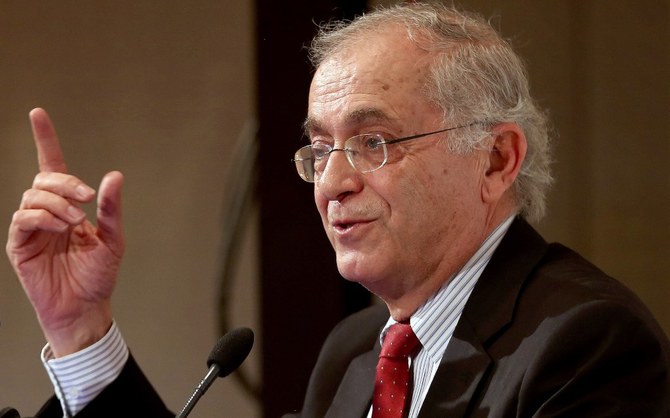
Charles Elachi, the retired director of the NASA Jet Propulsion Laboratory, is helping the UAE with its Mars mission. (AFP/File)
Short Url
Updated 26 June 2020
Follow

Former NASA scientist hopes UAE Mars mission inspires young people in the Middle East

  • Charles Elachi is an advisor to the UAE Space Agency and former director of the NASA Jet Propulsion Laboratory
  • Hope Mission expected to blast off on July 15

LOS ANGELES: A former NASA scientist advising the UAE space program said he hopes the Emirates' upcoming Mars mission will inspire young scientists in the Middle East.

The Mars Hope Mission is expected to blast off on July 15 with the aim of sending a probe to orbit the red planet.


Lending his experience as a member of the UAE Space Agency Advisory Board is Lebanese-American Charles Elachi, the retired director of the NASA Jet Propulsion Laboratory.

“This will be the first time a Middle Eastern country will be sending a spacecraft you know to Mars,” Elachi, who managed the launch of the Spirit and Opportunity Mars rovers, told Arab News. “I mean the Americans, we have done that and the Russians and the Europeans, so I find that extremely exciting.”

The launch comes just a few weeks after the 35th anniversary of Saudi Arabia’s Prince Sultan bin Salman becoming the first Arab to go to space.

“I remember meeting him,” Elachi said, recalling the prince’s 1985 expedition aboard the US Space Shuttle. “But that’s a number of years ago when that actually happened and I was very proud of having an Arab astronaut and I’m in regular communication with him even now.”

Elachi began his career at NASA when there were not opportunities to pursue space exploration in the Middle East. But he sees the Hope Mission as a return to the days when the Arab World was a leader in scientific exploration. 

“I’m seeing more and more interest in activities of young people in the Middle East who want to be involved in space,” Elachi said. “By having space agencies in the Middle East like in Saudi Arabia or United Arab Emirates gives them an opportunity to actually do that.”


When a Saudi went to space
Prince Sultan bin Salman speaks exclusively to Arab News about his 1985 NASA mission and how he became the first Arab, Muslim and royal in space

Enter


keywords


Trial opens in Tunisia of NGO workers accused of aiding migrants

Updated 59 min 7 sec ago
Follow

Trial opens in Tunisia of NGO workers accused of aiding migrants

  • Aid workers accused of assisting irregular migration to Tunisia went on trial on Monday, as Amnesty International criticized what it called “the relentless criminalization of civil society”

TUNIS: Aid workers accused of assisting irregular migration to Tunisia went on trial on Monday, as Amnesty International criticized what it called “the relentless criminalization of civil society” in the country.
Six staff members of the Tunisian branch of the France Terre d’Asile aid group, along with 17 municipal workers from the eastern city of Sousse, face charges of sheltering migrants and facilitating their “illegal entry and residence.”
If convicted, they face up to 10 years in prison.
Migration is a sensitive issue in Tunisia, a key transit point for tens of thousands of people seeking to reach Europe each year.
A former head of Terre d’Asile Tunisie, Sherifa Riahi, is among the accused and has been detained for more than 19 months, according to her lawyer Abdellah Ben Meftah.
He told AFP that the accused had carried out their work as part of a project approved by the state and in “direct coordination” with the government.
Amnesty denounced what it described as a “bogus criminal trial” and called on Tunisian authorities to drop the charges.
“They are being prosecuted simply for their legitimate work providing vital assistance and protection to refugees, asylum seekers and migrants in precarious situations,” Sara Hashash, Amnesty’s deputy MENA chief, said in the statement.
The defendants were arrested in May 2024 along with about a dozen humanitarian workers, including anti-racism pioneer Saadia Mosbah, whose trial is set to start later this month.
In February 2023, President Kais Saied said “hordes of illegal migrants,” many from sub-Saharan Africa, posed a demographic threat to the Arab-majority country.
His speech triggered a series of racially motivated attacks as thousands of sub-Saharan African migrants in Tunisia were pushed out of their homes and jobs.
Thousands were repatriated or attempted to cross the Mediterranean, while others were expelled to the desert borders with Algeria and Libya, where at least a hundred died that summer.
This came as the European Union boosted efforts to curb arrivals on its southern shores, including a 255-million-euro ($290-million) deal with Tunis.