ISLAMABAD: For Iqbal Javed, a 12-year-old student with hearing loss, months into school closures were passing with fear that he would forget how to speak. This was until Family Educational Services Foundation (FESF) stepped in and gave him a laptop with special software designed to bring deaf children back to class.
Like most educational institutions in Pakistan, schools for children with hearing impairments have also been shuttered since March due to the coronavirus outbreak. With over 50 million Pakistani students currently at the risk of falling behind, according to the education ministry, those with disabilities are disproportionally affected due to access barriers.
“We got laptops with all the lessons and exercises, now I am studying at home ... The school year will not be wasted,” Iqbal told Arab News in an email.
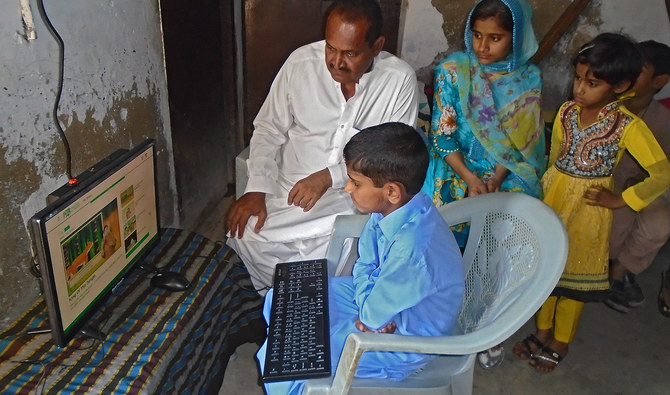
While Iqbal’s Deaf Reach School in Hyderabad remains closed, its students received laptops with visual learning materials in Pakistan Sign Language (PSL). Every few weeks, teachers visit them to collect worksheets with exercises and to install new classes.
“I love going to Deaf Reach because everyone speaks my language and understands how I feel and what I am trying to say. It has been over four months since the lockdown started. I have not seen my teachers and not been able to attend school with my friends. I started to fear that I will forget our sign language,” Iqbal said.
Now that he is studying at home, he still cannot talk to his friends, but FESF tried to make signing possible with family. “The amazing thing is that there are also lessons for my family members, and for the hearing grown-ups. We are now enjoying learning safely at home and signing with the family.”
Iqbal’s school is part of the Deaf Reach Pakistan (DRP) network of schools run by FESF in seven cities. Together, the Karachi-based NGO provides tuition to 1,200 students. Each of them will receive a laptop to get back to class despite the pandemic.
The organization has already distributed 250 laptops with content for Grades 2, 3 and 4, FESF development director Sarah Shaikh said, “A total of 1,200 laptops are required for the entire program to benefit students across our seven cities of operation. The remainder will be procured in the coming weeks and loaded with content for senior grades.”
The remote learning project aims to provide uninterrupted education to deaf students whom FESF is planning to prepare for university, as it will soon start a bachelor’s degree program, the NGO’s founder Richard Geary told Arab News.
Geary’s own experience with tuition for deaf children is most personal as it began with his own son who has a hearing impairment. “As we sought to educate ourselves about Michael’s needs and future, we were quickly confronted with the paucity of resources available to the deaf and their families, particularly in developing countries.”
According to UNICEF, Pakistan has more than 1 million deaf children of school age, yet only 5 percent of them attend school.
“We were living in the Philippines where we started a tuition program for deaf teenagers in Manila, calling it Deaf Reach,” Geary said, “From there we spent some years in India, again working with deaf teenagers until making Pakistan our home where we have been happily settled now for the past 30 years.”


![]()

Pakistani NGO makes remote learning accessible to deaf students
Short Url
https://arab.news/4be93
Pakistani NGO makes remote learning accessible to deaf students
- Like other educational institutions, schools for children with disabilities have also been shuttered due to the coronavirus outbreak
- Pakistan has more than 1 million deaf children of school age, only 5 percent of them attend school
Latest updates





© 2026 SAUDI RESEARCH & PUBLISHING COMPANY, All Rights Reserved And subject to Terms of Use Agreement.