



ANKARA: Turkish President Recep Tayyip Erdogan signed a decree on Friday to reopen Hagia Sophia, the UNESCO world heritage site that was the Roman Empire’s first Christian cathedral, constructed in the sixth century CE, as a mosque.
UNESCO had previously urged Turkish authorities “to engage in dialogue before taking any decision that might impact the universal value of the site.”
The long-predicted move has been widely interpreted as an attempt to rally conservative nationalist voters around the ruling party and its nationalist coalition partner ahead of snap elections that many have forecast will happen next year. Several commentators, however, doubt the efficacy of the move given that — under the current economic conditions — the majority of the Turkish people are focused on more urgent matters.
Around 55 percent of respondents to a poll conducted by Turkey’s Metropoll in June said the main reason for announcing the reconversion of Hagia Sophia into a mosque would be to distract from debates on Turkey’s economic crisis and to boost the government’s hand ahead of a snap election.
Soner Cagaptay of the Washington Institute for Near East Policy said the move is another step in Erdogan’s attempt to impose his “brand of conservative Islam,” in direct opposition to the founder of the Turkish Republic Mustafa Kemal Ataturk’s secular revolution.
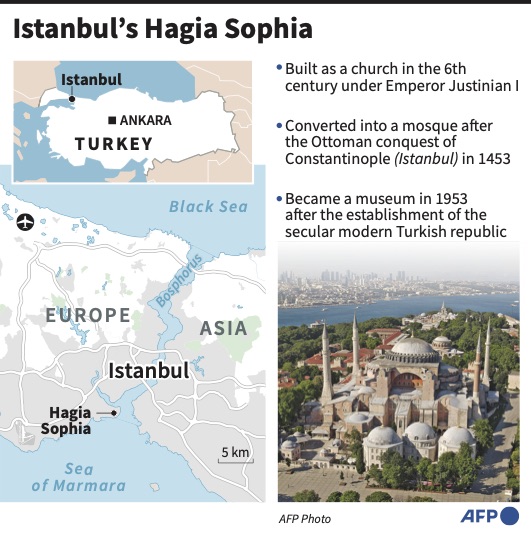
“Just as Ataturk ‘un-mosqued’ Hagia Sophia 86 years ago, and gave it museum status to underline his secularist revolution, Erdogan is remaking it a mosque to underline his religious revolution,” Cagaptay said.
The reconversion of Hagia Sophia into a mosque, regardless of domestic and international criticism, overlaps with Erdogan’s desire to be the “new sultan” of the country, he continued.
“Erdogan is already patronizing the construction of two mosques in Istanbul. He wants to leave a political and religious imprint behind, and Hagia Sophia completes his ‘trilogy’ of mosques,” he said.
But, Cagaptay noted, there is a tactical aspect to the announcement as well.
“As a nativist-populist leader, Erdogan hopes to rally his base by underlining their ‘victim’ narrative — saying, ’How dare these secularists deny us, pious Muslims, the liberty to pray at Hagia Sophia?’” he said.
BACKGROUND
- The long-predicted move has been widely interpreted as an attempt to rally conservative- nationalist voters around the ruling party ahead of snap polls.
Cagaptay, along with other experts, believes any boost Erdogan may enjoy following the announcement will likely be undermined by Turkey’s ongoing economic challenges, including high inflation and unemployment rates.
Last year, Hagia Sophia drew 3.7 million tourists to its famed dome, rust-colored walls and ornamental minarets. But many believe Erdogan’s latest move will hurt the country’s popularity as a tourist destination.
“Turkey’s global brand as a Muslim-majority society that is open to its Christian past is going to be irreversibly damaged,” Cagaptay said.
“One of the effects of the conversion of Hagia Sophia from a museum into a mosque will be a spike in Islamophobia in the West and elsewhere. Which, of course, Erdogan will then use to his advantage,” Dimitar Bechev of the Atlantic Council tweeted.


