

Foreign students fret over being sent home after US visa rule

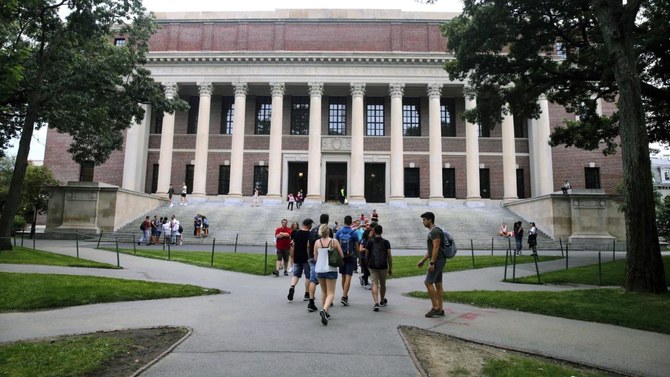
In this Aug. 13, 2019 file photo, students walk near the Widener Library in Harvard Yard at Harvard University in Cambridge, Mass. (AP)
Short Url
Updated 08 July 2020
Follow

Foreign students fret over being sent home after US visa rule

When the phone rang Tuesday morning, Raul Romero had barely slept.
The 21-year-old Venezuelan, on a scholarship at Ohio’s Kenyon College, had spent hours pondering his options after US Immigration and Customs Enforcement announced Monday that international students taking classes fully online for the fall semester would have to transfer to a school with in-person classes or leave the country.
A college employee called Romero to say he would not be immediately affected, but warned that a local outbreak of COVID-19 could force the school to suspend in-person classes during the year. If that happened, he may need to go home.
Romero is one of hundreds of thousands of international students in the United States on F-1 and M-1 visas faced with the prospect of having to leave the country mid-pandemic if their schools go fully online.
For some students, remote learning could mean attending classes in the middle of the night, dealing with spotty or no Internet access, losing funding contingent on teaching, or having to stop participating in research. Some are considering taking time off or leaving their programs entirely.
Reuters spoke with a dozen students who described feeling devastated and confused by the Trump administration’s announcement.
In a Venezuela beset by a deep economic crisis amid political strife, Romero said his mother and brother are living off their savings, sometimes struggle to find food and don’t have reliable Internet at home.
“To think about myself going back to that conflict, while continuing my classes in a completely unequal playing field with my classmates,” he said. “I don’t think it’s possible.”
And that’s if he could even get there. There are currently no flights between the United States and Venezuela.

WORKING REMOTELY WON’T WORK
At schools that have already announced the decision to conduct classes fully online, students were grappling with the announcement’s implications for their personal and professional lives. Blindsided universities scrambled to help them navigate the upheaval.
Lewis Picard, 24, an Australian second-year doctoral student in experimental physics at Harvard University, has been talking nonstop with his partner about the decision. They are on F-1 visas at different schools.
Harvard said Monday it plans to conduct courses online next year. After the ICE announcement, the university’s president, Larry Bacow, said Harvard was “deeply concerned” that it left international students “few options.”
Having to leave “would completely put a roadblock in my research,” Picard said. “There’s essentially no way that the work I am doing can be done remotely. We’ve already had this big pause on it with the pandemic, and we’ve just been able to start going back to lab.”
It could also mean he and his partner would be separated. “The worst-case scenario plan is we’d both have to go to our home countries,” he said.

’CAN’T TRANSFER IN JULY’
Aparna Gopalan, 25, a fourth-year anthropology PhD student at Harvard originally from India, said ICE’s suggestion that students transfer to in-person universities is not realistic just weeks before classes begin.
“That betrays a complete lack of understanding of how academia works,” she said. “You can’t transfer in July. That’s not what happens.”
Others were considering leaving their programs entirely if they cannot study in the United States, and taking their tuition dollars with them. International students often pay full freight, helping universities to fund scholarships, and injected nearly $45 billion into the US economy in 2018.
“It doesn’t make much sense to me to pay for an American education, if you’re not really receiving an American education,” said Olufemi Olurin, 25, of the Bahamas, who is earning an MBA at Eastern Kentucky University and wants to pursue a career in health care management.
“It’s kind of heartbreaking,” she said. “I’ve been building my life here. As an immigrant, even if you are as law-abiding as it gets, you still are always waiting for the rug to be pulled out from under you.”
Benjamin Bing, 22, from China, who was planning to study computer science at Carnegie Mellon in the fall, said he no longer feels welcome in the United States. He and his friends are exploring the possibility of finishing their studies in Europe.
“I feel like it’s kicking out everyone,” he said, of the United States. “We actually paid tuition to study here and we did not do anything wrong.”


Asia rings in 2026 and Australia is defiant after its worst mass shooting

Updated 4 sec ago
Follow

Asia rings in 2026 and Australia is defiant after its worst mass shooting

  • Australia holds defiant celebrations after its worst mass shooting in nearly 30 years
  • Hong Kong holds a subdued event after a deadly fire in tower blocks
MELBOURNE, Australia: Auckland was the first major city to ring in 2026 with a fireworks display launched from New Zealand’s tallest structure, Sky Tower, followed by a defiant celebration in Australia in the aftermath of its worst mass shooting.
South Pacific countries were the first to bid farewell to 2025. Clocks stuck midnight in Auckland 18 hours before the famous ball drop in New York’s Times Square. The five-minute display involved 3,500 fireworks.

Defiant celebration in Australia after worst mass shooting

Australia’s east coast welcomed 2026 two hours after New Zealand. In Sydney, the country’s largest city, celebrations were held under the pall of Australia’s worst mass shooting in almost 30 years. Two gunmen targeted a Hannukah celebration at Bondi Beach on Dec. 14, killing 15 and wounding 40.
A heavy police presence monitored the thousands who thronged to the waterfront to watch a fireworks show centered on the Sydney Harbor Bridge. Many officers openly carried rapid-fire rifles, a first for the annual event.
An hour before midnight, the massacre victims were commemorated with a minute of silence while images of a menorah were projected on the bridge pylons. The crowd was invited to show solidarity with Australia’s Jewish community.
New South Wales Premier Chris Minns urged Sydney residents not to stay away through fear, saying extremists would interpret smaller crowds at New Year’s Eve festivities as a victory.
“We have to show defiance in the face of this terrible crime and say that we’re not going to be cowered by this kind of terrorism,” he said.

Indonesia and Hong Kong hold subdued events

In Indonesia, one of Australia’s nearest neighbors, cities scaled back festivities as a gesture of solidarity with communities devastated by floods and landslides that struck parts of Sumatra island a month ago, claiming more than 1,100 lives.
The capital, Jakarta, was not ringing in 2026 with its usual fanfare, choosing subdued celebrations with a program centered on prayers for victims, city Gov. Pramono Anung said last week.
Makassar Mayor Munafri Arifuddin urged residents of one of Indonesia’s largest cities to forgo parties, calling for prayer and reflection. “Empathy and restraint are more meaningful than fireworks and crowds,” he said.
Concerts and fireworks on Indonesia’s tourist island of Bali were canceled and replaced with a cultural arts event featuring traditional dances.
Hong Kong, too, was ringing in 2026 without the usual spectacle in the sky over iconic Victoria Harbor, after a massive fire in November killed at least 161 people.
The facades of eight landmarks were turning into giant countdown clocks presenting a three-minute light show at midnight.
Many parts of Asia welcome the new year by observing age-old traditions.
In Japan, crowds were gathering at a Buddhist temple in Tokyo for a bell striking at midnight. In the South Korean capital, Seoul, a bell tolling and countdown ceremony were being held at the Bosingak Pavilion.

Berliners celebrate in snowfall

Tourists and Berliners alike marked the end of 2025 by enjoying snowfall, taking selfies and making snowmen in front of the German capital’s cathedral and the iconic Brandenburg Gate. The Berlin TV Tower was nearly invisible thanks to the falling flakes and fog.
Quieter celebrations in Greece and Cyprus
Greece and Cyprus were ringing in 2026 by turning down the volume, replacing traditional fireworks with low-noise pyrotechnics, light shows and drone displays in capital cities. Low-noise fireworks avoid the explosive bursts that generate the loud cracks of traditional displays.
Officials in the countries said the change is intended to make celebrations more welcoming for children and pets, particularly animals sensitive to loud noise.

Additional security in New York City

Police in New York City will have additional anti-terrorism measures at the Times Square ball drop, with “mobile screening teams” in search of suspicious activity. It is not in response to a specific threat, according to NYPD Commissioner Jessica Tisch.
After the ball drops in Times Square, it will rise once again, sparking in red, white and blue, to mark the country’s upcoming 250th birthday celebration. It will be one of several patriotic flourishes throughout the night, organizers said.
Zohran Mamdani will take office as mayor at the start of 2026. Two swearing-in ceremonies are planned, starting with a private ceremonial event around midnight in an old subway station.