

Israel has become India’s ‘coach’ in how to oppress Kashmiris - Pakistani President

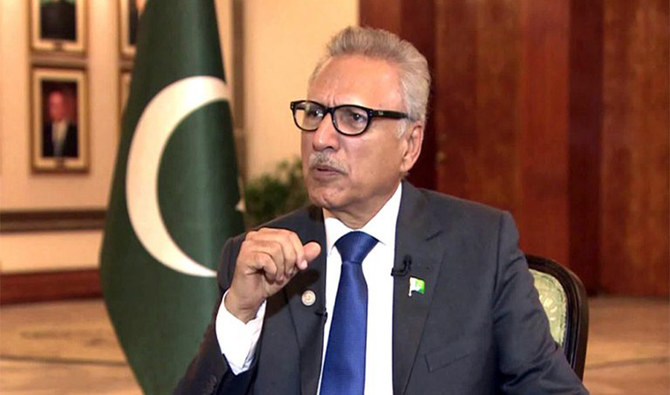
President Arif Alvi during an interview in Islamabad. (Photo Courtesy: Radio Pakistan)
Short Url
Updated 06 July 2020
Follow

Israel has become India’s ‘coach’ in how to oppress Kashmiris - Pakistani President

  • Alvi says India disenfranchising people of Kashmir by following in the footsteps of Israel and its occupation of the West Bank
  • Pakistan has long supported a two-state solution to the Israeli-Palestinain conflict

ISLAMABAD: Pakistani President Dr. Arif Alvi said in a television interview aired on Sunday that India was following in Israel’s footsteps in oppressing the people of Indian-administered Kashmir just as Israel had disenfranchised Palestinians. 

The Indian government in August revoked the constitutional autonomy of Jammu and Kashmir, India’s only Muslim-majority state, splitting it into two federal territories in a bid to integrate it fully with India.

Kashmir is claimed in full by both India and Pakistan. The two countries have gone to war twice over it, and both rule parts of it. India’s portion has been plagued by separatist violence since the late 1980s.

The Palestinians want an independent state in the West Bank, east Jerusalem and the Gaza Strip, territories Israel captured in a 1967 Middle East war. Palestinians and much of the world view settlements that Israel has built in captured territory as illegal, which Israel disputes.

“If we see Israel’s oppression against Palestinians, it [Israel] has become their [India’s] coach as far as Kashmir is concerned,” Alvi said in an interview to Pakistani channel Geo News.

“The way Israel is occupying the West Bank and in all these things… and in terms of the population, the way it is disenfranchising [Palestinians] … India made a law and started doing the same in Kashmir.”

Referring to recent viral photos from Kashmir of a three-year-old boy sitting on the corpse of his dead grandfather killed by Indian security forces, Alvi said: “It’s so painful … A three year old child, sitting on his grandfather’s stomach. These images are the kind that will shake the world.”

Last month, the Pakistani foreign office reiterated its official stance of supporting a two-state solution to the Israeli-Palestinian conflict, as envisaged by the United Nations.

“Pakistan continues to support a just and lasting solution of the Palestinian issue, through dialogue and negotiations, that leads to the realization of the legitimate rights of the Palestinians, including the right of self-determination,” the foreign office spokeswoman had said.


Pakistan expresses concern over Yemen crisis, reaffirms solidarity with Saudi Arabia

Updated 4 sec ago
Follow

Pakistan expresses concern over Yemen crisis, reaffirms solidarity with Saudi Arabia

  • Saudi-led coalition forces on Tuesday conducted a “limited” airstrike targeting two shipments of smuggled weapons coming from Fujairah
  • Pakistan’s foreign office calls for dialogue and diplomacy to resolve Yemen’s crisis, reiterates support for the country’s territorial integrity

ISLAMABAD: Pakistan’s foreign office spokesperson on Wednesday expressed concern over the resurgence of violence in Yemen, expressing solidarity with Saudi Arabia and calling for dialogue and diplomacy to resolve ongoing tensions in the country. 

The development takes place a day after the Saudi Arabia-led Coalition to Support Legitimacy in Yemen said it conducted a “limited” airstrike targeting two shipments of smuggled weapons and other military hardware coming from the Emirati port of Fujairah into Mukalla in southern Yemen.

Major General Turki Al-Maliki, spokesperson of the coalition forces, said the weapons were meant to support the Southern Transitional Council (STC) forces, backed by the UAE, in Yemen’s Hadramaut and Al-Mahra “with the aim of fueling the conflict.” Shortly after the airstrikes, Rashad Al-Alimi, the head of Yemen’s presidential council, told Emirati authorities to withdraw their troops from Yemen within 24 hours.

Disregarding previous agreements with the Arab Coalition, the STC separatist group launched a sweeping military campaign early in December, seizing the governorates of Hadramaut along the Saudi border and the eastern governorate of Al-Mahra in Yemen’s border with Oman.

“Pakistan expresses deep concern over resurgence of violence in Yemen,” the foreign office spokesperson said in a statement. 

“Pakistan reiterates its support for the unity and territorial integrity of Yemen, as well as all efforts aimed at establishing lasting peace and stability in the country.”

The foreign office said it opposes unilateral steps by “any Yemeni party” that could further escalate the situation, undermine peace efforts and threaten the country’s stability. 

“Pakistan welcomes regional efforts for de-escalating the situation and maintaining peace and stability in Yemen,” the statement said. “Pakistan expresses complete solidarity with the Kingdom of Saudi Arabia and reaffirms its commitment to security of the Kingdom.”

The statement concluded with Islamabad calling for dialogue and diplomacy to resolve tensions in Yemen. It also urged regional powers to work together for an “inclusive and enduring settlement of the issue.”

The STC’s advance has raised the specter of the return of South Yemen, a separate state from 1967 to 1990, while dealing a blow to slow-moving peace negotiations with Iran-backed Houthi rebels.

Saudi Arabia on Tuesday expressed regret over what it described as pressure by the UAE on STC forces to carry out military operations in Yemen’s Hadramout and Al-Mahra governorates, warning that such actions pose a direct threat to the Kingdom’s national security and regional stability.

The UAE announced the withdrawal of its remaining counter-terrorism units in Yemen on Tuesday, citing recent developments and concerns over the safety and effectiveness of ongoing operations.

It earlier reaffirmed its unwavering commitment to Saudi Arabia’s security and sovereignty, rejecting any actions that could threaten the Kingdom or undermine regional stability.

PAKISTANI PM MEETS SAUDI ENVOY

Prime Minister Shehbaz Sharif separately met Saudi Ambassador Nawaf bin Said Al-Malki at the Prime Minister’s House, a statement from Sharif’s office said on Wednesday. 

Both sides discussed bilateral relations between Pakistan and Saudi Arabia, including recent regional and global developments, the Prime Minister’s Office (PMO) said. 

“The prime minister underscored the importance of dialogue and diplomacy in maintaining peace and stability,” the PMO said. 

Sharif, along with Dar and other officials, separately met UAE President Sheikh Mohamed bin Zayed Al-Nahyan on Tuesday. The UAE president is on a private visit to the Pakistani city of Rahim Yar Khan following his first official visit to Islamabad earlier this month.

“The two leaders also discussed ways to enhance cooperation in a wide range of areas including IT, energy, mining & minerals, as well as defense cooperation,” Sharif’s office said on Tuesday.