

US envoy forges ahead with troubled Taliban peace deal 

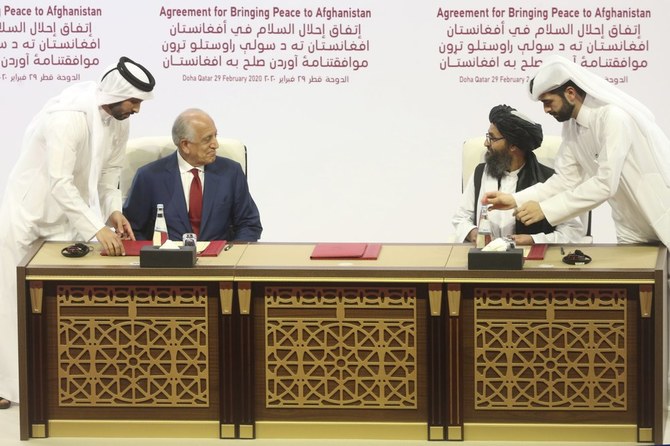
In this Feb. 29, 2020 file photo, U.S. peace envoy Zalmay Khalilzad, left, and Mullah Abdul Ghani Baradar, the Taliban group's top political leader sign a peace agreement between Taliban and U.S. officials in Doha, Qatar. (AP Photo)
Short Url
Updated 04 July 2020
Follow

US envoy forges ahead with troubled Taliban peace deal 

  • Khalilzad wrapped up a week long trip with his economic team to Uzbekistan, Pakistan and Qatar
  • Pakistan FM Shah Mahmood Qureshi tested positive for COVID-19 48 hours after meeting with Khalilzad

ISLAMABAD: Washington’s envoy to Afghanistan on Saturday emphasized the economic benefits of the peace deal with the Taliban, forging ahead with an agreement that has run into new political obstacles in the US and the region.

Zalmay Khalilzad was wrapping up a week-long trip that included stops in Uzbekistan, Pakistan and the Gulf state of Qatar, where Taliban negotiators are headquartered.

Accompanying Khalilzad for the first time was an economic development team led by US International Development Finance Corporation Chief Executive Officer Adam Boehler.

Khalilzad offered no details about the kinds of economic projects being envisioned to jump-start an economy battered by widespread corruption and currently 75% funded by international donations. However, he did suggest joint economic projects involving Qatar and Pakistan, possibly on infrastructure and trade.

The US signed a peace deal with the Taliban in February to end 19 years of war in Afghanistan.

Khalilzad has sought to stress the economic benefits of the peace deal throughout his tour. In a series of tweets early Saturday, the US envoy said he met with the Qatar Investment Authority and the Taliban’s chief negotiator Mullah Abdul Ghani, in the tiny Gulf state’s capital of Doha.

“We agreed development plans in support of peace can never start too early,” Khalilzad tweeted.

However, Washington has recently become embroiled in a controversy over intelligence reports that Russia was paying money to insurgents with links to the Taliban to kill American and NATO soldiers.

The identity of the insurgents who took the bounty money is still vague but the payments have been traced to an Afghan drug lord, Rahmatullah Azizi, who is living in Moscow, according to Afghan officials who spoke with The Associated Press. 

The officials said the money was delivered through Azizi’s brother Wahidullah, who was the go-between for those facilitating the attacks on US troops.

The New York Times first reported the US intelligence claiming the payment of bounties as well as Azizi’s involvement.

Added to the uncertainty and delays swirling around the US-Taliban peace deal, the Pentagon released a report Wednesday that questioned the Taliban’s commitment to end its ties with Al-Qaeda. 

The peace deal calls for the Taliban to fight against militant organizations and ensure Afghanistan would not be used again to attack US interests or its allies. Critics of the deal say the militants can’t be trusted.

Taliban spokesman Zabihullah Mujahid denied contacts with Al-Qaeda in the Indian subcontinent, saying the insurgents were committed to the peace deal.

Khalilzad embarked on his tour of the region last weekend, even as the rate of coronavirus infections in the United States soared and countries worldwide struggled with the dangers of re-opening.

He did not travel to Afghanistan, citing the dangers of the pandemic, and instead held video conference calls with Afghan President Ashraf Ghani and his government partner, Abdullah Abdullah.

Pakistan’s Foreign Minister Shah Mahmood Qureshi tested positive for COVID-19, just 48 hours after meeting with Khalilzad. Both had been pictured wearing masks during their meeting on Wednesday in the Pakistani capital of Islamabad.

Qureshi said he developed a fever on Friday and tested positive to the virus. But he promised to “carry on” his official duties from home.

Even as Khalilzad winds up his latest diplomatic mission, there was no date for crucial intra-Afghan negotiations that bring the Taliban together with the Afghan government and other local actors. Khalilzad called for a quick resolution of outstanding issues so those negotiations could begin.

The biggest hurdle has been the release of prisoners. The peace deal called for the Afghan government to free 5,000 Taliban prisoners in exchange for the Taliban releasing 1,000 government personnel. So far, the government has freed 4,015 and the Taliban has freed 669, according to the Afghan government..

Ghani earlier this week suggested that his government had a problem with some of the names on the Taliban’s list of prisoners to be released and said alternative names would be given.

It seems unlikely that the Taliban will accept anyone not on the list agreed upon during negotiations with the US.

Suhail Shaheen, Taliban political spokesman in Doha, called the Afghan government reasons for delaying prisoner releases “phony excuses” and the reason for the delay in beginning intra-Afghan talks.

As of Saturday, Afghanistan had recorded 32,600 confirmed cases of coronavirus, but international non-governmental organizations say the rate is much higher and have warned that the country’s war-ravaged health care system risks collapsing.

Seemingly indicative of the lack of health care facilities in Afghanistan to deal with the virus, Ghani’s special envoy for economic development, Yosuf Ghaznafar, went to Turkey when he became ill with COVID-19. 

On Friday he died of the disease, according to a statement from the presidency. Ghaznafar is the senior most Afghan official to die of the virus.

Afghanistan has so far recorded 826 deaths from the virus.


Trump urges Iranian Kurds to attack Iran as war widens

Updated 9 sec ago
Follow

Trump urges Iranian Kurds to attack Iran as war widens

  • Azerbaijan preparing unspecified retaliatory measures on Thursday
  • The seven-day war has now seen Iran target Israel, the Gulf states, Cyprus, Turkiye and Azerbaijan, and spread to the Indian Ocean off Sri Lanka

DUBAI/WASHINGTON: US President Donald Trump encouraged Iranian Kurdish forces in Iraq to launch attacks against Iran as the Middle East conflict widened, with Azerbaijan warning it would retaliate for being targeted by Iranian missiles.
Israel on Friday said it had ​started a “broad-scale” wave of attacks against infrastructure targets in Tehran, as Gulf cities came under renewed bombardment by Iran.
The seven-day war has now seen Iran target Israel, the Gulf states, Cyprus, Turkiye and Azerbaijan, and spread to the Indian Ocean off Sri Lanka where a US submarine sank an Iranian naval ship.
On the possibility of the Iranian Kurdish forces entering Iran, Trump told Reuters on Thursday: “I think it’s wonderful that they want to do that, I’d be all for it.”
Two Iranian drone attacks targeted an Iranian opposition camp in Iraqi Kurdistan on Thursday, security sources said.
Iranian Kurdish militias have consulted with the United States in recent days about whether, and how, to attack Iran’s security forces in the western part of the country, according to three sources with knowledge of the matter.
The Iranian Kurdish coalition of groups based on the Iran-Iraq border in ‌the semi-autonomous region ‌of Iraqi Kurdistan has been training to mount such an attack in hopes of weakening the country’s ​military, ‌as ⁠the United ​States ⁠and Israel pound Iranian targets with bombs and missiles. Trump, speaking with Reuters in a telephone interview, also said the United States must have a role in deciding who will be the next leader of Iran after airstrikes killed Supreme Leader Ayatollah Ali Khamenei last week.
“We’re going to have to choose that person along with Iran. We’re going to have to choose that person,” he said.
US Defense Secretary Pete Hegseth said on Thursday that the US was not expanding its military objectives in Iran, despite what Trump said about choosing the country’s next leader.
“There’s no expansion in our objectives. We know exactly what we’re trying to achieve,” he said. The attack on Iran is a major political gamble for the Republican president, with opinion polls showing little support and ⁠Americans concerned about the rise in gasoline prices caused by disruption to energy supplies. Trump dismissed that ‌concern. Shares on Wall Street fell on Thursday, weighed by surging oil prices, as the ‌economic impact of the campaign intensified, with countries around the world cut off from a ​fifth of global supplies of oil and liquefied natural gas and ‌air transport still facing chaos and global logistics increasingly snarled.

Azerbaijan prepares to retaliate
Azerbaijan was preparing unspecified retaliatory measures on Thursday after it said ‌four Iranian drones crossed its border and injured four people in the Nakhchivan exclave.
“We will not tolerate this unprovoked act of terror and aggression against Azerbaijan,” President Ilham Aliyev told a meeting of his Security Council.
Iran, which has a significant Azeri minority, denied it targeted its neighbor.
Lebanon’s Iran-backed Hezbollah militia warned Israeli residents to evacuate towns within 5 km (3 miles) of the border between the countries in a message posted on its Telegram channel in Hebrew early on Friday.
“Your military’s ‌aggression against Lebanese sovereignty and safe citizens, the destruction of civilian infrastructure and the expulsion campaign it is carrying out will not go unchallenged,” Hezbollah said.

Us munitions full
Hegseth and Admiral Brad Cooper, who leads ⁠US forces in the Middle East, ⁠said during a briefing about operations that the US has enough munitions to continue its bombardment indefinitely.
“Iran is hoping that we cannot sustain this, which is a really bad miscalculation,” Hegseth told reporters at Central Command headquarters in Florida. “Our munitions are full up and our will is ironclad.”
The Pentagon earlier this week said the military campaign, known as Operation Epic Fury, is focused on destroying Iran’s offensive missiles, missile production and navy, while not allowing Tehran to have a nuclear weapon.
Cooper said the US had now hit at least 30 Iranian ships, including a large drone carrier that he said was the size of a World War Two aircraft carrier.
He added that B-2 bombers had in the past few hours dropped dozens of 2,000 penetrator bombs targeting deeply buried ballistic missile launchers, and that bombings were also targeting Iran’s missile production facilities.
Iran’s ballistic missile attacks had decreased by 90 percent since the first day of the war, while drone attacks had decreased by 83 percent in that time frame, he said. In Iran, at least 1,230 people have been killed, according to the Iranian Red Crescent Society, including 175 schoolgirls and staff killed at a primary ​school in Minab in the country’s south on the first day ​of the war. Another 77 have been killed in Lebanon, its Health Ministry says. Thousands fled southern Beirut on Thursday after Israel warned residents to leave.