DUBAI: A fire and an explosion struck a centrifuge production plant above Iran's underground Natanz nuclear enrichment facility early Thursday, analysts said, one of the most-tightly guarded sites in all of the Islamic Republic after earlier acts of sabotage there.
The Atomic Energy Organization of Iran sought to downplay the fire, calling it an “incident” that only affected an under-construction “industrial shed,” spokesman Behrouz Kamalvandi said. However, both Kamalvandi and Iranian nuclear chief Ali Akbar Salehi rushed after the fire to Natanz, a facility earlier targeted by the Stuxnet computer virus and built underground to withstand enemy airstrikes.
The fire threatened to rekindle wider tensions across the Middle East, similar to the escalation in January after a US drone strike killing a top Iranian general in Baghdad and Tehran launched a retaliatory ballistic missile attack targeting American forces in Iraq.
While offering no cause for Thursday's blaze, Iran’s state-run IRNA news agency published a commentary addressing the possibility of sabotage by enemy nations such as Israel and the US following other recent explosions in the country.
“The Islamic Republic of Iran has so far has tried to prevent intensifying crises and the formation of unpredictable conditions and situations,” the commentary said. But ”the crossing of red lines of the Islamic Republic of Iran by hostile countries, especially the Zionist regime and the US, means that strategy ... should be revised.”
The fire began around 2 a.m. local time in the northwest corner of the Natanz compound in Iran's central Isfahan province, according to data collected by a US National Oceanic and Atmospheric Administration satellite that tracks fires from space.
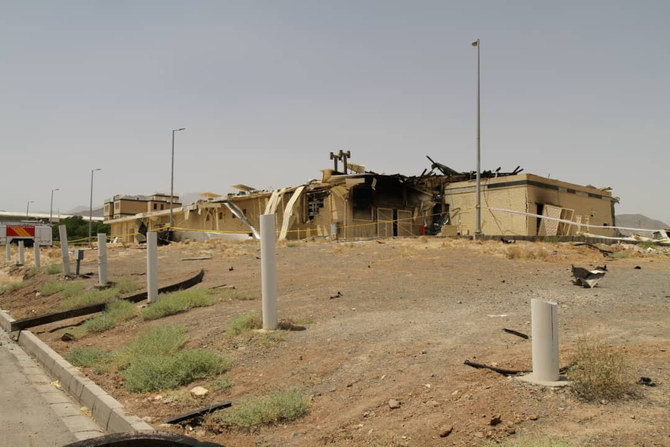
Images later released by Iranian state media show a two-story brick building with scorch marks and its roof apparently destroyed. Debris on the ground and a door that looked blown off its hinges suggested an explosion accompanied the blaze.
“There are physical and financial damages and we are investigating to assess,” Kamalvandi told Iranian state television. “Furthermore, there has been no interruption in the work of the enrichment site. Thank God, the site is continuing its work as before.”
The site of the fire corresponds to a newly opened centrifuge production facility, said Fabian Hinz, a researcher at the James Martin Center for Nonproliferation Studies at the Middlebury Institute of International Studies in Monterey, California.
Hinz said he relied on satellite images and a state TV program on the facility to locate the building, which sits in Natanz's northwest corner.
David Albright of the Institute for Science and International Security similarly said the fire struck the production facility. His institute previously wrote a report on the new plant, identifying it from satellite pictures while it was under construction and later built.
Iranian nuclear officials did not respond to a request for comment about the analysts' comments. However, any damage to the facility would be a major setback, said Hinz, who called the fire “very, very suspicious."
“It would delay the advancement of the centrifuge technology quite a bit at Natanz,” Hinz said. “Once you have done your research and development, you can’t undo that research and development. Targeting them would be very useful" for Iran's adversaries.
Natanz, also known as the Pilot Fuel Enrichment Plant, is among the sites now monitored by the International Atomic Energy Agency after Iran’s 2015 nuclear deal with world powers. That deal saw Iran agree to limit its uranium enrichment in exchange for the lifting of economic sanctions.
The IAEA said in a statement it was aware of reports of the fire. “We currently anticipate no impact on the IAEA’s safeguards verification activities,” the Vienna-based agency said.


![]()

Analysts: Fire at Iran nuke site hit new centrifuge facility
Short Url
https://arab.news/4r8fd
Analysts: Fire at Iran nuke site hit new centrifuge facility
- The fire happened early on Thursday at Natanz, an underground facility where Iran enriches uranium
- The Atomic Energy Organization of Iran sought to downplay the fire, calling it an “incident” that only affected an under-construction “industrial shed”

Latest updates







© 2026 SAUDI RESEARCH & PUBLISHING COMPANY, All Rights Reserved And subject to Terms of Use Agreement.