

Political solution ‘only way’ to end Syrian war: Saudi foreign minister

1 / 2
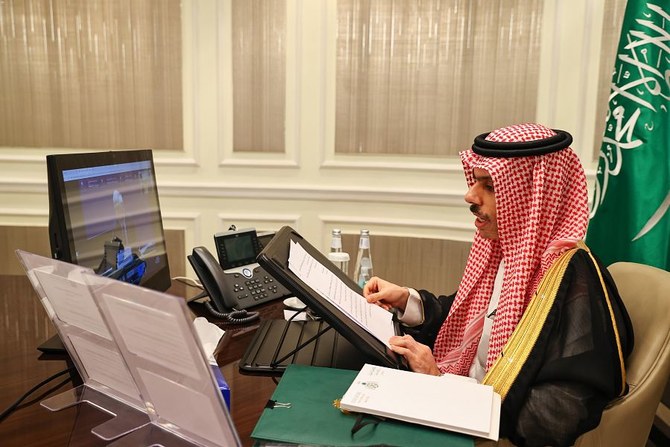
Saudi Foreign Minister Prince Faisal bin Farhan was addressing the fourth Brussels Conference on “Supporting the Future of Syria and the Region.” (SPA)
2 / 2
Saudi Foreign Minister Prince Faisal bin Farhan was addressing the fourth Brussels Conference on “Supporting the Future of Syria and the Region.” (SPA)
Short Url
Updated 30 June 2020
Follow

Political solution ‘only way’ to end Syrian war: Saudi foreign minister

  • “A political solution would be the only way to put an end to the war,” Saudi FM says

RIYADH: Saudi Arabia on Tuesday told a high-profile international conference that only political dialogue could resolve the crisis in Syria.

Speaking at the virtual meeting, co-chaired by the EU and the UN, Saudi Foreign Minister Prince Faisal bin Farhan, said: “A political solution, in line with the (UN) Security Council’s Resolution 2254 (calling for a cease-fire and political settlement in Syria) and the Geneva 1 Conference, would be the only way to put an end to the war.”

He was addressing the fourth Brussels Conference on “Supporting the Future of Syria and the Region,” being held 10 years after the start of the Syrian conflict which has devastated the country and resulted in major issues surrounding regional and international security and stability.

Prince Faisal reiterated the Kingdom’s full support for the efforts of the UN, its special envoy to Syria, Geir Pedersen, the resumption of the work of the constitutional committee, and all initiatives aimed at stopping the fighting in Syria.

“As part of its contribution to a political solution, the Kingdom hosted the Riyadh 1 and 2 conferences, which led to the establishment of the Syrian Negotiation Commission (SNC) and will continue to work on unifying the Syrian opposition.

“Iran continues to pose a significant threat to Syria’s future and identity. If some international parties have interests, Iran has a dangerous regional project, which aims to dominate using sectarian militias and causing civil wars that destroy peoples and homelands,” the prince said.

He pointed out that sectarian militias and terrorist groups were “two sides of the same coin,” creating chaos and destruction, and prolonging the crises and he stressed the importance of combating terrorist organizations in all forms.

“The Kingdom has contributed to alleviating the suffering of the Syrian people by hosting hundreds of thousands of Syrian brothers on its territory. They are treated as equals to Saudi citizens when it comes to job opportunities and healthcare services, while more than 100,000 Syrian students are enrolled in Saudi schools and universities,” the minister added.

Saudi Arabia has to date contributed $1.150 billion to support programs to help millions of Syrian refugees in Jordan, Turkey, and Lebanon carried out by the King Salman Humanitarian Aid and Relief Center (KSRelief) in coordination with the concerned governments.

Prince Faisal told conference delegates that the reconstruction of Syria was dependent on launching a real political settlement process led by the UN, because the repatriation of refugees required “ensuring the necessary conditions to their return according to international standards acknowledged by the UN High Commissioner for Refugees.”


Carved by time: Saudi Arabia’s hidden geotourism gem of Razan

Updated 06 February 2026
Follow

Carved by time: Saudi Arabia’s hidden geotourism gem of Razan

  • Long before modern engineering, the geology of Razan functioned as effective natural infrastructure, sustaining life in an arid environment
  • This utility made Razan a strategic landmark, playing a vital role in the ancient Yemeni Hajj Road

AL-LITH: Sixty kilometers north of Al-Lith governorate in the Kingdom's west, rising above the shifting sands and valleys of the Makkah region, lies a place where the earth itself tells a story. This is Razan, a geological wonder where history is not written in ink, but etched into the stone by the patient hands of wind, water, and time.

Perched atop a high rocky mass and flanked by valleys to the northwest and southeast, Razan stands in natural isolation. This geographic solitude has acted as a guardian, preserving a landscape that feels almost otherworldly — a pristine stage set by nature over millennia.

The place is defined by its striking rock formations: dense clusters of stone, stepped ridges that resemble ancient staircases, and natural ceilings sculpted by the relentless flow of seasonal torrents.

The visual impact is one of dramatic contrast — the heaviness of solid rock balanced against open, airy spaces carved by erosion. Fine channels and intricate flow patterns mark the stone, serving as fossilized evidence of the water that once rushed through these corridors, shaping the land into a rugged work of art.
 

In the quiet majesty of Razan, the past is preserved. (SPA)

Nature’s infrastructure 

But Razan is more than just a scenic marvel; for centuries, it served as a lifeline. The same forces that sculpted the cliffs also hollowed out natural rock basins. These geological depressions acted as seasonal reservoirs, catching rainwater and supplementing nearby wells. Long before modern engineering, the geology of Razan functioned as effective natural infrastructure, sustaining life in an arid environment.

This utility made Razan a strategic landmark, playing a vital role in the ancient Yemeni Hajj Road. The sturdy, elevated terrain provided a natural pathway for pilgrims, offering stability and protection on their spiritual journey toward Makkah.

Today, Razan stands at the intersection of heritage and opportunity. No longer just a passage for pilgrims, it is emerging as a valuable asset for geotourism. Its unique topography offers a visual feast for travelers and a treasure trove for scientists studying geological history.

As Saudi Arabia moves toward the goals of Vision 2030, sites like Razan are finding new purpose. By transforming this geological narrative into a tourism destination, the region aims to preserve its natural heritage while breathing new life into the local economy.