

Huawei controversy opens field for 5G challengers

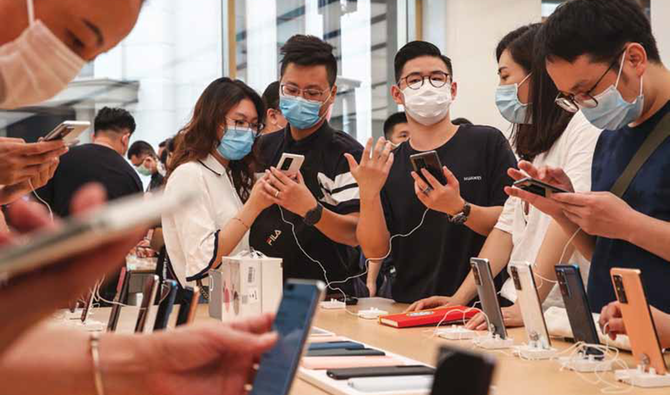
Customers look at Huawei smartphones at a flagship store in Shanghai. Huawei plans to strengthen the brand in its core domestic market. (AFP)
Short Url
Updated 29 June 2020
Follow

Huawei controversy opens field for 5G challengers

  • Current situation offers opportunity to firms like NEC and Samsung to shine

TOKYO: With growing pressure to keep China’s Huawei out of 5G network development, it could be time for firms like Japan’s NEC and South Korea’s Samsung to shine.

Washington has pushed allies to bar Huawei, a Chinese telecom giant, from building next-generation 5G mobile networks, claiming its equipment can be used to spy for Beijing.

Huawei denies the charges, but US pressure has prompted an about-turn in Britain.

The government had already pledged to cut the firm out of the most sensitive “core” elements of 5G that access personal data, and is now reportedly pushing for plans to end Huawei’s involvement in Britain’s 5G infrastructure by 2023.

But excluding Huawei is not without challenges, because there are currently only two alternatives in Europe for 5G equipment such as antennas and relay masts: Finland’s Nokia and Sweden’s Ericsson.

Britain has encouraged Washington to form a club of 10 democratic nations that could develop its own 5G technology, but there has been little movement so far.

“The vast majority of the commercial networks sold in the world come from the big three,” said Sylvain Chevallier, in charge of telecoms at BearingPoint consultancy, referring to Huawei, Nokia and Ericsson. “But a world of three is not good for operators, and if it goes down to two it will be worse still,” he told AFP.

That leaves a tempting potential opening for telecoms firms like Samsung and NEC. But building a successful 5G network is no simple task.

That is a lesson Samsung has already learned. Despite being a major player in 3G, it found itself unable to compete with the big three on 4G and struggled to win commercial contracts.

“This has been a challenge for Samsung,” said Daryl Schoolar, a mobile technology specialist at consulting group Omdia.

In building its 5G network, Samsung has so far focused on North America and parts of the Asia-Pacific region.
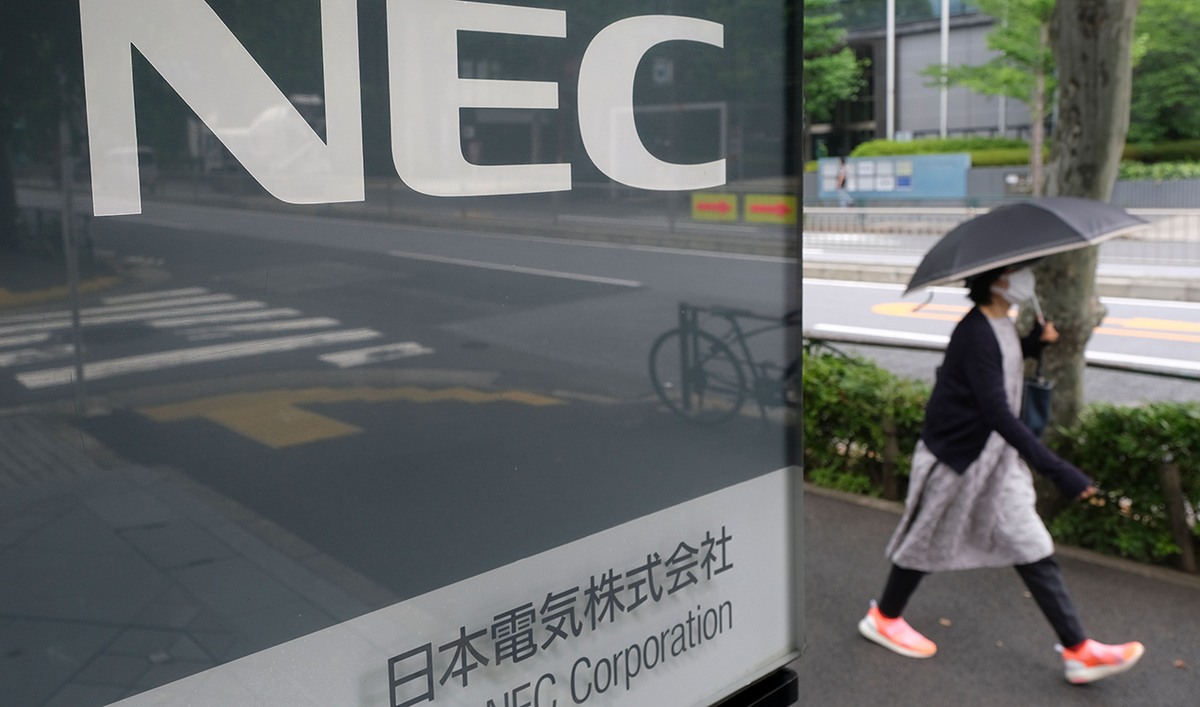


The logo of NEC, Japan’s electronics and information technology company, is displayed at the firm’s headquarters in the capital Tokyo. (AFP/File)

“So while operators may feel uncertain about Samsung Networks, they are much further along in the process of being a global presence than NEC,” Schoolar added.

NEC does have some advantages, including a partnership in Japan with mobile operator Rakuten.

The firms have already cooperated on a 4G network and are now jointly developing a 5G system.

The Japanese firm is also a leader on undersea cables, fiber optic networks and — thanks to its affiliate Netcracker — logistics management software.

“Netcracker has a strong presence with operators in Europe, which could be a real entry point for NEC,” said Stephane Teral, chief telecoms analyst at LightCounting, a market research firm.

NEC is tightlipped about its contracts for mobile networks, saying only that it is holding feasibility demonstrations for “a number of customers and we are engaged in commercial discussions with others.”

Britain’s government has reportedly asked both NEC and Samsung to take part in demonstrations as it looks to diversify its 5G options.

And on Thursday, NEC announced a tie-up with Japanese operator NTT intended in part to speed up the development of a 5G network.

Samsung and NEC joined forces 2 years ago and have launched a joint marketing team to offer 5G products to European and Asian markets.

Still, the path ahead will be tough, said Schoolar.

“I think it’s a major challenge for NEC. It requires more than radios, it requires investing in people who can do system integration, sales, customer support, network design and engineering,” he said.

“Plus NEC will need to build operator trust that they will be there to support them in 5 to 10 years as those 5G networks evolve.”

Washington has backed the use of nonproprietary technology like Open RAN in 5G development, hoping it will provide an entry point for US firms.

Such a move would open up opportunities for NEC, allowing them to “create an economic model that would shake up traditional equipment manufacturers,” said Chevallier.


Saudi Maaden reports 156% profit surge to $2bn on strong commodity prices, record production

Updated 05 March 2026
Follow

Saudi Maaden reports 156% profit surge to $2bn on strong commodity prices, record production

RIYADH: Saudi mining and metals company Maaden has reported a 156 percent jump in its net profit attributable to shareholders for 2025, driven by higher commodity prices, record production volumes, and a one-off bargain purchase gain.

The state-backed giant posted a net profit of SR7.35 billion ($1.95 billion) for the full year 2025, an increase from SR2.87 billion in the previous year. The firm’s revenue surged by 19 percent to SR38.58 billion, up from SR32.55 billion in 2024.

This comes as Saudi Arabia steps up efforts to expand its mining sector as a pillar of economic diversification, encouraging international participation and private investment to unlock the Kingdom’s estimated $2.5 trillion in untapped mineral resources under Vision 2030.    

In a statement on Tadawul, the company said: “Performance was led by record phosphate production, near record aluminum production, an increase in all three of Maaden’s main output commodity prices.”

The performance was also fueled by a 60 percent increase in gross profit, which reached SR14.79 billion. In its annual results announcement, Maaden attributed the top-line growth to “higher commodity market prices for phosphate, aluminum and gold business units,” as well as increased sales volumes in its phosphate and aluminum segments. This was partially offset by slightly lower sales volume in the gold unit.

Maaden’s CEO, Bob Wilt, hailed 2025 as a transformative year for the company, marked by strategic growth and operational excellence. “This was a great year for Maaden’s strategic growth. We delivered strong financial results and sustained operational excellence across the business,” he said in a statement.

“This was driven by growth in production across all businesses, including record-breaking DAP (di-ammonium phosphatevolumes), disciplined cost control across and a clear commitment to our role as a cornerstone of the Saudi economy,” Wilt added.

Profitability was further bolstered by an increased share of net profit from joint ventures and an associate. This included a one-off bargain purchase gain of SR768 million related to Maaden’s investment in Aluminium Bahrain B.S.C. The company also benefited from lower finance costs.

The fourth quarter of 2025 was strong, with Maaden swinging to a net profit of SR1.67 billion, compared to a loss of SR106 million in the same period of the prior year. Quarterly revenue rose 7 percent to SR10.64 billion.

The firm achieved record production of di-ammonium phosphate, reaching 6.72 million tonnes for the year, a 9 percent increase. Aluminum production remained near-record levels, while the company added a net 7.8 million ounces to its reportable gold mineral resources through discovery and resource development.

The phosphate division saw sales jump 17 percent to SR20.77 billion, with the earnings before interest, taxes, depreciation, and amortization margin expanding to 47 percent. The aluminum business reported a 9 percent increase in sales to SR10.99 billion, with EBITDA more than doubling in the fourth quarter.

Looking ahead, Wilt emphasized that the pace of growth will accelerate as the company advances key initiatives, including the Phosphate 3 Phase 1 and Ar Rjum projects, which remain on budget and schedule. Maaden has also secured a gas supply for its future Phosphate 4 project.

“This pace of growth will only accelerate. Not only as we advance projects and increase the scale of our exploration program, but as we continue to grow production and implement technology that will further modernize, streamline and unlock value,” Wilt added.

Earnings per share for the year rose sharply to SR1.91, up from SR0.78 in 2024. Total shareholders’ equity increased by 18.7 percent to SR61.59 billion.