HALLE, Belgium: For a long time, few people in the small Belgian town of Halle paid much attention to the monuments. They were just fixtures in a local park, tributes to great men of the past.
But these are very different times, and yesterday’s heroes can be today’s racist villains.
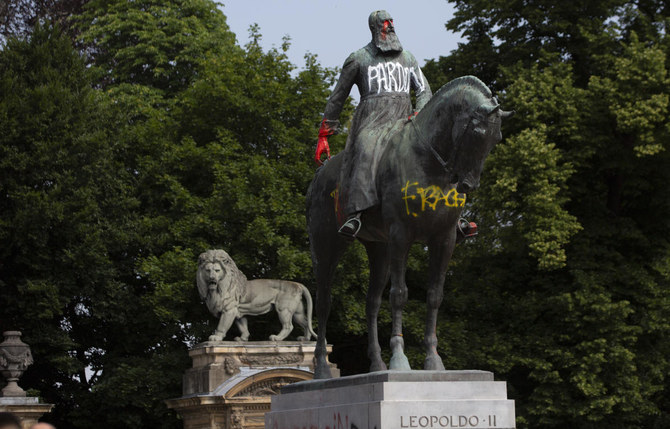
And so it was that three weeks ago, a bust of Leopold II, the Belgian king who has been held responsible for the deaths of millions of Congolese, was spattered in red paint, labeled “Murderer,” and later knocked off its pedestal.
Nearby, a pale sandstone statue formally known as the “Monument to the Colonial Pioneers” has stood for 93 years. It depicts a naked Congolese boy offering a bowl of fruit in gratitude to Lt. Gen. Baron Alphonse Jacques de Dixmude, a Belgian soldier accused of atrocities in Africa.
These monuments, and others across Europe, are coming under scrutiny as never before, no longer a collective blind spot on the moral conscience of the public. Protests sweeping the world that followed the death of George Floyd, a Black man killed last month by Minneapolis police, are focusing attention on Europe’s colonial past and racism of the present.
Eric Baranyanka, a 60-year-old musician who came to Halle as a refugee from Belgium’s African colony of Burundi when was 3, said he has always found the statue of Jacques “humiliating.”
“I had this pride being who I was. It was in complete contradiction with that statue,” he said.
But Halle Mayor Marc Snoeck appears to be more representative of his citizenry. He said he “never really noticed” the monuments until an anti-colonial group raised awareness of them a dozen years ago in the town of 40,000 people about 15 kilometers (10 miles) south of Brussels.
“I’m part of an older generation and I heard precious little during my studies about colonialism, the Congo Free State and the Belgian Congo,” said the 66-year-old Snoeck, noting he was taught about how Europeans brought civilization, not exploitation and death, to the heart of Africa.
Statues of Leopold, who reigned from 1865 to 1909, have been defaced in a half-dozen cities, including Antwerp, where one was burned and had to be removed for repairs. It’s unclear if it will ever come back.
But Leopold is hardly the only focus. Snoeck found it remarkable that protesters have not targeted the statue of Jacques, which he called “possibly even worse.”
The mayor said the statue is known locally as “The White Negro,” because of the hue of the sandstone depicting the Congolese youth offering the fruit to the colonial-era Belgian who condoned or was responsible for murders, rapes and maiming workers in the Congo Free State.
Baranyanka was lovingly raised by a white foster family in Halle and said he never experienced prejudice until after he had been in Belgium for about a decade.
His 98-year-old foster mother Emma Monsaert recalls others in town asking her if she was really going to take in a Black youth in the 1960s: “I said, ‘Why not, it is a child after all.’”
But at school, Baranyanka found out how others felt about race.
One teacher poured salt on his head, he recalled, saying it would make it whiter. When he wanted a part in a school play of the 17th century fairy tale “Puss in Boots,” he was denied a role, with a teacher telling him: “Mr. Baranyanka, in those days there were no Blacks in Europe.”
He counts himself lucky to have had a close circle of friends that survives to this day. As a teenager, he often talked to them about the monuments, his African roots and Leopold’s legacy.
“They understood, and they were grateful I explained it,” he said.
On Tuesday, Congo celebrates 60 years of independence from Belgium. The city of Ghent will remove a statue of Leopold to mark the anniversary and perhaps take a healing step forward.
Eunice Yahuma, a local leader of a group called Belgian Youth Against Racism and the youth division of the Christian Democrats, knows about Belgium’s troubled history.
“Many people don’t know the story, because it is not being told. Somehow they know, ‘Let’s not discuss this, because it is grim history,’” said Yahuma, who has Congolese roots. “It is only now that we have this debate that people start looking into this.”
The spirit of the times is different, she said.
“Black people used to be less vocal. They felt the pain, but they didn’t discuss it. Now, youth is very outspoken and we give our opinion,” Yahuma added.
History teachers like 24-year-old Andries Devogel are trying to infuse their lessons with the context of colonialism.
“Within the next decade, they will be expecting us to stress the impact of colonialism on current-day society, that colonialism and racism are inextricably linked,” Devogel said. “Is contemporary racism not the consequence of a colonial vision? How can you exploit a people if you are not convinced of their second-class status?”
The colonial era brought riches to Belgium, and the city of Halle benefited, building a rail yard that brought jobs. Native son Franz Colruyt started a business that grew into the supermarket giant Colruyt Group with 30,000 employees — one of them Baranyanka’s foster father.
Halle has escaped the violence seen in other cities from the protests, and officials would rather focus attention on its Gothic church, the Basilica of St. Martin, as well as its famous fields of bluebells and Geuze beer.
Baranyanka, who will soon stage a musical show of his life called “De Zwette,” — ”The Black One,” returned recently to the park and the monuments.
Despite the hostility and humiliation he felt as a youngster, he didn’t consider their destruction as the way to go.
“Vandalism produces nothing, perhaps only the opposite effect. And you see that suddenly such racism surges again,” he said. “It breeds polarization again. This thing of ‘us against them.’”
Devogel, the teacher, says it is the task of education “to let kids get in touch with history.”
“Otherwise, it will remain a copper bust without meaning,” he said of the Leopold II monument. “And you will never realize why, for all these people, it is so deeply insulting.”


![]()

In Belgian town, monuments expose a troubled colonial legacy
In Belgian town, monuments expose a troubled colonial legacy
- Protests sweeping the world that followed the death of George Floyd are focusing attention on Europe’s colonial past and racism of the present
Latest updates


Recommended


© 2026 SAUDI RESEARCH & PUBLISHING COMPANY, All Rights Reserved And subject to Terms of Use Agreement.