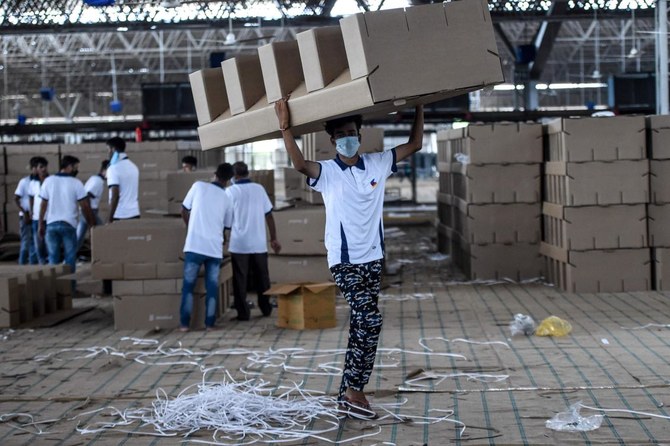
BHIWADI, India: India is deploying thousands of beds made of cardboard to makeshift medical facilities as it struggles to deal with the surging number of coronavirus cases.
The low-cost beds are chemically coated to make them waterproof and can hold a 300-kilogramme (660-pound) load, said Vikram Dhawan, who along with his brother came up with the design while they were stuck at home during the country’s months-long lockdown.
“One person can pick it up very comfortably,” Dhawan told AFP at his factory in the northern city of Bhiwadi which already makes cardboard products.
“It’s compact, lightweight and can be manufactured and assembled in minutes.”
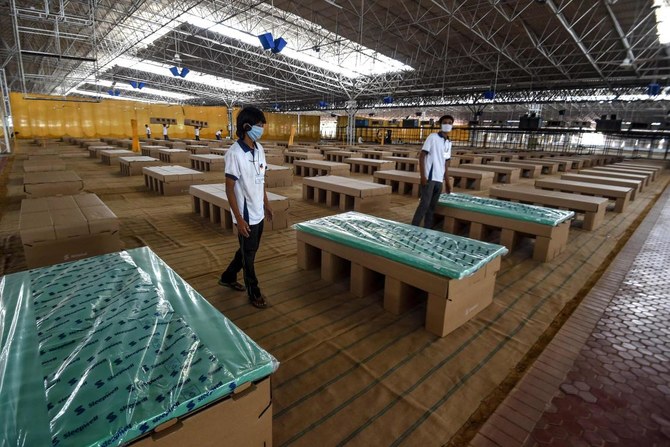
The New Delhi government is installing 10,000 of the beds in a spiritual center on the outskirts of the city that is being converted into a dedicated coronavirus facility.
Mumbai, which like the capital has seen its hospitals overwhelmed by COVID-19 patients, is also using them.
“The most important thing is that the virus only stays on the surface of cardboard for 24 hours,” Dhawan said.
“On any other surface, metal, wood or plastic, it stays for three to four days.”
A study published in March in the US journal NEJM showed the coronavirus can remain for up to three days on plastic but only for 24 hours on cardboard.
Mattresses for the beds are supplied by Sheela Foam Limited which teamed up with the Dhawan brothers earlier this year.
“We typically associate beds with steel or wood but the requirement here was such that we needed a kind of disposable or sanitization bed,” said Sudhir Varanasi, head of supply chain management at Sheela.
“Both here have a protective coating so that they can be cleaned and not get spoiled after any accidental spillage,” Varanasi said as workers set up the beds at the vast Radha Soami Spiritual Center.
The Dhawan brothers have not publicly revealed the price tag of making each bed, but it reportedly costs around $10.
Once the coronavirus epidemic is over, they see a market for their product.
“I think 50 to 60 of our own workers have taken it home and are very happy using it everyday,” said Dhawan.
“It costs the amount you’d spend each time you go out to eat at a restaurant.”

India turns to cardboard beds in coronavirus battle
Short Url
https://arab.news/b7nf2
India turns to cardboard beds in coronavirus battle
- New Delhi’s government is installing 10,000 of the beds in a center that is being converted into a coronavirus facility
- A study published in a US journal showed the coronavirus can remain for up to three days on plastic but only for 24 hours on cardboard
Voting passes peacefully in Nepal’s first election since September youth-led protests
KARMANDU: Voting was peaceful in Nepal’s first nationwide election Thursday since a violent, youth-led uprising forced the government from power in September.
Turnout was about 60 percent and only a few minor incidents were reported, according to Nepal’s acting Chief Election Commissioner Ram Prasad Bhandari.
Vote counting would begin immediately after the ballot boxes are collected and transported to counting centers across the Himalayan nation, which could be as early as Thursday night. Results were expected by the weekend. Helicopters will be used to ferry the boxes from polling stations in remote mountain villages in the northern region by Friday morning, Bhandari said.
The next administration is expected to inherit daunting challenges. It must deliver on changes demanded by last year’s protests, tackle entrenched corruption and carefully manage ties with its powerful neighbors, India and China.
“I came to vote mainly because of the protest and so many people gave their lives in the hope of a change, in hope of seeing better Nepal,” said Luniva, a first-time voter. “Hopefully, I want to see my country become better by all the sacrifices that have been made.”
Others shared similar hopes that the election could usher in positive change after months of political unrest.
Voters are directly electing 165 members to the House of Representatives, the lower chamber of Parliament. The remaining 110 seats in the 275-member body will be allocated through a proportional representation system, under which political parties nominate lawmakers based on their share of the vote.
The election is widely seen as a three-way contest, shaped by voter frustration over widespread corruption and demands for greater government accountability.
The National Independent Party, founded in 2022, is considered the front-runner, posing a strong challenge to two long-dominant parties: the Nepali Congress and the Communist Party of Nepal (Unified Marxist–Leninist).
The new party’s prime ministerial candidate is rapper-turned-politician Balendra Shah, who won the 2022 Katmandu mayoral race and emerged as a leading figure in the 2025 uprising that ousted former Prime Minister Khadga Prasad Oli.
Shah, 35, has rode a wave of public anger toward traditional political parties. He highlighted health and education for poor Nepalis as a key focus of his campaign.
The protests against corruption and poor governance were triggered by a social media ban before snowballing into a popular revolt against the government. Dozens were killed and hundreds injured when protesters attacked government buildings and police opened fire on them.
While the Congress and the Communists retain loyal voter bases, Shah’s party has drawn larger crowds on the campaign trail, highlighting its growing appeal among younger voters seeking an alternative.
There are about 19 million registered voters among the country’s nearly 30 million people, according to the Election Commission of Nepal.
Millions of Nepalis living overseas are unable to take part in the vote. An estimated 3 million citizens work abroad — largely in the Middle East, Southeast Asia and neighboring India — and cannot cast ballots because the country does not yet have a system allowing voting from abroad.
Turnout was about 60 percent and only a few minor incidents were reported, according to Nepal’s acting Chief Election Commissioner Ram Prasad Bhandari.
Vote counting would begin immediately after the ballot boxes are collected and transported to counting centers across the Himalayan nation, which could be as early as Thursday night. Results were expected by the weekend. Helicopters will be used to ferry the boxes from polling stations in remote mountain villages in the northern region by Friday morning, Bhandari said.
The next administration is expected to inherit daunting challenges. It must deliver on changes demanded by last year’s protests, tackle entrenched corruption and carefully manage ties with its powerful neighbors, India and China.
“I came to vote mainly because of the protest and so many people gave their lives in the hope of a change, in hope of seeing better Nepal,” said Luniva, a first-time voter. “Hopefully, I want to see my country become better by all the sacrifices that have been made.”
Others shared similar hopes that the election could usher in positive change after months of political unrest.
Voters are directly electing 165 members to the House of Representatives, the lower chamber of Parliament. The remaining 110 seats in the 275-member body will be allocated through a proportional representation system, under which political parties nominate lawmakers based on their share of the vote.
The election is widely seen as a three-way contest, shaped by voter frustration over widespread corruption and demands for greater government accountability.
The National Independent Party, founded in 2022, is considered the front-runner, posing a strong challenge to two long-dominant parties: the Nepali Congress and the Communist Party of Nepal (Unified Marxist–Leninist).
The new party’s prime ministerial candidate is rapper-turned-politician Balendra Shah, who won the 2022 Katmandu mayoral race and emerged as a leading figure in the 2025 uprising that ousted former Prime Minister Khadga Prasad Oli.
Shah, 35, has rode a wave of public anger toward traditional political parties. He highlighted health and education for poor Nepalis as a key focus of his campaign.
The protests against corruption and poor governance were triggered by a social media ban before snowballing into a popular revolt against the government. Dozens were killed and hundreds injured when protesters attacked government buildings and police opened fire on them.
While the Congress and the Communists retain loyal voter bases, Shah’s party has drawn larger crowds on the campaign trail, highlighting its growing appeal among younger voters seeking an alternative.
There are about 19 million registered voters among the country’s nearly 30 million people, according to the Election Commission of Nepal.
Millions of Nepalis living overseas are unable to take part in the vote. An estimated 3 million citizens work abroad — largely in the Middle East, Southeast Asia and neighboring India — and cannot cast ballots because the country does not yet have a system allowing voting from abroad.
© 2026 SAUDI RESEARCH & PUBLISHING COMPANY, All Rights Reserved And subject to Terms of Use Agreement.