

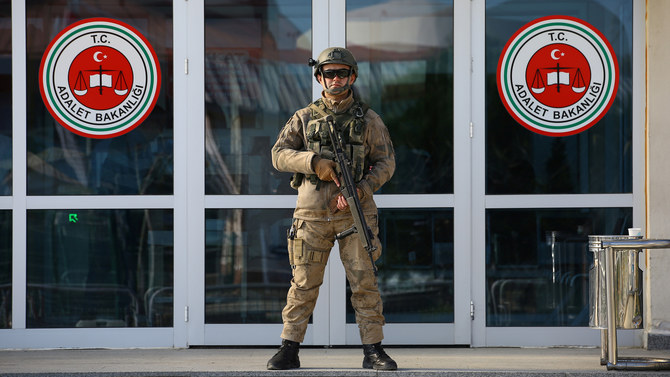

ANKARA: In a surprise move, Turkey on Wednesday released three journalists charged with revealing state secrets in their coverage of the deaths of Turkish intelligence officers in Libya.
However, three others were remanded in custody while they stand trial on charges of revealing the identities of two members of Turkey’s intelligence agency.
The high-profile case, with the defendants facing up to 19 years in jail, has been closely monitored by domestic and international press freedom groups following the arrest of the journalists four months ago.
The journalists who appeared in court on Wednesday worked for media outlets supporting the political views of the Turkish opposition, ranging from ultra-nationalists to pro-Kurdish and socialist segments.
Baris Terkoglu, Ferhat Celik and Aydin Keser were released from prison following the court decision, while the other three defendants will remain in jail until the next hearing, which is set for Sept. 9.
“This trial should not exist since the indictment fails to prove its claim of conspiracy by the journalists,” said Ozgur Ogret, Turkish representative for the Committee to Protect Journalists (CPJ).
“But since it exists, all the defendants should have been released on Wednesday to be tried without arrest,” he told Arab News.
Another source of controversy was the identity of the intelligence officer being leaked — before any media reports — by an opposition MP, Umit Ozdag, during a parliamentary speech.
Baris Pehlivan, one of the three journalists still behind bars, said during his defense that the group are victims of a “political operation” that was held through the “funeral ceremony of the martyr.”
Ogret said the arrest of the journalists was “potentially deadly” because of the pandemic.
“No journalist should be in prison for reporting at any time, but jailing journalists now is a risk to their health and possibly life,” he said.
In a report on June 10, the US-based Center for American Progress said that Turkey’s censorship “is rapidly reshaping how Turks get their news, with major implications for Turkish foreign policy, political polarization and President Recep Tayyip Erdogan’s rule.”
When Twitter recently suspended more than 7,300 Turkish accounts, arguing that these were part of a network associated with the youth wing of the government, Ankara said in a harshly worded statement that these were attempts to “redesign Turkish politics.”
The government also accused Twitter of acting as a “propaganda machine” with a political agenda.
Meanwhile, Turkey’s court of appeal on June 23 upheld a nine-year prison sentence given to Canan Kaftancioglu, the Istanbul chair of Turkey’s main opposition party, over anti-government tweets she posted seven years ago.
Renan Akyavas, Turkey program coordinator at the Vienna-based International Press Institute, said the Turkish government has been suppressing media outlets for a long time.
“Especially when it comes to the most topical and sensitive issues in Turkey’s agenda, journalists from all sides of the political spectrum have been targeted by authorities. The release of three journalists yesterday is at best only the smallest hint of ‘justice,’ given that the other three remain in prison for at least another two months,” she told Arab News.
Akyavas added that the journalists should not have been jailed for reporting on a topic in the public interest.
“A known fact already in the public domain cannot be criminalized. The right thing here would be to drop all charges against these journalists without delay,” she said.
Akyavas said that public pressure on individual cases can influence institutions and decision-makers, “even though the overall landscape on media freedom is still in a terrible state.”


