Lebanon opens its airport, but will accept only 2,000 travelers per day

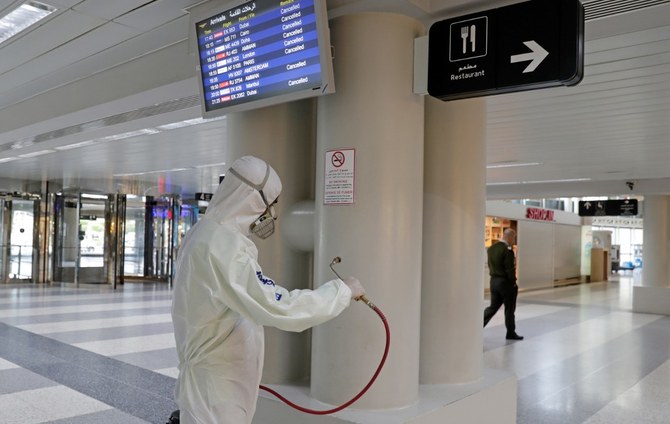
Passengers will conduct a PCR upon their arrival at the Rafik Hariri International Airport “at the airline’s expense.” (File/AFP)
Short Url
Updated 24 June 2020
Follow

Lebanon opens its airport, but will accept only 2,000 travelers per day

  • Sri Lanka evacuates 167 of its nationals, but 25,000 remain in Lebanon

BEIRUT: Lebanon is preparing to reopen the Rafic Hariri International Airport in Beirut on July 1 for the first time in more than three months.

It is reducing the number of flights from countries where the polymerase chain reaction (PCR) test for the virus is not available to passengers to 20 percent of pre-pandemic levels. Flights from countries that do have the test will be at 80 percent of previous levels.

A source at Lebanese Middle East Airlines (MEA) said that “not many reservations have been made by Lebanese to leave Lebanon when the airport opens. Europe is still closed to the Lebanese, as are the Gulf states. The only countries that are accepting flights from Lebanon are Greece, Cyprus and Turkey. Spain may soon do so. Lebanese who hold Schengen visas are not allowed to enter European countries.”

The source said: “Beirut airport will not accept more than 2,000 passengers per day.”

Face masks will be mandatory for passengers and aircrews inside the terminal and on the plane. All travelers are required to bring with them a sufficient number of masks to use and to change them every four hours. They must also bring their own hand sanitizer.

The Minister of Health, Hamad Hassan, said that “the criterion is no longer the number of COVID-19 infections. Rather, it is the gradual societal immunity. The country was opened because the economic situation is deteriorating and we will gain societal immunity.”

The MEA announced the conditions set by the Lebanese authorities for travelers entering Lebanon. One is that travelers coming from countries that have PCR tests should take the test in laboratories licensed by the local authorities at most four days before the departure date, and must show the result of the test at check-in counters. Travelers will have to take another PCR test, at the expense of the airline, on their arrival at Beirut airport.

Travelers who come from countries where PCR tests are not available will take a PCR test on arrival at Beirut airport at the expense of the airline. They must take a second PCR test after 72 hours at their own expense.

Travelers coming to Lebanon must possess a health insurance policy that is valid for the duration of their stay, covering all costs of treatment for COVID-19 on Lebanese soil. Lebanese nationals must also have insurance but enjoy the right to medical treatment in their country.

Sri Lanka’s ambassador to Lebanon, Shani Calyaneratne, has announced that 167 Sri Lankan nationals are being evacuated by plane from Lebanon today, leaving “about 25,000 workers who came in the 1980s, 1990s and the beginning of this century and wish to stay will remain in Lebanon as long as the employers approve this.”


Lifting sanctions on Syria will prevent Daesh resurgence and strengthen the nation, experts say

Updated 11 December 2025
Follow

Lifting sanctions on Syria will prevent Daesh resurgence and strengthen the nation, experts say

  • Conference in Washington discusses effects US policies are having on post-Assad Syria, and the continuing economic hardships in the country that could fuel terrorism
  • Participants praise US President Donald Trump for taking the right steps to help the war-torn nation move towards recovery and stabilization

Syria faces serious challenges in the aftermath of the fall of the Assad regime a year ago, including rebuilding its economy, lifting refugees and civilians out of poverty, and preventing a resurgence of Daesh terrorism.

But experts in two panel discussions during a conference at the Middle East Institute in Washington, D.C., on Wednesday, attended by Arab News, agreed that US President Donald Trump had so far taken all the right steps to help the war-torn nation move toward recovery and stabilization.

One of the discussions explored the effects American policies are having on the rebuilding of Syria, including the lifting of sanctions and efforts to attract outside investments and stabilize the economy. Moderated by the institute’s vice president for policy, Kenneth Pollack, the participants included retired ambassadors Robert Ford and Barbara Leaf, and Charles Lister, a resident fellow at the institute.

The other discussion focused on the continuing economic hardships in Syria that could fuel terrorism, including a resurgence of Daesh. Moderator Elizabeth Hagedorn, of Washington-based Middle East news website Al-Monitor, was joined by Mohammed Alaa Ghanem of the Syrian American Council, Celine Kasem of Syria Now, and Jay Salkini from the US-Syria Business Council.

“As we went into a transitional era, US diplomacy took a back step for a while as the Trump administration came into office,” Lister noted during the first panel discussion.

Everyone has been “super skeptical” of where the new government led by President Ahmad Al-Sharaa, a former commander with the Syrian opposition forces, would lead the country, he said, but Trump had stepped up through policies and support.

“Frankly, I think in January none of us expected that President Donald Trump would be shaking hands with Ahmad Al-Sharaa” a few months later, he added.

“Despite the obvious challenges, this new (Syrian) government has to be engaged.”

The US had maintained strong ties to the Syrian Democratic Forces, and with Al-Sharaa’s Hayat Tahrir Al-Sham, Lister said, in the decade leading up to the collapse of Syrian President Bashar Assad’s regime on Dec. 8, 2024.

“Of course, we’ve had 10 years of a superb partnership with the Syrian Democratic Forces, but they were a non-state actor not a sovereign government,” he continued.

“Now, we have a sovereign government that we could test, we can engage, and we can see where that goes. And in working through a sovereign government, there is no comparison that comes anywhere close to what we’ve seen on Syria.”

Lister praised Trump, saying: “I think a lot of that goes down to President Trump’s own kind of gut instinct of the way to do things.

“But there is a deeper, deeper government bench that has worked on this through Treasury and State and elsewhere. I think they all deserve credit for moving so rapidly and so boldly to give Syria a chance, as President Trump says.”

Ford said a key aspect of the process as Syria moves forward will be the removal of all sanctions imposed by the US against the Assad regime under the 2019 Caesar Act, an effort that is now underway in Congress.

He said Trump recognizes that the future of Syria and the wider Middle East lies in the hands of the Arab people, and has pursued policies based on “shared interests” including a “national security

strategy” to help the war-torn country shift away from extremism and violence toward a productive economy and safer environment for its people.

The Trump administration recognizes this reality, Ford added, and will “work on a practical level towards shared interests.”

However, he cautioned that “Syria is not out of the woods, by any stretch of the imagination” in terms of ensuring there is no resurgence of violence driven by desperate people burdened by the harsh economic realities in the country.

“If they can work with the Syrian government, and with more and more important regional actors as the United States retrenches — like Israel, Turkiye, Saudi Arabia, the United Arab Emirates, Qatar and Egypt; it’s a long list — it will become more important,” Ford said.

“There is still a way for the Americans to work with all of them, even if we don’t have big boots on the ground, or if we’re not providing billions of dollars.”

Nonetheless, “America’s voice will still be heard,” he added, thanks to the interest Trump is taking in Syria.

Adopted by Congress six years ago, toward the end of Trump’s first term as president, the Caesar Act imposed wide-ranging sanctions on Syria, including measures that targeted Assad and his family in an attempt to ensure his regime would be held accountable for war crimes committed under its reign. The act was named after a photographer who leaked images of torture taking place in Assad’s prisons.

Lister noted that the removal of the US sanctions has been progressing at “record-breaking speeds.”

In pre-taped opening remarks to the conference, which took place at the institute’s offices in Washington, Adm. Brad Cooper, commander of the US Central Command, said the Trump administration’s priority in Syria is the “aggressive and relentless pursuit” of Daesh, while working on the integration of the Syrian Democratic Forces with the new Syrian government through American military coordination.

“Just to give an example, in the month of October, US forces advised, assisted and enabled Syrian partners during more than 20 operations against (Daesh), diminishing the terrorists’ attacks and export of violence around the world,” he said. “We’re also degrading their ability to regenerate.”

Cooper added that the issue of displacement camps in northeastern Syria must also be addressed. He said he has visited Al-Hawl camp four times since his first meeting with Al-Sharaa, “which reinforced my view of the need to accelerate repatriations.”

He continued: “The impact on displaced persons devastated by years of war and repression has been immense. As I mentioned in a late-September speech at the UN, continuing to repatriate displaced persons and detainees in Syria is both a humanitarian imperative and a strategic necessity.”

The US is working with Syrian forces to “supercharge” this effort, Cooper said, noting that the populations of Al-Hawl and Al-Roj camps have fallen from 70,000 to about 26,000.

The second panel discussion painted a very bleak picture of the economic challenges the Syrian people face, with the average income only $200-$300 a month, a level that the experts warned could push desperate people to violence just to survive.

The US-Syria Business Council’s Salkini said many major companies and factories that once operated in Syria had relocated to neighboring countries such as Lebanon, Iraq and Turkiye.

“We’re looking at about 50 percent-plus unemployment,” he said. “Let me give you statistics on the wages: A factory worker today, his salary is $100-$300 a month. A farmer makes $75-$200 a month in salary. A manager (or) a private in the military makes $250 a month.

“So you can imagine how these people are living on these low wages, and still have to buy their iPhone, their internet, pay for electricity.”

Many displaced people are unable to return to their former homes, the panelists said, because they were destroyed during the war and there is no accessible construction industry to rebuild them.

The capital, Damascus, faces many challenges they added, and the situation is even worse in the country.