

Saudi Arabia announces Hajj with limited pilgrims from nationalities residing inside Kingdom

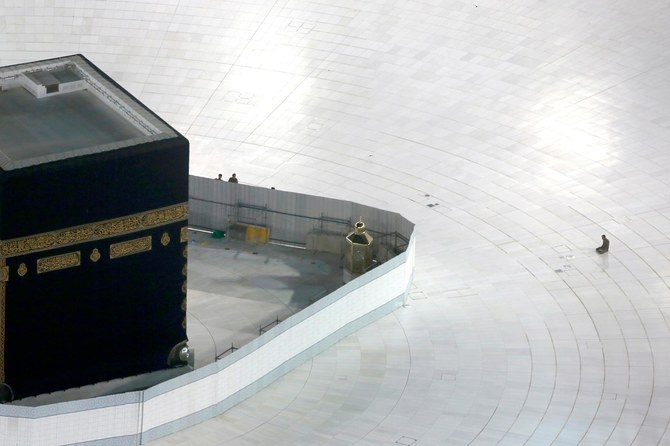
Saudi Arabian security officers stand in front of the Kaaba at an empty Grand Mosque, as a preventive measure against COVID-19 during the holy month of Ramadan, in the holy city of Makkah on May 5, 2020. (REUTERS/ Saudi Press Agency Handout )
Short Url
Updated 22 June 2020
Follow

Saudi Arabia announces Hajj with limited pilgrims from nationalities residing inside Kingdom

  • Hajj ministry says decision taken to ensure Hajj safely performed while committing to preventive measures against coronavirus
  • Some 2.5 million pilgrims visit the holiest sites of Islam in Makkah and Madinah for the week-long Hajj pilgrimage each year

RIYADH: Saudi Arabia’s ministry of Hajj announced on Monday that only a limited number of people, irrespective of nationality, who currently reside in the Kingdom would be allowed to perform the annual Hajj pilgrimage this year.

Some 2.5 million pilgrims visit the holiest sites of Islam in Makkah and Madinah for the week-long Hajj each year. In March, Saudi Arabia asked Muslims to put Hajj plans on hold and suspended Umrah until further notice.

On Sunday, Saudi Arabia lifted a three-month long curfew introduced in March to halt the spread of the new coronavirus, including 24-hour curfews in most towns and cities, with most people only allowed out for essential shopping or urgent medical reasons.

Saudi Arabia has so far reported more than 157,000 COVID-19 cases and 1,267 deaths.

“As COVID-19 cases continue to grow globally while the risks of coronavirus spread in crowded spaces and to countries still exist, Hajj 1441H is decided to take place this year with a limited number of pilgrims from all nationalities residing in Saudi Arabia only, who are willing to perform Hajj,” the state-run SPA news agency said in a statement, quoting the ministry of Hajj.

“This decision is taken to ensure Hajj is safely performed while committing to all preventive measures to protect Muslims and adhere strictly to the teachings of Islam in preserving our health and safety.”

In 2019, around 19 million pilgrims attended Umrah while Hajj drew 2.6 million. An economic reform plan by Crown Prince Mohammed bin Salman aims to increase Umrah and Hajj capacity to 30 million pilgrims annually and generate 50 billion riyals ($13.32 billion) of revenues by 2030.

The SPA statement said Saudi Arabia was honored to serve millions of Hajj and Umrah pilgrims annually and said the decision to allow a limited Hajj this year “is in consideration of its constant care of maintaining the safety of pilgrims on its land until departing back to their home countries. We ask Allah the Almighty to protect all countries from this pandemic and keep all humans protected and safe."


Australia Day protesters demand Indigenous rights

Updated 7 sec ago
Follow

Australia Day protesters demand Indigenous rights

SYDNEY: Thousands of people rallied in cities across Australia demanding justice and rights for Indigenous peoples on Monday, a national holiday marking the 1788 arrival of a British fleet in Sydney Harbor.
Crowds took to the streets in Sydney, Melbourne, Canberra, Perth and other cities on Australia Day, many with banners proclaiming: “Always was, always will be Aboriginal land.”
In Sydney, police allowed the protests to go ahead despite new curbs introduced after gunmen opened fire on a Jewish Hanukkah festival on Bondi Beach on December 14, killing 15 people.
Millions of Australians celebrate the annual holiday with beers and backyard barbecues or a day by the sea, and this year a broad heatwave was forecast to push the temperature in South Australian capital Adelaide to 45C.
Shark sightings forced people out of the water at several beaches in and around Sydney, however, after a string of shark attacks in the region this month — including one that led to the death of a 12-year-old boy.
Many activists describe the January 26, 1788, British landing as “Invasion Day,” a moment that ushered in a period of oppression, lost lands, massacres and Indigenous children being removed from their families.
Aboriginal and Torres Strait Islander peoples make up about four percent of the population.
They still have a life expectancy eight years shorter than other Australians, higher rates of incarceration and deaths in custody, steeper youth unemployment and poorer education.

- Anti-immigration protests -

“Let’s celebrate on another day, because everyone loves this country and everyone wants to celebrate. But we don’t celebrate on a mourning day,” Indigenous man Kody Bardy, 44, told AFP in Sydney.
Another Indigenous protester in Sydney, 23-year-old Reeyah Dinah Lotoanie, called for people to recognize that a genocide happened in Australia.
“Ships still came to Sydney and decided to kill so many of our people,” she said.
Separately, thousands of people joined anti-immigration “March for Australia” protests in several cities, with police in Melbourne mobilizing to keep the two demonstrations apart.
In Sydney, “March for Australia” protesters chanted, “Send them back.” Some carried banners reading: “Stop importing terrorists” or “One flag, one country, one people.”
“There’s nowhere for people to live now, the hospitals are full, the roads are full, you’ve got people living on the streets,” said one demonstrator, 66-year-old Rick Conners.
Several also held aloft placards calling for the release of high-profile neo-Nazi Joel Davis, who is in custody after being arrested in November on allegations of threatening a federal lawmaker.
“There will be no tolerance for violence or hate speech on Sydney streets,” New South Wales Premier Chris Minns told reporters.
“We live in a beautiful, multicultural community with people from around the world, but we will not tolerate a situation where on Australia’s national day, it’s being pulled down by divisive language, hate speech or racism,” he said.
“Police are ready and willing to engage with people that breach those rules.”