


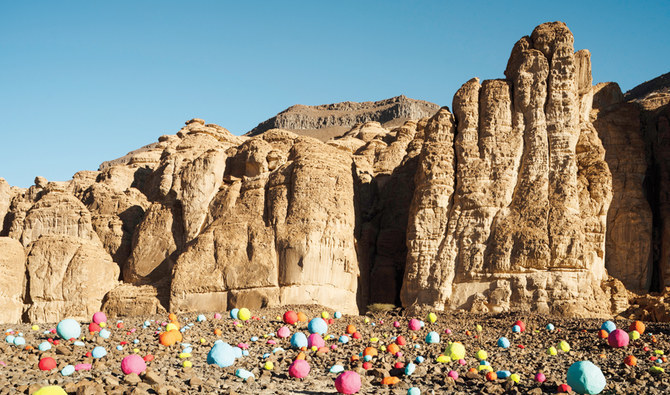
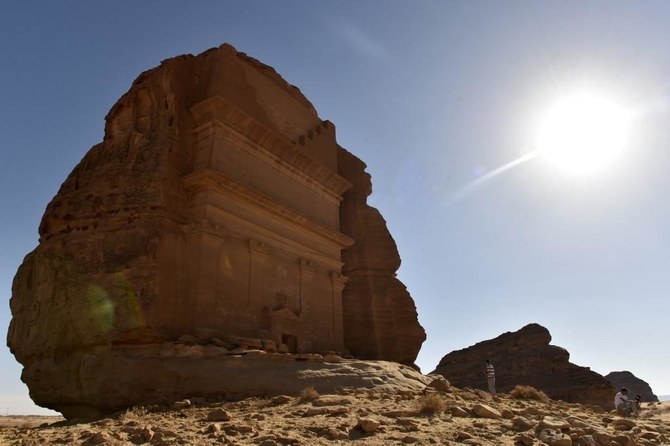

LONDON: Separated by 300 km and 4,000 years of history, Saudi Arabia’s oldest and newest cities may seem to have little in common beyond the mutual heritage of the land they share.
In fact, the story of the ancient settlement of Hegra in AlUla and the vast embryonic megacity of Neom is an inspiring tale of two cities that encapsulates the ambition of Saudi Arabia’s Vision 2030, the “bold yet achievable blueprint for an ambitious nation” conceived by Crown Prince Mohammed bin Salman.
Hewn from the rocks of the Hijaz in the Kingdom’s northwest two millennia ago by the Nabateans, the mysterious forebears of today’s Saudis, Hegra was the nerve center of a commercial empire that dominated trade throughout the ancient Middle East.
Neom, launched by the crown prince in 2017, is destined to transform over 26,500 sq. km in Saudi Arabia’s northwestern Tabuk region, including 468 km of Red Sea waterfront. More than 30 times the size of New York City, it is, as the government has declared, nothing less than “the world’s most ambitious project.”
Both cities are centerpieces of the crown prince’s determination to grow and diversify the nation’s economy away from reliance on fossil fuels, and living examples of how the great strategic plan is focused not only on building the nation’s future, but also on safeguarding its past.
Nowhere in the Kingdom is that past more dramatically represented than at Hegra, an archaeological wonderland that in 2008 became the first site in Saudi Arabia to be inscribed on UNESCO’s World Heritage List.
------
READ MORE: Mohammed bin Salman: 3 years as Saudi Arabia’s crown prince
Giant gains for women under Vision 2030
------
Hegra is surrounded by spectacular monumental tombs, carved from the rocks over 2,000 years ago. Many are decorated with carved images of monsters, animals, human faces and Nabatean inscriptions, offering a unique insight into the lives of the people who lived there.
Once at the heart of a dynamic kingdom that attracted traders, travelers and invaders from the four corners of the Middle East and beyond, today the ancient city is the centerpiece of the 22,000 sq. km AlUla region, an area roughly the size of Belgium.
Home to more than 23,000 sites of archaeological interest, and the focus of fast-moving plans to transform its dramatic landscape and heritage into one of the world’s great cultural tourism destinations, AlUla is a cornerstone of Vision 2030.
The Royal Commission for AlUla (RCU) is working to transform an area that throughout history has served as a meeting place for caravans, merchants and pilgrims into a major global destination, a “living, open museum” complete with museums, archaeological sites, luxury hotels and entertainment offerings.
“People from across the world will be touched by the transcendental beauty of AlUla,” RCU CEO Amr Al-Madani said last year. “It is truly a humbling destination. When you visit, you immediately understand why civilization after civilization chose to make this magnificent place their home.”
Tourists will be able to visit soon. This month it was announced that the archaeological sites and other cultural and heritage attractions of AlUla will reopen to the public in October. From then on they will be accessible all year round, adding to the other attractions at AlUla such as the 11-week annual Winter at Tantora cultural festival, which since 2018 has attracted a wide range of international music stars.
Other projects in the pipeline, including the Sharaan Resort and Nature Reserve, due to open in 2023, will boost AlUla’s profile as a must-visit international destination. For those who call AlUla home today, a project that by 2035 is predicted to see 2 million visitors per year will also massively boost the local economy, generating 35,000 jobs and contributing an estimated SR120 billion ($32 billion) to the Kingdom’s gross domestic product.
The project has already had an impact on local lives, demonstrating on a micro scale the massive potential of Vision 2030 to transform the Kingdom’s economic future. Last year, Arab News reported that in under three years Al-Ula, a once-neglected region with few prospects for its residents, had achieved a “negative” unemployment rate of 2 percent.
Many more jobs are on the way. The RCU is running the Hammayah program to train 2,500 residents as advocates for AlUla’s heritage. A scholarship program will also see 1,000 students from AlUla sent overseas to study subjects vital to the region’s development as a cultural tourism destination.
If the ancient city of Hegra dominated the cultural and commercial landscape of its time, 300 km to the northwest a megacity is emerging which, in the words of the crown prince, “will drive the future of human civilization.” Neom, vast and being developed with its own rules and regulations independent of the Kingdom’s existing governmental framework, is perhaps best described as a city-state in the making.
At its launch in October 2017, the crown prince said Neom would “focus on nine specialized investment sectors and living conditions that will drive the future of human civilization — energy and water, mobility, biotech, food, technological and digital sciences, advanced manufacturing, media and entertainment, with livability as its foundation.”
Funded initially to the tune of $500 billion by Saudi Arabia’s Public Investment Fund (PIF), which the crown prince chairs, Neom is expected to attract regional and international investment as its potential becomes apparent.
Without doubt it will be an attractive place to live, work and visit — and a dramatic symbol of Saudi Arabia’s determination to meet the challenges of climate change head-on by diversifying its economy away from reliance on fossil fuels.

keywords
Situated in a part of the Kingdom blessed with breezes and mild temperatures, the development of what will be some of the world’s largest wind and solar farms means Neom will be powered solely by renewable energy.
Future technologies of all kinds, said the crown prince, will “form the cornerstone for Neom’s development,” from automated vehicles, passenger drones and free high-speed wireless internet access, to new ways of growing and processing food, and free world-class continuous online education.
Despite the 4,000-year gulf between them, in many ways the two cities, ancient and modern, are twinned.
Located within eight hours’ flying time of 70 percent of the world’s population, Neom is, in the words of Gavin van Tonder, head of its water sector, “an opportunity to create a template for what the world needs to be in the future.” The clue, after all, is in the name. Neom is derived from neo, the Latin word for new, and M, the first letter of the Arabic word mostaqbal (future).
Hegra, a self-contained city-state positioned at the junction of Arabia’s key trading routes, was the Neom of its day. Now, emerging from the past as part of the cultural reawakening of the AlUla region, it has a key role to play in the building of that new future.


