

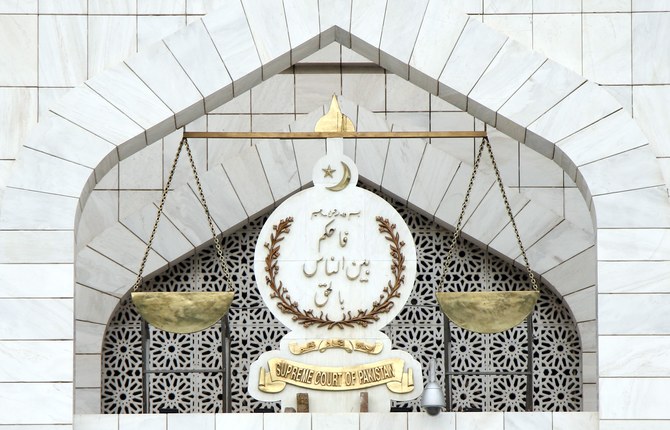

ISLAMABAD: Pakistan’s Supreme Court on Friday dismissed a presidential reference against Justice Qazi Faez Isa in a case that was widely seen as pitting the country’s judiciary against its government and powerful armed forces.
Calling the reference invalid, the Supreme Court said in its judgment: “[The reference] is declared to be of no legal effect whatsoever and stands quashed.
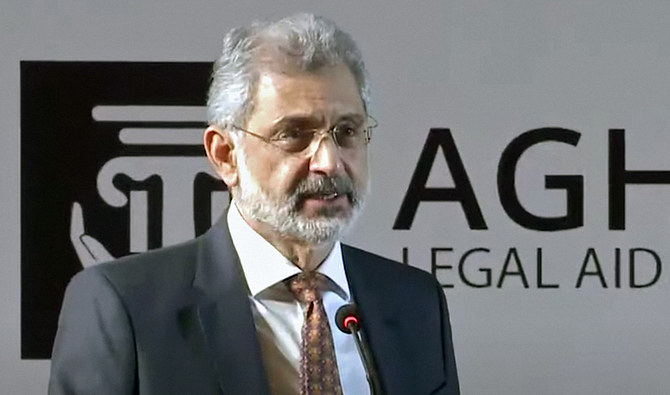
Justice Qazi Faez Isa, judge at Supreme Court of Pakistan, speaking at Asma Jahangir Conference in Lahore on Oct. 19, 2019. (Photo courtesy: Voicepk.net/YouTube)
The reference, filed by the government in May last year, alleged that between 2011 and 2015, Isa had acquired three London properties on lease in the name of his wife and children but had not disclosed them in his wealth returns. Isa denied the allegation, saying he was not a beneficial owner of the flats directly or indirectly.
In a petition filed against the reference, Isa argued that the Asset Recovery Unit constituted by the government to investigate his family’s properties was illegal and working without any legal standing and therefore any actions taken by the unit against Isa and his family were also illegal and without legal effect. The petition said the names and property details of Isa’s family were gathered through illegal surveillance.
On Thursday, Isa’s wife recorded her statement before the court via video link, and provided the money trail for the purchase of the three properties in London, saying the details of her accounts were available with the State Bank of Pakistan. The court then instructed her to present her documents before relevant tax authorities.
“I must tell you one thing: we, as judges, are answerable for our actions in private and public life; therefore, we are much more accountable than other people, as we are holding other people accountable,” Justice Umar Ata Bandial, one of the judges hearing the case said in court, addressing Isa’s wife. “This not the trial of your husband and yours as well, but the trial of our institution [the judiciary].”
In February last year, the Supreme Court, and Isa in particular, came under fire for passing a verdict that warned the military and intelligence agencies not to exceed their mandate and meddle in politics, in what was seen as a rebuke over security agencies’ handling of protests by a religious party in 2017.
The judges’ comments were a rare public ticking off for the powerful armed forces, which have ruled for nearly half of Pakistan’s history and have in recent years been criticized for resuming a more active role in politics.
The army has repeatedly denied any interference.
The Supreme Court was investigating the so-called “Faizabad protest”, which saw a hard-line religious group paralyze the capital Islamabad, accusing a minister of blasphemy.
But the court’s inquiry also looked at the role of security agencies, including in ending the standoff through mediation.
The army’s role particularly came under criticism after video footage shared on social media showed a senior officer giving cash to protesters after a deal was struck to end the blockade.
“The involvement of ISI and of the members of the Armed Forces in politics, media and other ‘unlawful activities’ should have stopped,” read the verdict which was authored by Isa and another judge. “Instead when (protest) participants received cash handouts from men in uniform, the perception of their involvement gained traction.”
Social media campaigns unleashed fury upon Isa for the judgment, and in May, reports emerged on social media and TV channels that President Arif Alvi had filed a reference against him over undisclosed assets. The same month, Zahid F Ebrahim, additional attorney general of Pakistan, resigned, calling the reference a “reckless attempt to tar the reputation of independent individuals and browbeat the judiciary of Pakistan.”
The Sindh High Court Bar Association also called the reference “malicious” and aimed at “undermining the independence of the judiciary and rule of law”.
The government finally confirmed on June 2 that it had filed a reference.
In 2018, the Pakistan government dismissed a High Court judge who accused a spy agency of interfering in judicial proceedings to influence the July 2018 election, following an investigation demanded by the military.


