
BAGHDAB: Baghdad on Thursday demanded Ankara immediately halt its assault in northern Iraq, where Turkish special forces and helicopters have been targeting Kurdish rebel hideouts.
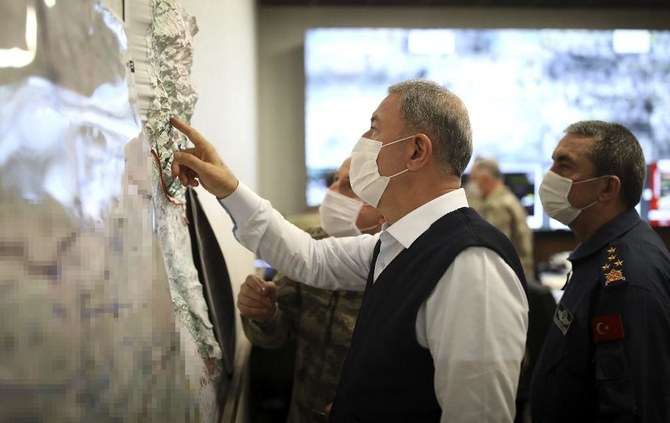
Turkey early Wednesday launched a cross-border operation into the mountainous regions of northern Iraq where the Kurdistan Workers’ Party (PKK), considered by Ankara to be a “terrorist” group, is thought to be hiding out.
Iraq’s foreign ministry summoned the Turkish ambassador on Thursday and handed him a “strongly-worded memorandum calling for a halt to such provocative actions.”
“We stress that Turkey must stop its bombardment and withdraw its attacking forces from Iraqi territory,” the ministry said in a statement.
“We affirm our categorical rejection of these violations.”
Iraq on Thursday also summoned Iran’s envoy Iraj Masjedi in protest over its shelling of Kurdish areas on Tuesday.
The foreign ministry statement urged Iran “respect Iraq’s sovereignty and stops these types of actions.”
“This ministry affirms Iraq is keen to maintain and develop the historical ties between the two countries, and also stresses its condemnation of these actions,” the ministry said.
Tehran has cultivated close political, military and economic ties with Iraqi leaders over decades, including with top Kurdish officials.
Iran, which has its own minority Kurdish population, has also been fighting Kurdish rebels who use neighboring Iraq as a base to mount attacks inside the country.
Its Revolutionary Guards last month mounted an operation against rebels in Iran’s western province of Kurdistan.
Thursday marked the second time in a week that Baghdad summoned Turkish ambassador Fatih Yildiz.
He was also called to the foreign ministry on Tuesday following Turkish bombardment in northern Iraq, also against PKK hideouts.
After that meeting, Yildiz said he had told Iraqi officials that if Baghdad did not take action against the rebels, Ankara would continue to “fight the PKK wherever it is.”
The PKK has fought an insurgency against the Turkish state since 1984, using the rugged mountains of neighboring northern Iraq as a rear base.
It has a tense relationship with the semi-autonomous Kurdish government in Iraq’s north (KRG), which see the PKK as a rival but have been unable to uproot it from the area.
Analysts say the Turkish operation, dubbed “Claw-Tiger,” could not have taken place without the KRG’s tacit approval.
There has been no comment from Iraq’s new Foreign Minister Fuad Hussein, himself a Kurd who is close to top KRG authorities.