Exhibition by Syrian painter in France to open on World Refugee Day

1 / 2
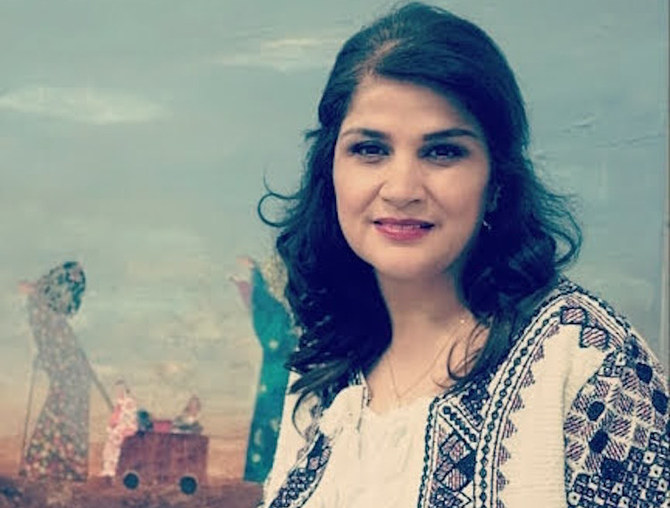
Syrian sculptor and painter Oroubah Dieb. (Supplied)
2 / 2
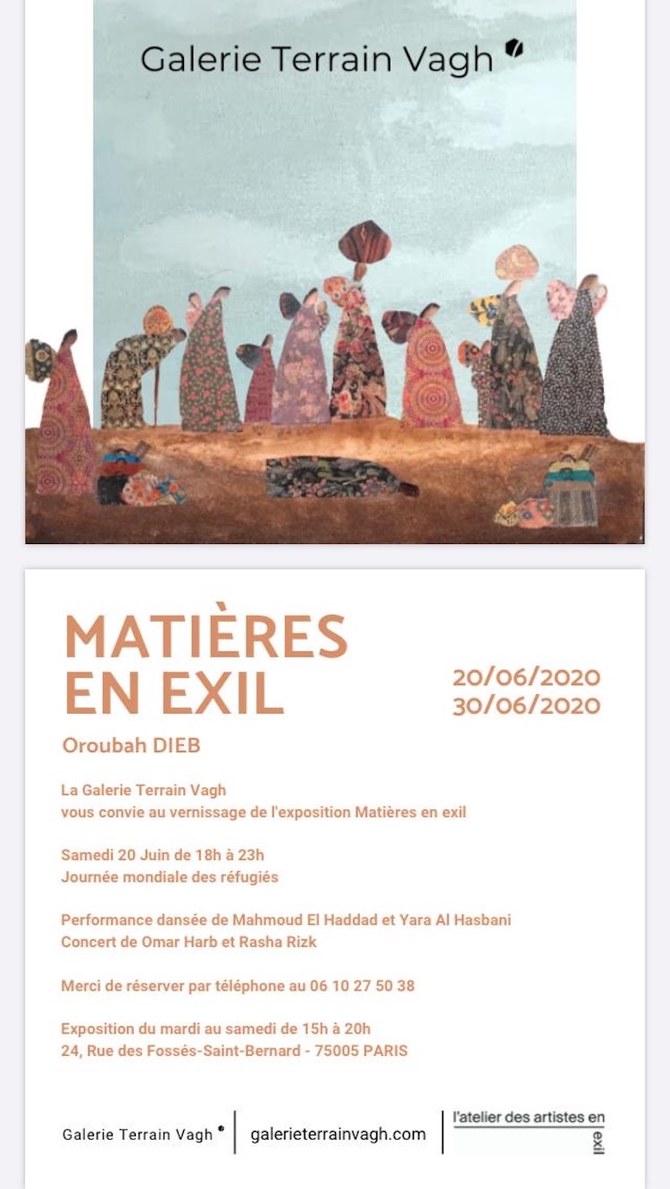
A poster publicising Materials in Exile, an exhibition of work by Syrian sculptor and painter Oroubah Dieb. (Supplied)
Short Url
Updated 17 June 2020
Follow

Exhibition by Syrian painter in France to open on World Refugee Day

  • Dieb is currently working at the Artists in Exile workshop in Paris and participates in art events across Europe
  • Much of her art embodies the experience of living in exile that refugees are forced to face

PARIS: To mark World Refugee Day, “Materials in Exile,” an exhibition of work by Syrian sculptor and painter Oroubah Dieb, will open at Galerie Terrain Vagh in Paris on June 20.

The artist left Damascus in 2012, seven years after founding a private art school in the city with her husband, Hammoud Shantout, who is also a painter and sculptor.

“We were the first to establish a private fine arts school for children and adults in Syria,” said Dieb. “We worked with schools and universities, and sponsored numerous exhibitions and activities.

“We launched the project seven years before we were forced to leave Syria. In 2012 we had to close the school and move to Lebanon due to the war that was ravaging the country. We could no longer remain, with our three girls, in our country and we could not take part in this war so we left Syria when our lives became impossible. We had to give up very good jobs and a comfortable life to go to Lebanon and France, where we have had to change our lives completely.”

Since leaving Syria, Dieb has worked to help refugees. In Lebanon, she taught art to children in the Khiara refugee camp. She has also worked with Syrian humanitarian and relief foundation Najda Now International, which has set up projects in Sabra and Shatila camps, which were originally set up for Palestinian refugees. They have a resident psychoanalyst, Dr. Yasser Moalla, and Dieb’s daughter Nour Shantout, who was studying at the Lebanese Academy of Fine Arts, an architectural university in Beirut.

“We were working in the camp on how to remedy the effects of war on children through the arts,” said Dieb. “We held many exhibitions at the French Embassy in Lebanon and also in downtown Beirut. There are Syrian refugees who have settled in the Sabra and Shatila camps and we worked with them.”

Dieb is currently working at the Artists in Exile workshop in Paris and participates in art events across Europe. Her work has been displayed around the world in Beirut, Dubai and many other cities. She said that much of her art embodies the experience of living in exile that refugees are forced to face. Her paintings depict the dramatic situations they encounter, and their suffering and misery.

“In my case, I was lucky enough to leave with my family on a plane when my daughter was already in France,” she said. “I had many acquaintances, so my situation was really very good compared with others.

“Still, the exile was a disaster for me because I had to give up everything I had worked for with my husband for 45 years in Syria. We arrived in France where no one knew us and where we had nothing but worries. This is my suffering — and I am well aware of the much greater drama and misery of millions of Syrian refugees in Lebanon, Jordan and Turkey.”

Materials in Exile by Oroubah Dieb will be at Galerie Terrain Vagh in Paris from June 20 to 30. The show has been organized by the gallery’s owners, Tunisian artist Moufida Atig and Judith Depaule of the Craftsmen’s Workshop.

The opening on June 20 will be accompanied by a series of events at the gallery, including performances by acclaimed Syrian singer Racha Rizk and young Syrian guitarist, Omar Harb, and a dance display by Mahmoud Al-Haddad from Egypt and Yara Hasbani from Syria. All of the day’s events will focus on the plight of refugees.


How science is reshaping early years education 

Updated 27 December 2025
Follow

How science is reshaping early years education 

DUBAI: As early years education comes under renewed scrutiny worldwide, one UAE-based provider is making the case that nurseries must align more closely with science.

Blossom Nursery & Preschool, which operates 32 locations across the UAE, is championing a science-backed model designed to close what it sees as a long-standing gap between research and classroom practice.

“For decades, early years education has been undervalued globally — even though science shows the first five years are the most critical for brain development,” said Lama Bechara-Jakins, CEO for the Middle East at Babilou Family and a founding figure behind Blossom’s regional growth, in an interview with Arab News.

Lama Bechara-Jakins is the CEO for the Middle East at Babilou Family and a founding figure behind Blossom’s regional growth. (Supplied)

She explained that the Sustainable Education Approach was created to address “a fundamental gap between what we know from science and what actually happens in nurseries.”

Developed by Babilou Family, the approach draws on independent analysis of research in neuroscience, epigenetics, and cognitive and social sciences, alongside established educational philosophies and feedback from educators and families across 10 countries. The result is a framework built around six pillars; emotional and physical security, natural curiosity, nature-based learning, inclusion, child rhythms, and partnering with parents.

Two research insights, Bechara-Jakins says, were particularly transformative. “Neuroscience shows that young children cannot learn until they feel safe,” she said, adding that stress and inconsistent caregiving can “literally alter the architecture of the developing brain.” 

Equally significant was evidence around child rhythms, which confirmed that “pushing children academically too early is not just unhelpful — it can be counterproductive.”

Feedback from families and educators reinforced these findings. Across regions, common concerns emerged around pressure on young children, limited outdoor time and weak emotional connections in classrooms. What surprised her most was that “parents all sensed that something was missing, even if they couldn’t articulate the science behind it.”

At classroom level, the strongest body of evidence centres on secure relationships. Research shows that “secure attachments drive healthy brain development” and that children learn through trusted adults. At Blossom, this translates into practices such as assigning each child “one primary educator,” prioritising calm environments, and viewing behaviour through “a neuroscience lens — as stress signals, not misbehaviour.”

Bechara-Jakins believes curiosity and nature remain overlooked in many early years settings, despite strong evidence that both accelerate learning and reduce stress. In urban centres such as Dubai, she argues, nature-based learning is “not a luxury. It is a developmental need.” 

For Blossom, this means daily outdoor time, natural materials, gardening, and sensory play — intentional choices aimed at giving children what science says they need to thrive.