

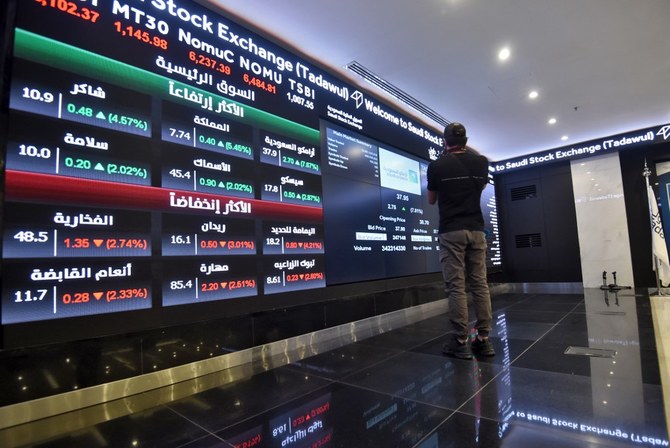
Saudi Arabia rises in world competitiveness rankings

Saudi Arabia had big advantages over many countries in the form of big financial reserves and low indebtedness, which gives it the capacity to raise funds on global capital markets. (File/AFP)
Short Url
Updated 16 June 2020
Follow

Saudi Arabia rises in world competitiveness rankings

  • The rise reflected a surge in the value of the Kingdom’s stock market
  • Saudi Arabia had big advantages over many countries in the form of big financial reserves and low indebtedness

DUBAI: Saudi Arabia has risen two places in the annual world competitiveness rankings calculated by the Switzerland-based International Institute for Management Development (IMD).
The rise — from 26 to 24 out of 63 countries ranked in the prestigious report — reflected a surge in the value of the Kingdom’s stock market after the record listing of Saudi Aramco last year, as well as a positive view by global business executives of its economic dynamism, policy stability and reliable infrastructure.
Arturo Bris, director of the IMD World Competitiveness Center, told Arab News that Saudi Arabia is “doing competitiveness by the book,” and praised the Vision 2030 strategy.
“Five years ago, Saudi Arabia was in the bottom 10 in the world for competitiveness. Now it has reached number 24,” he said.
“Vision 2030 has written the competitiveness playbook, and is a case study for the rest of the world.”

The rankings are calculated on economic data relating to last year, before the global COVID-19 pandemic struck, but also take in the views of business executives surveyed between February and April this year, when the Kingdom and the world were in the middle of economic lockdown.
The IMD warned that the Kingdom faces challenges this year, including the need to “raise the regional competitiveness within Saudi Arabia to align with Vision 2030 goals.”
It also has to “continue the strategic government initiatives to mitigate economic loss” during the pandemic.
Bris said the pandemic will have a big impact on Saudi Arabia as the process of diversification away from oil dependency is still underway, and much depends on the response of policymakers to the economic impact of the crisis.
“I’m not sure that the new tax rules are a move in the right direction. Liquidity injections into the banking system are positive initiatives, but they don’t necessarily transfer into more competitiveness,” he added.
Saudi Arabia has big advantages over many countries in the form of large financial reserves and low indebtedness, which give it the capacity to raise funds on global capital markets.
“Saudi has huge horsepower in its ability to raise debt and in reserves. The purpose of a sovereign wealth fund is to support the sustainability of the economy for future generations,” Bris said.
Weaknesses perceived by executives in the Saudi economy in 2019 included relatively low income growth per capita and continued over-reliance on oil as is main export, the IMD survey found.
Singapore came top of the global rankings for the second consecutive year, followed by Denmark and Switzerland.
The US fell seven places to 10, one slot below the UAE, which was the top-ranking Middle East country.


‘Cake not hate’ campaign becomes ‘Dates not hate’ in Madinah

“The Joshie-Man” and his father Dan Harris in the courtyard of the Prophet’s Mosque in Madinah. (Supplied)
Updated 02 February 2026
Follow

‘Cake not hate’ campaign becomes ‘Dates not hate’ in Madinah

  • Dan said he was very impressed by Saudi hospitality and that his family was warmly welcomed
  • He said being in Madinah exposed him to the true diversity of Islam

LONDON: A British autistic and non-verbal boy who has been visiting UK mosques and distributing cakes to promote solidarity amid an increase in far-right support in the country has taken his message of love to Madinah.

Joshua Harris, or “The Joshie-Man” as the 12-year-old is known to his social media fans, has handed out hundreds of his baked goods to worshipers at mosques in major British cities over the last few months.

The “Cake not hate” campaign came about after an Islamophobic attack on a mosque in his home city of Peterborough in October 2025.

Harris and his father visited Masjid Darassalaam, the mosque that was targeted, with cakes that the boy had baked and distributed them to the congregation soon after the attack. Since then, Harris has visited dozens of mosques in the UK.

On a recent trip to the Middle East, he and his father visited Madinah. In a local twist that pays tribute to the holy city’s famous date varieties including ajwa and ambar, Harris handed out dates to people in the courtyard of the Prophet’s Mosque. The “Cake not hate” campaign became “Dates not hate” for Saudi Arabia.

“He was greeted really, really warmly. There were some really touching moments where people were kissing his hands and his head. It was really lovely,” his father, Dan Harris, said.

Dan, the founder of global charity Neurodiversity in Business, said being in Madinah exposed him to the true diversity of Islam.

“We met people from all around the world. It was amazing. It’s like the United Nations there, you get people from different countries and it just goes to show you that the Muslim community, or the Ummah more generally, is not a homogeneous group,” he said.

“We saw people from Tajikistan and Uzbekistan and it was really interesting for us.”

Dan said his visit to Madinah, considered the second holiest city in Islam after Makkah for Muslims, was “profound and life-changing.”

He added: “I would say it’s my favourite city in the world due to the peace and tranquillity I felt there.”

Dan added that he was very impressed by Saudi hospitality: “Everywhere we went, people were taking down my number and insisting that we come for dinner, insisting they pick us up from the location. They were extremely attentive to Joshie as well, making sure his needs were met. We felt a great sense of welcome, something Saudi Arabia is known for.”