

UK fears Islamophobia rise with mosques set to reopen 

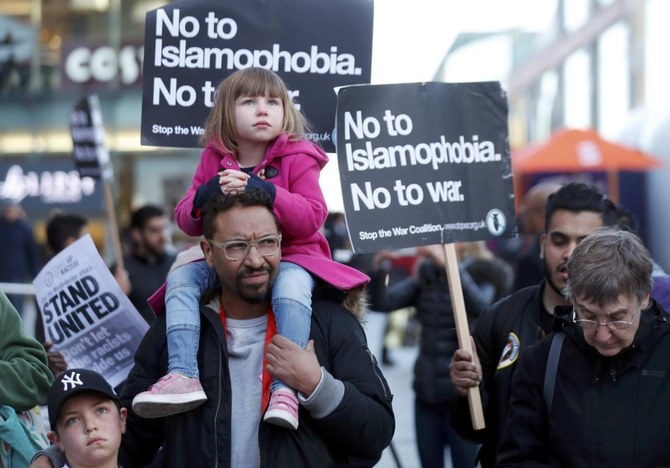
The UK is preparing itself for increases in incidents of Islamophobia as the country begins to end its lockdown introduced to curb the spread of COVID-19. (Reuters/File Photo)
Short Url
Updated 15 June 2020
Follow

UK fears Islamophobia rise with mosques set to reopen 

  • Anti-Muslim abuse had already increased during COVID-19 lockdown, according to MPs

LONDON: The UK is preparing itself for increases in incidents of Islamophobia as the country begins to end its lockdown introduced to curb the spread of COVID-19.

There are fears that mosques and other Islamic community centers could be targeted, having been closed to worshippers for much of the period.

Places of worship for all faiths in the UK were reopened by the government on June 13, but only for “private prayer.” 

Guidance on congregational worship, such as Friday prayers, is less clear, raising fears that Muslims trying to pray while observing social distancing measures could be unfairly accused of ignoring them.

Tell Mama, a UK organization that supports Muslim victims of racist abuse, says it has recorded several cases of far-right groups blaming Muslims for spreading COVID-19 during the lockdown.

Several British-Muslim MPs said they had also received racist emails during the lockdown, especially around Ramadan and Eid.

They added that they had seen evidence of anti-Muslim conspiracy theories spread on social media, including that Muslims increased transmission of COVID-19 by congregating at mosques.

MP Afzal Khan, vice chair of the UK’s All-Party Parliamentary Group (APPG) for British Muslims, said: “The journey of this is first the thoughts, then the words, then the action comes. We know in the past things have happened.”

He added that he received racist messages after he criticized Tommy Robinson, former leader of the far-right English Defence League, and another far-right group, Britain First.

Khan told The Guardian newspaper: “It’s true that a large number of people do participate (in prayer at mosques). But they understand the risk. They are complying with (the rules) and there is no evidence to show that they are not, and yet the narrative from the far right is the opposite.”

Sikh MP Tan Singh Dhesi, vice chair of the APPG for British Muslims, said: “There have been attacks in the past — people have been cooped up at home, and there’s been a distortion of what’s going on through social media. They may feel very, very worked up.”

He added: “Communal elements are more common in certain faiths but there have been certain elements of the far right saying this is how the coronavirus is spreading. This is a dangerous narrative we need to call out.”

MP Wes Streeting, another vice chair of the APPG for British Muslims, has called on police to step up security at mosques.

The Muslim Council of Britain (MCB) has offered advice to imams and Muslim communities across the UK on how to operate social distancing in British mosques, by limiting numbers and staggering entry.

MCB Secretary-General Harun Khan said: “Though we as Muslims are longing to go back to our mosques and worship with our communities, it is essential that we do not rush.”

He added: “Coronavirus is still prevalent and dangerous, and mosque leaders must carefully plan and decide when they feel they can put the required controls in place to reopen in the safest way possible.”


EU, India successfully conclude major trade deal: New Delhi

Updated 3 sec ago
Follow

EU, India successfully conclude major trade deal: New Delhi

  • Indian government officials say the pact, which was two decades in the making, will be unveiled Tuesday
  • European Commission President Ursula von der Leyen and European Council president Antonio Costa appear as guests of honor at India’s Republic Day parade
NEW DELHI: India and the European Union have finalized a massive free trade deal, Indian government officials said on Monday, about two decades after negotiations were first launched.
Facing challenges from China and the United States, Brussels and New Delhi have sought closer ties, producing a pact that is to be unveiled in the Indian capital on Tuesday.
Feted Monday as guests of honor at India’s Republic Day parade, European Commission President Ursula von der Leyen and European Council president Antonio Costa are to meet Indian Prime Minister Narendra Modi for a summit.
“Official level negotiations are being concluded and both sides are all set to announce the successful conclusion” of talks at the Tuesday summit, Indian commerce secretary Rajesh Agrawal told AFP.
The EU has eyed India — the world’s most populous nation — as an important market for the future, while New Delhi sees the European bloc as an important source of much-needed technology and investment to rapidly upscale its infrastructure and create millions of new jobs.

’Mother of all deals’

Bilateral trade in goods reached 120 billion euros ($139 billion) in 2024, an increase of nearly 90 percent over the past decade, according to EU figures, with a further 60 billion euros ($69 billion) in trade in services.
India’s Commerce Minister Piyush Goyal has described the new pact as “the mother of all deals.”
“Final negotiations have been focused and fruitful, and we are now very optimistic that we will land this historic trade deal,” an EU official said Monday speaking on condition of anonymity.
Under the agreement, India is expected to ease market access for key European products, including cars and wine, in return for easier exports of textiles and pharmaceuticals, among other things.
“The EU stands to gain the highest level of access ever granted to a trade partner in the traditionally protected Indian market,” von der Leyen said on Sunday, adding that she expected exports to India to double.
“We will gain a significant competitive advantage in key industrial and agri-good sectors.”
Talks went down to the wire on Monday, focusing on a few sticking points, including the impact of the EU’s carbon border tax on steel, according to sources familiar with the discussions.
The accord comes as both Brussels and New Delhi have sought to open up new markets in the face of US tariffs and Chinese export controls.
India and the EU were also expected to conclude an accord to facilitate movement for seasonal workers, students, researchers and highly skilled professionals, and a security and defense pact.
“India and Europe have made a clear choice. The choice of strategic partnership, dialogue and openness,” von der Leyen wrote on social media. “We are showing a fractured world that another way is possible.”
New Delhi, which has relied on Moscow for key military hardware for decades, has tried to cut its dependence on Russia in recent years by diversifying imports and pushing its own domestic manufacturing base.
Europe is doing the same with regard to the United States.