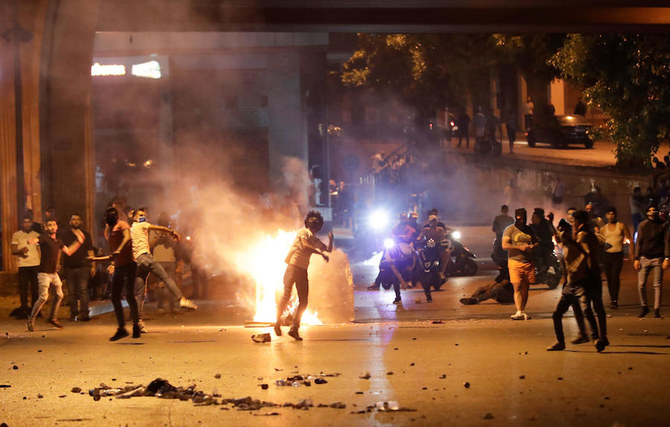
BEIRUT: Lebanese protesters took to the streets in Beirut and other cities Saturday in mostly peaceful protests against the government, calling for its resignation as the small country sinks deeper into economic distress.
The protests come after two days of rallies spurred by a dramatic collapse of the local currency against the dollar. Those rallies degenerated into violence, including attacks on private banks and shops.
The local currency, pegged to the dollar for nearly 30 years, has been on a downward trajectory for weeks, losing over 60% of its value. But the dramatic collapse this week deepened public despair over the already troubled economy. Lebanon is heavily dependent on imports and the dollar and local currency have been used interchangeably for years.
The unrivaled economic and financial crises are proving a major challenge to the government of Prime Minister Hassan Diab, who took office earlier this year after his predecessor resigned amid nationwide protests. Diab was faced with handling the coronavirus pandemic soon after taking office. Lebanon’s financial problems predate the coronavirus pandemic, which put the country in lockdown for months, further compounding the crisis.
Diab’s government is supported by the powerful militant group Hezbollah and its allies, but has already been weakened by the economic crisis. He was due to address the nation later Saturday.
For the protesters Saturday, many of them members of organized political parties, Diab’s government has failed to handle the crisis.
Neemat Badreddin, a political activist, described the government as captive to the interests of political groups and not the public.
“This current government proved to be a failure,” said Badreddin, wearing a face mask featuring the Lebanese flag with its green cedar tree in the center. “We want a new government ... we want stability and we want to be able to live without begging or without people having to migrate.”
Protesters in Beirut carried a banner that read “There is an alternative.”
In the southern city of Sidon, some directed their wrath at the central bank governor. One protester raised a banner called him the “protector of all thieves in Lebanon.”
In the northern city of Tripoli, army troops forcefully dispersed dozens of protesters who had blocked the road preventing trucks from moving forward, according to videos posted online. The protesters allege the trucks were smuggling goods to Syria — a common complaint in Lebanon as the neighboring country grapples with its own economic hardships.
After an emergency Cabinet meeting Friday to address the crisis, the government announced that the central bank would inject fresh dollars into the market to prop up the Lebanese pound — a measure that many everyday Lebanese and government critics say is likely to offer only temporary relief.
The dollar shortage, coupled with already negative economic growth, has crunched Lebanon’s middle class and increased poverty in the small Mediterranean nation of over five million that’s home to over 1 million Syrian refugees.
The heavily indebted government has been in talks for weeks with the International Monetary Fund after it asked for a financial rescue plan but there are no signs of an imminent deal.

Lebanon protesters call on government to resign amid crisis
Short Url
https://arab.news/9fyg9
Lebanon protesters call on government to resign amid crisis
- The protests come after two days of rallies spurred by a dramatic collapse of the local currency against the dollar
- The local currency, pegged to the dollar for nearly 30 years, has been on a downward trajectory for weeks, losing over 60% of its value
Hamas seeks role for its police in Gaza
- Letter from Hamas assures its 40,000 civil servants and security forces that it is working to incorporate them into the new government
CAIRO: Hamas is seeking to incorporate its 10,000 police officers into a new US-backed Palestinian administration for Gaza, sources say, a demand likely to be opposed by Israel as the militant group debates whether to surrender its arms.
Islamist group Hamas retains control of just under half of Gaza following an October ceasefire deal brokered by US President Donald Trump.
The agreement ties further Israeli troop withdrawals to Hamas giving up its weapons.
The 20-point plan to end the war, now in its second phase, calls for the governance of Gaza to be handed to the National Committee for the Administration of Gaza, a Palestinian technocratic body with US oversight that is meant to exclude Hamas.
In a letter to staff on Sunday, seen by Reuters, Gaza’s Hamas-run government urged its more than 40,000 civil servants and security personnel to cooperate with the NCAG but assured them it was working to incorporate them into the new government.
That would include the roughly 10,000-strong Hamas-run police force, four sources familiar with the matter said, a demand that has not been previously reported. Many of them have been patrolling Gaza as Hamas reasserts its grip in areas under its control.
It was not immediately clear whether Israel, which has adamantly rejected any Hamas involvement in Gaza’s future, would agree to the civil and security workers’ inclusion in the NCAG.
Israeli Prime Minister Benjamin Netanyahu’s office did not respond to a request for comment.
Sticking points
Hamas’ plans for its police force and workers point to wide gaps between Hamas and Israel, backed by the US, as Trump pushes ahead with his plans. Last week, Trump hosted a signing ceremony to establish his “Board of Peace” that will serve as a transitional administration to set the framework and coordinate funding for the redevelopment of Gaza. The framework includes a provision barring “foreign terrorist organizations” from participating in governance.
Hamas spokesperson Hazem Qassem told Reuters the group was prepared to hand over governance to the 15-member NCAG and its chair, Ali Shaath, with immediate effect.
“We (have) full confidence that it will operate on the basis of benefiting from qualified personnel and not wasting the rights of anyone who worked during the previous period,” Qassem said, referring to the inclusion of the 40,000 personnel.
The four sources said Hamas is open to the NCAG restructuring ministries and sending some workers into retirement. Mass dismissals risked chaos, the sources said.
Hamas and NCAG Chair Shaath have not yet met in person to discuss governance, a Hamas official said. Shaath’s office did not respond to a request for comment.
Another issue was whether Sami Nasman, the former Palestinian Authority general assigned to oversee security under the NCAG, would be able to operate effectively, a Palestinian official said.
Nasman, originally from Gaza, moved to the occupied West Bank after Hamas routed Palestinian Authority forces from the enclave in 2007 following a brief civil war. A Hamas court in Gaza later sentenced him in absentia, accusing him of instigating chaos. Nasman denies this.
Neutralizing arms
Trump’s administration wants to see heavy weapons decommissioned immediately, with “personal arms registered and decommissioned by sector as (the) NCAG police become capable of guaranteeing personal security,” according to a document shared by the White House last week. A US official said on Tuesday that Hamas fighters would be granted some sort of amnesty.
The militant group is still believed to possess rockets, which several diplomats estimated to number in the hundreds. It is also estimated to possess thousands of light weapons, including rifles.
Hamas recently agreed to discuss disarmament with other Palestinian factions and with mediators, sources said. However, two Hamas officials told Reuters that neither Washington nor the mediators had presented the group with any detailed or concrete disarmament proposal.
A Palestinian official close to the disarmament talks said the US had approached Hamas to explore potential disarmament mechanisms involving parties including Israel, Qatar, Egypt and Turkiye.
“Hamas has spoken about the possibility of neutralising arms, which could be achieved if there is a truce, and it is ready for a long-term ceasefire — five years or a little longer,” the official said.
“But Hamas strongly believes that a serious political negotiation process must begin on Palestinian statehood, whereby weapons and fighters would come under the authority of the State of Palestine,” the official said.
Hamas is not the only militant group in the enclave to possess arms. A source in a Gaza faction allied with Hamas said other groups were discussing disarmament but worried about being left defenseless.
In remarks to parliament on Monday, Netanyahu said that the next phase of the Gaza deal “is not reconstruction.”
Rather, he said, “the next phase is demilitarization of the Strip and disarming Hamas.”
Islamist group Hamas retains control of just under half of Gaza following an October ceasefire deal brokered by US President Donald Trump.
The agreement ties further Israeli troop withdrawals to Hamas giving up its weapons.
The 20-point plan to end the war, now in its second phase, calls for the governance of Gaza to be handed to the National Committee for the Administration of Gaza, a Palestinian technocratic body with US oversight that is meant to exclude Hamas.
In a letter to staff on Sunday, seen by Reuters, Gaza’s Hamas-run government urged its more than 40,000 civil servants and security personnel to cooperate with the NCAG but assured them it was working to incorporate them into the new government.
That would include the roughly 10,000-strong Hamas-run police force, four sources familiar with the matter said, a demand that has not been previously reported. Many of them have been patrolling Gaza as Hamas reasserts its grip in areas under its control.
It was not immediately clear whether Israel, which has adamantly rejected any Hamas involvement in Gaza’s future, would agree to the civil and security workers’ inclusion in the NCAG.
Israeli Prime Minister Benjamin Netanyahu’s office did not respond to a request for comment.
Sticking points
Hamas’ plans for its police force and workers point to wide gaps between Hamas and Israel, backed by the US, as Trump pushes ahead with his plans. Last week, Trump hosted a signing ceremony to establish his “Board of Peace” that will serve as a transitional administration to set the framework and coordinate funding for the redevelopment of Gaza. The framework includes a provision barring “foreign terrorist organizations” from participating in governance.
Hamas spokesperson Hazem Qassem told Reuters the group was prepared to hand over governance to the 15-member NCAG and its chair, Ali Shaath, with immediate effect.
“We (have) full confidence that it will operate on the basis of benefiting from qualified personnel and not wasting the rights of anyone who worked during the previous period,” Qassem said, referring to the inclusion of the 40,000 personnel.
The four sources said Hamas is open to the NCAG restructuring ministries and sending some workers into retirement. Mass dismissals risked chaos, the sources said.
Hamas and NCAG Chair Shaath have not yet met in person to discuss governance, a Hamas official said. Shaath’s office did not respond to a request for comment.
Another issue was whether Sami Nasman, the former Palestinian Authority general assigned to oversee security under the NCAG, would be able to operate effectively, a Palestinian official said.
Nasman, originally from Gaza, moved to the occupied West Bank after Hamas routed Palestinian Authority forces from the enclave in 2007 following a brief civil war. A Hamas court in Gaza later sentenced him in absentia, accusing him of instigating chaos. Nasman denies this.
Neutralizing arms
Trump’s administration wants to see heavy weapons decommissioned immediately, with “personal arms registered and decommissioned by sector as (the) NCAG police become capable of guaranteeing personal security,” according to a document shared by the White House last week. A US official said on Tuesday that Hamas fighters would be granted some sort of amnesty.
The militant group is still believed to possess rockets, which several diplomats estimated to number in the hundreds. It is also estimated to possess thousands of light weapons, including rifles.
Hamas recently agreed to discuss disarmament with other Palestinian factions and with mediators, sources said. However, two Hamas officials told Reuters that neither Washington nor the mediators had presented the group with any detailed or concrete disarmament proposal.
A Palestinian official close to the disarmament talks said the US had approached Hamas to explore potential disarmament mechanisms involving parties including Israel, Qatar, Egypt and Turkiye.
“Hamas has spoken about the possibility of neutralising arms, which could be achieved if there is a truce, and it is ready for a long-term ceasefire — five years or a little longer,” the official said.
“But Hamas strongly believes that a serious political negotiation process must begin on Palestinian statehood, whereby weapons and fighters would come under the authority of the State of Palestine,” the official said.
Hamas is not the only militant group in the enclave to possess arms. A source in a Gaza faction allied with Hamas said other groups were discussing disarmament but worried about being left defenseless.
In remarks to parliament on Monday, Netanyahu said that the next phase of the Gaza deal “is not reconstruction.”
Rather, he said, “the next phase is demilitarization of the Strip and disarming Hamas.”
© 2026 SAUDI RESEARCH & PUBLISHING COMPANY, All Rights Reserved And subject to Terms of Use Agreement.