



KARACHI: A renowned Pakistani truck artist has painted the portrait of George Floyd, an African-American who was killed by the police in Minneapolis on May 25. The incident enraged people, resulting in violent demonstrations across the United States where protesters turned Floyd into a symbol of resistance against racial discrimination and injustices throughout the world.
Haider Ali, a Karachi-based artist, painted the portrait in the typical truck art style at the rooftop of his residence and decorated it with colorful flowers and popular slogans in favor of racial equality. The inscriptions include popular lyrics from Bollywood songs and social media trends like #BlackLivesMatter.
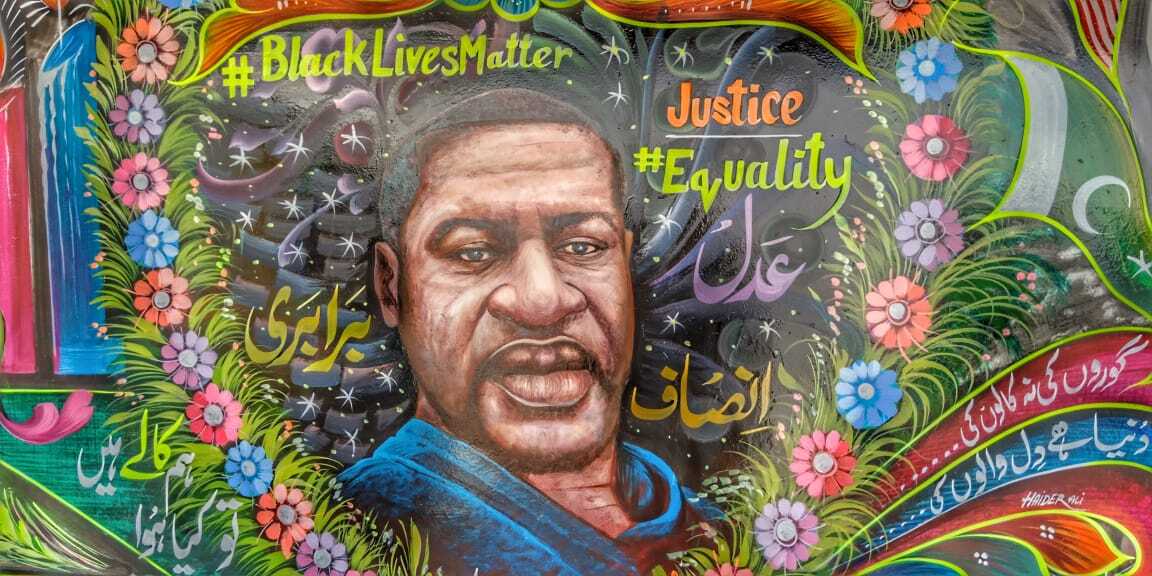
Pakistani truck artist Haider Ali paints a mural of George Floyd on the wall of his house in Karachi to pay homage to the African-American man who died while in custody of Minneapolis police. (Photo courtesy: Social Media)
Asked if he had painted other famous personalities, Ali said he had drawn numerous portraits of actors on trucks and sketched lost children on buses and auto rickshaws.
Ali is a 40-year-old professional truck artist who owns a company, Phool Patti, which specializes in the business. He also runs a design school and maintains a studio at his residence in Hawks Bay, Karachi, which also has hundreds of truck stations. He has also traveled around the world and promoted his art in countries like the United States and United Kingdom.
“I have been in this profession since a very early age,” he told Arab News on Friday. “My father migrated from Jalandhar at the time of Partition and settled in Lahore. He started painting trucks in typical solid colors with images of flowers, animals and humans. Later, the family moved to Karachi and we continued with the same profession.”
Ali further informed that he had returned from London after painting a hotel almost a week before the COVID-19 lockdown and confined himself to his residence where he conceived the idea of making the painting.
“I was not doing much during the lockdown. The trucks were not moving and demand for my work was low. So I started painting my roof during that phase. I was moved by the tragic incident in the US and wanted to show solidarity with those who were seeking justice. That is when I decided to paint the man whose unpardonable killing triggered the resistance movement,” he said.
Ali has also painted murals across Karachi besides painting trucks that ply the roads of this seaside metropolis, adorning walls, bridges and pillars with familiar motifs and bright shades. However, some of his art was removed by local authorities since he had not secured their permission beforehand. This was also the reason why he chose the parapet wall at his rooftop to display the portrait.
Ali insisted his craft should be recognized as a fine art among the local community of painters, sculptors and designers, adding that it should also be taught at art schools. “This genre has still not been appreciated at the level at which it gets respect outside the country,” he maintained.
Asked if he had thought his painting would become so popular among people or instill a sense of awareness in them about social justice, he said: “My entire art carries a message of love and peace. It is up to the people how they react to it or interpret it.”


