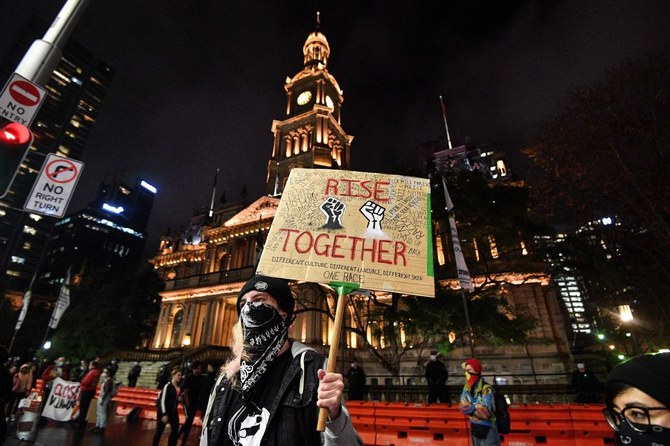
Thousands attend Black Lives Matter protests across Australia

The Sydney rallies attended by thousands, and dominated by a heavy police presence, were mostly peaceful. (AFP)
Short Url
Updated 13 June 2020
Follow

Thousands attend Black Lives Matter protests across Australia

  • The rallies, dominated by a heavy police presence, were mostly peaceful

SYDNEY: Thousands of people across Australia attended Black Lives Matter protests on Saturday wearing masks and practicing social distancing amid warnings from state leaders to call off the events on fears of a second wave of coronavirus infections.
The rallies, dominated by a heavy police presence, were mostly peaceful. Protesters marched on the streets or gathered at public parks carrying posters that said “No Justice, No Peace” and “Sorry For The Inconvenience, We Are Trying To Change The World.”
“There have been people like my dad and Aunty Mingelly who have been pushing for change since they were my age — you know that was 50 years ago,” Jacinta Taylor, an organizer of the protest in Perth, told the rally.
“I don’t want to be having to be 80 years old and pushing for this kind of change for my children and my children’s children.”
Anti-racism protests were triggered around the world following the death late last month of African American George Floyd after a Minneapolis police officer was filmed kneeling on the handcuffed Floyd’s neck for nearly nine minutes.
Perth saw the largest gathering of all major Australian cities on Saturday, despite pleas from the premier of Western Australia (WA) state, Mark McGowan, to cancel the event until the coronavirus pandemic was over.
A Black Lives Matter protester in Melbourne had tested positive for the new coronavirus, which causes COVID-19, this week, while Prime Minister Scott Morrison has warned the mass gatherings were putting at risk the nation’s recovery.
WA Health Minister Roger Cook this week advised large gatherings were not advisable, although his wife, an indigenous woman, said she would join the rally.
Cook said in a statement his wife was a private citizen and made her own personal choices. “That’s one of the many reasons why I love her,” he said. “I have great sympathy for the cause of ensuring Aboriginal people and minorities are protected from racism.”
Protesters also gathered in small numbers in Melbourne and Sydney, calling for freedom for refugees stuck in indefinite detention.


WHO appeals for $1 bn for world’s worst health crises in 2026

Updated 58 min 6 sec ago
Follow

WHO appeals for $1 bn for world’s worst health crises in 2026

  • The UN health agency estimated 239 million people would need urgent humanitarian assistance this year and the money would keep essential health services going

GENEVA: The World Health Organization on Tuesday appealed for $1 billion to tackle health crises this year across the world’s 36 most severe emergencies, including in Gaza, Sudan, Haiti and the Democratic Republic of Congo.
The UN health agency estimated 239 million people would need urgent humanitarian assistance this year and the money would keep essential health services going.
WHO health emergencies chief Chikwe Ihekweazu told reporters in Geneva: “A quarter of a billion people are living through humanitarian crises that strip away the most basic protections: safety, shelter and access to health care.
“In these settings, health needs are surging, whether due to injuries, disease outbreaks, malnutrition or untreated chronic diseases,” he warned.
“Yet access to care is shrinking.”
The agency’s emergency request was significantly lower than in recent years, given the global funding crunch for aid operations.
Washington, traditionally the UN health agency’s biggest donor, has slashed foreign aid spending under President Donald Trump, who on his first day back in office in January 2025 handed the WHO his country’s one-year withdrawal notice.
Last year, WHO had appealed for $1.5 billion but Ihekweazu said that only $900 million was ultimately made available.
Unfortunately, he said, the agency had been “recognizing ... that the appetite for resource mobilization is much smaller than it was in previous years.”
“That’s one of the reasons that we’ve calibrated our ask a little bit more toward what is available realistically, understanding the situation around the world, the constraints that many countries have,” he said.
The WHO said in 2026 it was “hyper-prioritising the highest-impact services and scaling back lower?impact activities to maximize lives saved.”
Last year, global funding cuts forced 6,700 health facilities across 22 humanitarian settings to either close or reduce services, “cutting 53 million people off from health care.” Ihekweazu said.
“Families living on the edge face impossible decisions, such as whether to buy food or medicine,” he added, stressing that “people should never have to make these choices.”
“This is why today we are appealing to the better sense of countries, and of people, and asking them to invest in a healthier, safer world.”