

How a TikTok challenge raised $200,000 this Ramadan

Short Url
Updated 17 June 2020
Follow

How a TikTok challenge raised $200,000 this Ramadan

  • • TikTok partners with UNICEF in Ramadan to raise money for assisting children during COVID-19.
  • • The campaign enlists regional celebrities including Yara, Khaled Selim, and Balqees Fathi to host 17 live sessions.

Video-sharing social app TikTok partnered with UNICEF this Ramadan to raise money to provide critical assistance for children during COVID-19.  

UNICEF says that 99 percent of young people under 18 live in countries with some form of movement restrictions in place due to COVID-19. Already, 1.8 million children in Yemen are acutely malnourished. The crisis isn’t affecting society only now, but will continue to do so for many years. Taking action today can help to lessen the impact of the crisis for decades to come.

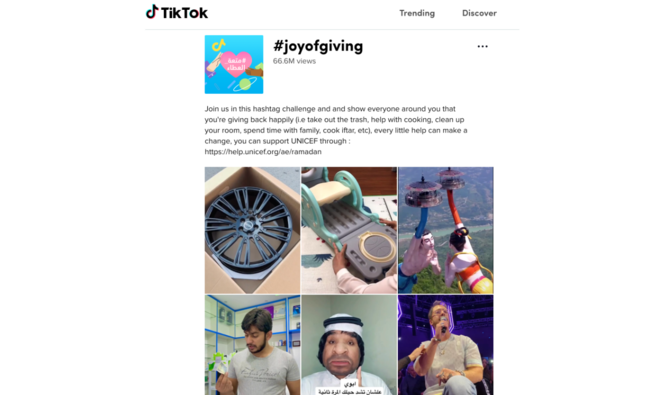
TikTok ran the #JoyofGiving challenge during Ramadan, the month of giving, inviting content creators on the platform to participate in 17 live sessions and to create their own content to show how they’re giving back (taking out the trash, helping with cooking, cleaning up their rooms, spending time with family, cooking iftar, etc.)


The live sessions were hosted by a number of celebrities and regional content creators including Yara, Balqees Fathi, Khalid and Salama Al-Ameri, Carmen Soliman, Raya Abirached and Khaled Selim. The interactive sessions focused on UNICEF’s initiatives to provide critical supplies for children and on personal experiences during COVID-19.

UNICEF also hosted live sessions on its own TikTok page for the Middle East and North Africa featuring renowned musician and composer Jad Rahbani and senior nutrition advisor Vilma Taylor.

The campaign received a positive response with more than 2.3 million views, achieving the donation goal and raising $200,000, which will be utilised by UNICEF to deliver crucial resources to children and affected communities across the MENA region, providing much-needed relief.


Apple, Google offer app store changes under new UK rules

Updated 10 February 2026
Follow

Apple, Google offer app store changes under new UK rules

LONDON: Apple and Google have pledged changes to ensure fairness in their app stores, the UK competition watchdog said Tuesday, describing it as “first steps” under its tougher regulation of technology giants.
The Competition and Markets Authority placed the two companies under “strategic market status” last year, giving it powers to impose stricter rules on their mobile platforms.
Apple and Google have submitted packages of commitments to improve fairness and transparency in their app stores, which the CMA is now consulting market participants on.
The proposals cover data collection, how apps are reviewed and ranked and improved access to their mobile operating systems.
They aim to prevent Apple and Google from giving priority to their own apps and to ensure businesses receive fairer terms for delivering apps to customers, including better access to tools to compete with services like the Apple digital wallet.
“These are important first steps while we continue to work on a broad range of additional measures to improve Apple and Google’s app store services in the UK,” said CMA chief executive Sarah Cardell.
The commitments mark the first changes proposed by US tech giants in response to the UK’s digital markets regulation, which came into force last year.
The UK framework is similar to a tech competition law from the European Union, the Digital Markets Act, which carries the potential for hefty financial penalties.
“The commitments announced today allow Apple to continue advancing important privacy and security innovations for users and great opportunities for developers,” an Apple spokesperson said.
The CMA in October found that Apple and Google held an “effective duopoly,” with around 90 to 100 percent of UK mobile services running on their platforms.
A Google spokesperson said existing practices in its Play online store are “fair, objective and transparent.”
“We welcome the opportunity to resolve the CMA’s concerns collaboratively,” they added.
The changes are set to take effect in April, subject to the outcome of a market consultation.