ISLAMABAD: Pakistan must take long-term and wide-ranging measures to ensure the revival of its industrial and services sectors, senior economists said after the launch of Pakistan Economic Survey 2019-20 on Thursday, recommending the government to keep the economic targets realistic for the upcoming fiscal year.
The country’s Gross Domestic Product (GDP) growth for the fiscal year 2020 is estimated at negative 0.38 percent due to the negative 2.64 percent and negative 0.59 percent growth in the industrial and services sectors, respectively.
“The clock has turned back. This government started the fiscal year with higher deficit and lower growth and it was ending with the same trend,” Khurram Husain, an economist and business editor at daily Dawn, told Arab News.
He said that much of the negative economic impact on different sectors during the outgoing fiscal year was due to the COVID-19 outbreak, but “still the government should have performed better.”
Husain said the government had initiated macroeconomic adjustments under the International Monetary Fund’s (IMF) $6 billion bailout package, and it would have to take “tough measures” in the upcoming year as well to ensure social protection for the poor and job opportunities for the bulging youth.
Pakistan signed the bailout package with the IMF in May last year to stave off a looming balance of payments crisis. The country had initiated tough economic reforms in the public sector under the program which experts believe resulted in the devaluation of rupee against dollar and high interest rates.
“The good thing, at the moment, is that inflation rate and energy prices are low as compared to the previous months,” Husain said, urging the government to adopt a holistic approach to revive the economy.
Economists said the survey document was a reflection of the “ground realities” and the government should take guidance from it to prepare the budget for the upcoming financial year.
“This was a challenging year. The economy was already in a downturn because of the type of policies we pursued to correct our balance of payments,” Dr. Ashfaque Hasan Khan, senior economist and Principal and Dean of the School of Social Sciences and Humanities at NUST, told Arab News.
He said the economy had contracted, the per capita income had declined and COVID-19 had severely dampened the domestic and global economic activities. “This is the time to provide relief to businesses and people to revive the economy and not to indulge in setting unrealistic revenue targets,” Khan said.
Dr. Vaqar Ahmed, who works as the deputy executive director at the Sustainable Development Policy Institute in Islamabad, said the government had managed to gain “some public sympathy and favor” due to the impact of COVID-19 on the country’s economy in the last two quarters of the financial year.
However, he added: “It has clearly failed to come up with viable structural reforms targets agreed with the IMF like circular debt plan, privatization of public entities and overcoming losses in public sector enterprises.”
Ahmed suggested the government to present a clear-cut policy on tax targets, power sector subsidies for consumers and provincial revenue surpluses in the upcoming budget to revive the economy
“The economic revival remains the real challenge for the government, and this can only be achieved through transparency in each sector and good governance,” he added.


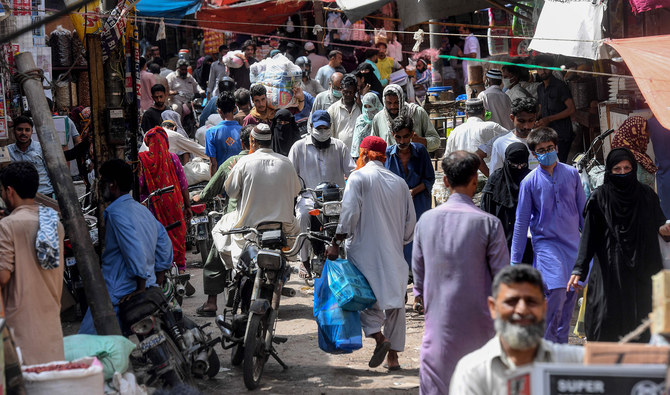
Wide-ranging measures required to boost Pakistan’s economy — experts
https://arab.news/jdjj7
Wide-ranging measures required to boost Pakistan’s economy — experts

- Economists ask the government to set realistic revenue targets to revive the economy
- Say the government had failed to achieve structural reform targets that were agreed with the IMF

Pakistani PM seeks faster reform implementation in talks with World Bank chief
- 10-year World Bank framework announced last year will focus $20 billion in lending to Pakistan over the coming decade on development issues
- Ajay Banga is on his first official visit to Pakistan as head of World Bank Group and as Islamabad works to advance multi-year reform agenda
ISLAMABAD: Pakistani Prime Minister Shehbaz Sharif and World Bank Group President Ajay Banga agreed on Monday on the need to accelerate implementation and strengthen oversight of development priorities, as Islamabad seeks to deliver reforms “at speed and scale” under the World Bank’s Country Partnership Framework (CPF), Sharif’s office said.
Banga is on his first official visit to Pakistan as head of the World Bank Group and as the country works to advance a multi-year reform agenda supported by international financial institutions, including the World Bank and the International Monetary Fund.
According to a statement issued by the Prime Minister’s Office, Sharif welcomed Banga and acknowledged the World Bank Group’s long-standing partnership with Pakistan, particularly its support through the 10-year CPF announced last year. The one-of-a-kind plan will focus $20 billion in lending to the cash-strapped nation over the coming decade on development issues like the impact of climate change as well as boosting private-sector growth.
The prime minister said Pakistan was pursuing a comprehensive, domestically driven reform program aimed at achieving sustainable economic stability, the statement said, adding that the government was working across multiple sectors, including energy, agribusiness, digital development, fiscal reforms and job creation.
“Prime Minister and Mr.Banga reiterated the need to fast-track implementation and ensure strong oversight to deliver impact at speed and scale on CPF-aligned priorities,” a statement from Sharif’s office said.
“These measures would duly assist Prime Minister’s initiative to address and resolve Implementation bottlenecks in development projects.”
Sharif also reaffirmed the government’s commitment to structural reforms aimed at unlocking job-rich growth and strengthening investor confidence, according to the statement.
According to the statement, Banga welcomed Pakistan’s ongoing reform efforts and reaffirmed the World Bank Group’s commitment to deepening cooperation through what he described as a “One World Bank Group” approach, the statement said.
“Greater leverage of private resources, in addition to strong coordination with development partners, is necessary to meet the ambition of the government’s reform agenda,” the statement quoted Banga as saying.
Pakistan has relied heavily on multilateral financing and development support in recent years as it navigates balance-of-payments pressures, high inflation and the need for deep-seated structural reforms to boost growth and resilience.
The South Asian nation is currently under a $7 billion International Monetary Fund bailout program, which requires the country to boost government revenues and shore up external sources of financing, much of which comes from loans from China and Gulf nations.
Announcing the CPF last January, Sharif said in a post on social media platform X that the new plan would focus the global institution’s pledge of $20 billion in areas including clean energy and climate resilience in the ten years from 2026.
The World Bank said in a statement at the time that policy and institutional reforms to boost private sector growth and expand fiscal space for government investment in crucial areas would also be key to the CPF.
“We are focused on prioritising investment and advisory interventions that will help crowd-in much needed private investment in sectors critical for Pakistan’s sustainable growth and job creation, including energy and water, agriculture, access to finance, manufacturing and digital infrastructure,” said Zeeshan Sheikh, the World Bank’s International Finance Corporation Country Manager for Pakistan and Afghanistan in a statement.
The World Bank has currently committed about $17 billion to Pakistan for 106 projects.


